The Folk Horror Songbook
Folk horror songbook: eleven songs, and how few are as old as they sound.

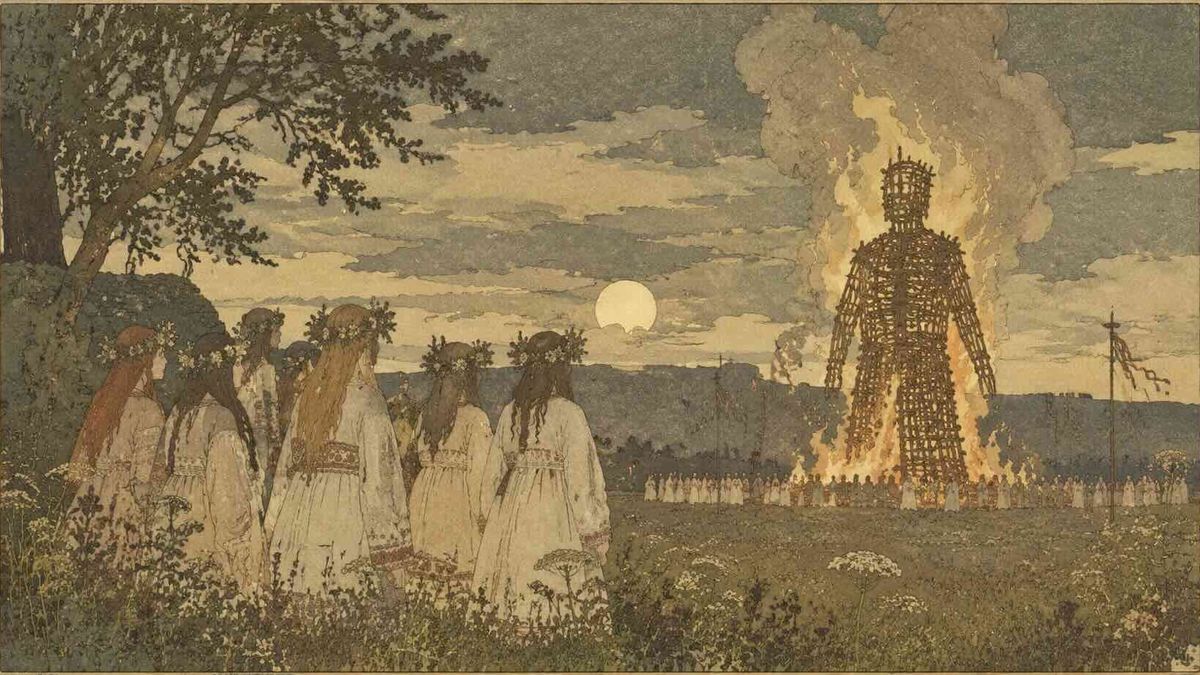
A genre built on the idea of tradition turns out to use very little of it straight. Of the eleven songs and scores gathered here, two reach the screen with old words and an old tune together. The rest were set, borrowed, rewritten or invented, and several were made to sound older than they are.
This songbook collects music from folk horror on film and television between 1964 and 2019, from England, Scotland, Japan, Czechoslovakia, Sweden and New England. Each entry gives the film, the song or score, who wrote it, who sings or plays it on screen, and where it came from. The provenance line matters most. It sorts every entry into one of six kinds, and the count at the end is the songbook’s finding.
The entries run in order of release. Hwael has written at length about some of these films, and The Wicker Man’s soundtrack has its own essay, so the three songs from Summerisle here are kept short.
01. Onibaba (1964) · Hikaru Hayashi
Provenance: no folk material. Composed score.
Kaneto Shindō built Onibaba on a Buddhist parable and set it in reeds during a fourteenth-century civil war, and his regular composer Hikaru Hayashi scored it with taiko drums, jazz and recorded human screams. Nothing in the music claims to be old. The film reads as a folk tale while its sound belongs to 1964, and it is the clearest case here of a folk horror film that never asks music to supply an ancestry.
02. The Ballad of Tam Lin (1970) · “Tam Lin”, Pentangle
Provenance: traditional words, new setting.
Roddy McDowall’s only film as director moved the Border ballad into the present day, with Ava Gardner in the part that stands in for the fairy queen. Pentangle recorded their own setting of “Tam Lin” for it, which returns several times in the film. The recording stayed off record for almost four decades and first appeared on the band’s compilation The Time Has Come, 1967–73 in 2007.
03. Valerie and Her Week of Wonders (1970) · Luboš Fišer
Provenance: new music in an archaic idiom.
Fišer’s score for Jaromil Jireš uses harpsichord, pastoral orchestration and choral writing that sound inherited and are entirely his. He also wrote Songs for the Blind King John of Luxembourg for voices and ancient instruments, so the old idiom was a working language for him. The score stayed in the Barrandov vaults until Finders Keepers issued it in 2006.
04. The Blood on Satan’s Claw (1971) · Marc Wilkinson
Provenance: invented, and admitted.
Wilkinson, then director of music at the National Theatre, built the score on a descending chromatic line. The film’s best-known melody came afterwards. In his sleeve notes for the first release, on Trunk, he wrote that the principal melody, “which sounds like an English folk song, but is not”, was added because the producer found the music too austere. It is the one entry in this songbook where the composer says outright that the tradition is a costume.
05. The Wicker Man (1973) · “Corn Rigs”, Paul Giovanni
Provenance: old words, new music.
The words are Robert Burns’s “The Rigs o’ Barley”. The music is Giovanni’s, played by Magnet, the band assembled by the film’s associate musical director Gary Carpenter, and Giovanni sings it himself over Sergeant Howie’s arrival on the island.
06. The Wicker Man (1973) · “Willow’s Song”, Paul Giovanni
Provenance: new song with borrowed lines.
Giovanni wrote it for the film and lifted one couplet from George Peele’s play The Old Wives’ Tale, printed in 1595: “Fair maiden, white and red, / Comb me smooth and stroke my head.” Britt Ekland mimes it. According to Carpenter, the voice on screen belongs to Rachel Verney; other sources credit Annie Ross, who dubbed Ekland’s speaking voice.
07. The Wicker Man (1973) · “Sumer Is Icumen In”
Provenance: traditional words and tune.
The islanders sing it at the burning. The round survives in a thirteenth-century manuscript, Harley MS 978, and it is the oldest piece of music in this songbook by several centuries.
08. Penda’s Fen (1974) · Elgar, The Dream of Gerontius
Provenance: no folk material. A commercial recording.
Stephen, the vicar’s son at the centre of David Rudkin’s play, listens to Elgar, and the music he hears is a specific record: Benjamin Britten’s 1971 Decca recording, with Yvonne Minton as the Angel. The album appears on screen as a prop, and Paddy Kingsland of the BBC Radiophonic Workshop manipulated parts of it electronically. In this play, English ancestry arrives on vinyl from a record company.
09. A Field in England (2013) · “Baloo My Boy”, Jim Williams
Provenance: old tune, new song.
Williams took a traditional Scottish pipe tune and made a lullaby of it, which Richard Glover sings straight to the camera. It returns later in Ben Wheatley’s film, and Williams recorded a second version with his own voice for the soundtrack.
10. Midsommar (2019) · Bobby Krlic
Provenance: legend borrowed, music new.
Ari Aster named his commune after Hårga, the place in the Swedish song “Hårgalåten”, which is tied to a story published in 1785 about a fiddler who makes the young dance until they die. The film’s maypole contest draws on that legend; Aster said he wanted the place tethered to the real story without copying it. Krlic’s score uses no folk music, and the “Maypole Longdance” heard in the scene was composed for the film and first released on a cassette packaged with the vinyl soundtrack.
11. The Lighthouse (2019) · “Doodle Let Me Go (Yaller Girls)”, A. L. Lloyd
Provenance: traditional song in an archival recording.
Robert Eggers used A. L. Lloyd’s recording of the shanty over the end credits and in the trailer. Lloyd was a folklorist as well as a singer, and in 1956 he had already sung a shanty on screen, as the Pequod leaves harbour in John Huston’s Moby Dick. Here the tradition arrives with its collector attached.
| Provenance | Entries | Count |
|---|---|---|
| Traditional words and tune | 07, 11 | 2 |
| Traditional words, new music | 02, 05 | 2 |
| Traditional tune, new song | 09 | 1 |
| New music made to sound old | 03, 04, 06 | 3 |
| Legend borrowed, music new | 10 | 1 |
| No folk material | 01, 08 | 2 |
Two of eleven are old in both words and tune, and one of those two reaches the film through a folklorist’s record. The largest group is new music made to sound old. Folk horror has needed tradition mostly as a sound, and when the real article was not to hand, composers made one up, and in one case wrote that down.
Last revised: November 2026