Ben Wheatley :: A Field in England
Folk horror as reenactment: a clean field, woodcut poses, dead men who stand up.

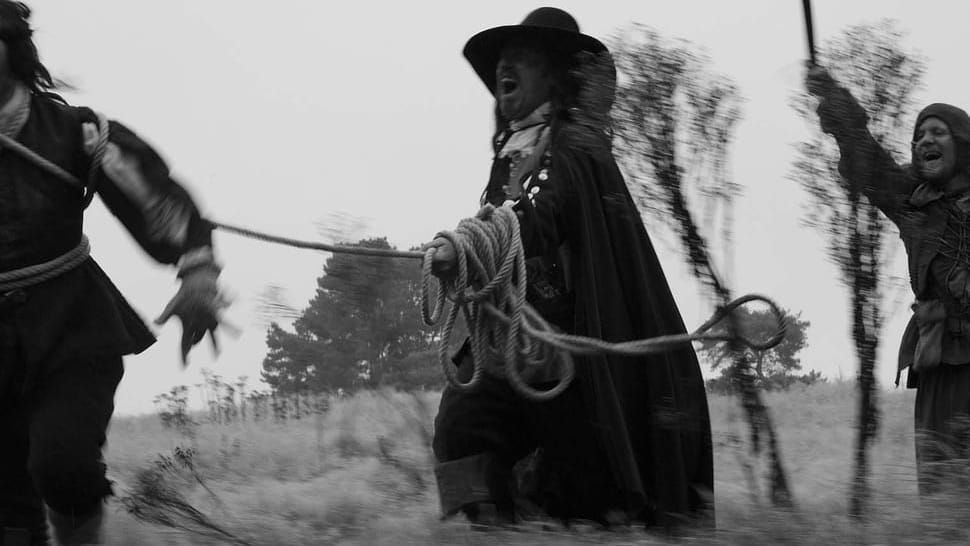
Nobody has dug a trench in this field. For a film set in the middle of the English Civil War, the ground Ben Wheatley chose is oddly clean: no craters, no bodies, grass to the knee and a hedge along one side.
A Field in England was shot in twelve days in the autumn of 2012 on an estate in Surrey, for about £300,000, in black and white, from a script by Amy Jump. Five men leave a battle that the soundtrack keeps just out of frame. Whitehead (Reece Shearsmith) is an alchemist’s assistant running from his commander; Cutler (Ryan Pope) kills that commander and promises an alehouse nearby; Jacob (Peter Ferdinando) and Friend (Richard Glover) are deserters with little to give the war beyond their appetite. The alehouse never appears. A rope does, and on the end of it, hauled out of the ground by the four of them, comes O’Neill (Michael Smiley), a rival alchemist, who has stolen the papers of Whitehead’s master and believes the field is hiding a treasure.
The film’s origins matter more than reviews usually allow. Wheatley’s first draft grew out of battle footage he had once shot for the Sealed Knot, the society that restages Civil War engagements on English weekends, and he has said he wanted the monochrome to resemble Peter Watkins’s Culloden, the 1964 BBC docudrama that filmed an eighteenth-century massacre as though a news crew had been present. Both point to the same practice: history performed by living people in a real field, in costume, for a camera. Read from there, the film’s strangest device turns out to be its most exact. At intervals the story halts and the cast arrange themselves into tableaux modelled on seventeenth-century woodcuts, a man with a pike, a man on his knees, a body with one arm out. They hold the pose and cannot quite hold it. The grass moves, a chest rises, somebody’s weight drifts onto one leg. Several critics found these interludes funnier than intended, and the small failure looks deliberate: a woodcut can keep a dead man still for three and a half centuries, while a man standing in a field manages about twenty seconds.
The reenactor’s grammar runs through the plot as well. On a restaged battlefield the dead get up for tea, and here they get up too. Friend is shot, dragged into the bushes and later walks back into the story with a wound that has stopped counting. In this field death is a part somebody can be released from, which is the most frightening thing the film suggests about the war beyond the hedge. Jump’s dialogue, a working Early Modern English that drops into toilet jokes and climbs back out, sounds like men who learned their lines from pamphlets and keep losing their place.
Sound carries the period where costume cannot. Jim Williams builds the score from early-music textures that thicken, over the ninety minutes, into electric overload, and Martin Pavey’s design lets the battle leak in as noise from somewhere else. The one piece that keeps its shape is “Baloo My Boy”, a lullaby set to a traditional Scottish pipe tune, which Glover sings straight to the lens and which returns later in the film. Bodies in this field are shot, revived and rearranged; the song comes back intact, which is roughly how a reenactment society works, with the tunes surviving better than anybody’s idea of what the war was for.
The film is weakest when it stops trusting its field. The long mushroom sequence, mirrored and strobing and cut fast enough to need a warning, is the passage everyone describes and the least particular thing in it: it could belong to any film about a drug. The last stretch ends more than once, each close a little less necessary than the one before. Shearsmith holds those minutes together. His Whitehead begins as a man who apologises with his whole body, and the change in him across ninety minutes is the one development the film fully earns, while Smiley plays O’Neill quietly enough that he seems to take up more of the frame than he does.
The release, on 5 July 2013, matched the method. A Field in England opened in cinemas, on DVD, on demand and on free television on the same day, the first British film to do so, as if a restaged battle were being offered to whoever happened to be at home.
Whitehead enters the film pushing through a hedgerow and leaves it the same way. On the far side, the second time, Friend and Jacob are waiting, and so is Whitehead.
Whatever O’Neill does to Whitehead inside the tent stays off screen. The camera keeps only the exit, slowed almost to stillness, a man walking back into daylight altered.
The treasure, when Cutler finally digs it up, is a skull. He shoots it, which settles nothing.
The estate is never named on screen. The field has no church tower, no road, no county, only the hedge and a sky that never darkens, since the whole film plays out in daylight.