Ghost Folk, a Thing That Changes
Essay on ghost folk: a 2013 mood, a 2020 album, a song changed in transit.
Type ghost folk into a Japanese search box, in katakana, and near the top of the page comes a forkball thrown for the New York Mets. The English results are hardly better: a Swedish arena-metal band, prompts for music software with a tempo attached, and one sentence on Last.fm.
That sentence says ghost folk is folk music that is “dark, eerie, and powerful”, and that the term was coined in 2013 in a review of an Australian trio called Little May. Little else answers the query. Ghost folk has no Wikipedia entry, while freak folk, New Weird America and neofolk each have one, with dates, compilations and arguments about who refused the label. Generative-music sites have filled the gap in their own fashion, listing “Ghost-Folk” beside Outlaw Americana and stomp-clap percussion, as an instruction for a machine to follow.
Hwael is no neutral party here. Ghost Folk is one of the magazine’s twenty-four canonical tags, and since July 2026 it has been attached to five pieces, among them a four-track debut recorded in New York, Norway and Georgia and Colin Cant’s 1980s BBC adaptation of The Children of Green Knowe. A tag used like that claims that the words name something. The question here is narrower than the one typed into search engines: whether the term has ever named a practice, something more than a colour laid over songs, and where that practice can be heard.
The research ran through English, German, Japanese, Chinese and Italian sources. It found the phrase used three ways: in Sydney, in Rhode Island and, by an accident of spelling, in Japan. The first use is a mood. The second and the third each hold one word of a definition that nobody has yet put together.
I. Sydney, a few weeks before November 2013
On 10 November 2013 a music blog called Indie Obsessive, pointed towards the band by a reader in Montreal, reported that Little May described themselves as “three girls making ghost folk”. They were Annie Hamilton, Liz Drummond and Hannah Field, from Sydney, and their second single, “Hide”, had reached number two on the Hype Machine chart. Two days later Hamilton told Music Feeds that the term had come from a review of the band published a few weeks earlier and had simply stuck. She tied it to the direction of the writing, which was getting darker, deliberately so.
By October 2014, talking to Interview, Hamilton told it differently: somebody had used the term in an interview, and it stuck. She added that the band never thought of its music as typically folk. The review she first mentioned has not been located in this research. It may sit in a blog that has since gone dark, or it may be a half-remembered phrase from a radio introduction. What can be documented is the sequence: a critic’s adjective, adopted within weeks as a self-description, separated from its author by the band’s own retelling, then fixed by Last.fm as a coinage with a year attached.
At this first stage the ghost is a mood. It reports minor keys and close harmony in the same register as “haunting”, the word Interview used for the lyrics, and it says nothing about the folk half of the phrase, which the band itself disowned. The German site museek, introducing Little May, set “Ghost Folk” beside “Femme Folk” as well-meant attempts that only partly hit the mark. This research found no compilation under the name and no musician arguing against it, the usual signs that a genre has formed. Freak folk had Devendra Banhart’s The Golden Apples of the Sun and Banhart’s own public irritation at the label.
II. Folk as people
Seven years later the phrase became a title. Allysen Callery, a self-taught guitarist from Bristol, Rhode Island, released Ghost Folk on 30 October 2020 as an LP on cosirecords, a small label in Oberhausen (CRLP004). Myles Baer produced it at Black Hole Sound Studios and Pete Weiss mastered it. The dedication is to Nick Drake, the November Man, and to all the quiet ones.
The label’s notes take care to refuse the gothic: there are no murder ballads here, and the ghosts are passers-by and regulars of an ordinary New England day. The more productive reading arrived in German. Reviewing the record for African Paper in November 2020, the critic first took the title for a home-made genre label, of the kind Sarah June once invented for her own dusty songs, and then turned the word round. Folk can also be translated as Leute, people, so the title might point at the introverts the album is dedicated to, a Geisterbande, a gang of ghosts.
That second meaning is the older one. Before folk was a shelf in a record shop it was a word for people, the English cousin of the German Volk, and folk song took its name from the people who were supposed to carry it. Read this way, the second word of the phrase asks who has had the song in their hands.
Callery’s record gives that question something to work on. Ten of its twelve songs are hers. The other two came to her from elsewhere: “Katie Cruel”, a traditional song with no author to credit, and “Go Your Way”, which the sleeve gives to Anne Briggs. David Kidman, writing for Folk Radio UK, thought the ghost folk tag fitted because Callery’s songs seem familiar from somewhere you cannot place, “the ghost of a song you might know perhaps”. On two tracks the song you might know is a matter of record.
III. Obake
The Japanese results looked like noise. Katakana writes folk and fork with the same four characters, フォーク, so a search engine cannot tell a song from a pitch. ゴースト・フォーク is how the sports press has rendered the forkball of Kodai Senga, the Mets pitcher, which in Japanese is more often お化けフォーク, obake fōku. In March 2025 the singer Yūsuke, once Daisuke Matsuzaka’s catcher at Yokohama High School, released a song called “Ghost Fork”, its lyric built around a magic that appears and then vanishes.
The word inside the nickname repays a slower look. Obake, like bakemono, comes from a verb of transformation: literally, a thing that changes. Folklorists keep it apart from yūrei, the spirit of a dead person; an obake is more usually a living thing or a being that has taken on a temporary form. A forkball leaves the hand on the line of a fastball and alters on the way to the plate, and the batter is beaten by what happens in transit. The ghost, in this vocabulary, is a behaviour between two points.
Sydney used the first word of the phrase for a mood and left the second alone. Rhode Island, with German help, recovered the second: folk are the people who carry a song. Japanese supplies a better first word. A song handed on by people has always behaved like an obake. It leaves one singer and arrives at another altered, with a verse dropped, a name moved, a tune bent to a different instrument or a different breath. Hwael’s essay on “Polly Vaughn” followed one ballad through eight recordings in which a dead woman returns to clear the man who shot her, and the spirit inside the story turned out to be the least of its returns. The ballad itself is the thing that changes, and every recording is a version that has come back slightly wrong.
IV. A Tascam 424 in three places
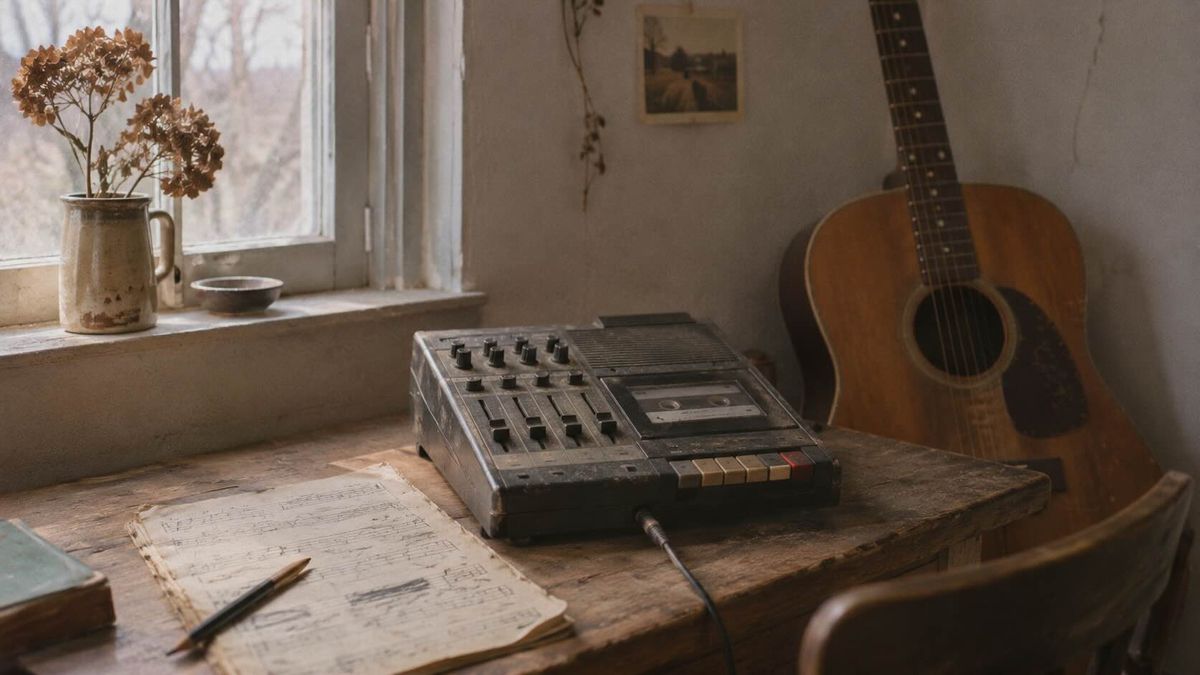
Dagmar Zuniga, a Nicaraguan-American musician based in Brooklyn, recorded in filth your mystery is kingdom / far smile peasant in yellow music between 2019 and 2024 on a Tascam 424 four-track cassette recorder, in New York, Norway and Athens, Georgia. Friends running a DIY label, People’s Coalition of Tandy, put it on Bandcamp and YouTube on 8 January 2025, alongside a small tape run that sold out at once. The record passed two hundred thousand plays, reached Phil Elverum, who took her on tour with Mount Eerie, and in 2026 was reissued by the London label AD 93 on LP, CD and cassette (WHYT108).
Most writing about it reaches for ghosts as atmosphere; Stereogum heard songs “flickering in and out of our reality like ghosts”. When Hwael reviewed it in July and tagged it Ghost Folk, the review followed the tape, a medium that hands songs back altered. The release notes put that reading on firmer ground. AD 93 describes hiss, distortion and degradation as treated material, and the four-track as a co-author.
Zuniga wrote these songs, three of them with Hayes Hoey, so no line of singers stands behind them, and the carrying falls to the recorder. A line of singers needs generations to wear a song into another shape. She went back to one machine for five years, in three places, and every pass through it did some of that wearing.
The record lets the wear be heard, because it keeps two states of the same song. “Even God Gets Stuck in Devotion” opens the record on an acoustic guitar picked slowly, with Austyn Wohlers’s flute around the vocal line. It comes back later at less than half the length, rebuilt on piano, the voice now echoing from somewhere behind the instrument. “Plenty For All The Masses” pushes its guitar past the fader until the signal breaks into distortion; its twin, “Plenty (For All of Life’s Messes)”, returns with gentler chords and a title that has been misheard on the way. In “LN60: Jupiter Opposite Jupiter”, over organs that will not hold their tuning, Zuniga’s voice is mixed in backwards, and the singer becomes the previous version of herself.
Zuniga has said, in the biography that accompanied the reissue, that what is not material does not exist; she paints, makes her own sleeves and videos, and sells bootleg tapes of unfinished songs only at her shows.
Two of the uses traced here can be checked with a pair of ears: Callery’s borrowed songs against the versions they came from, and Zuniga’s doubled songs against each other. The first cassettes, from January 2025, are sold out. The cassette in the AD 93 reissue carries the number WHYT108MC.
Last revised: November 2026