Robert Eggers :: The Lighthouse
Maritime horror, labour, hierarchy and the forbidden machinery of light

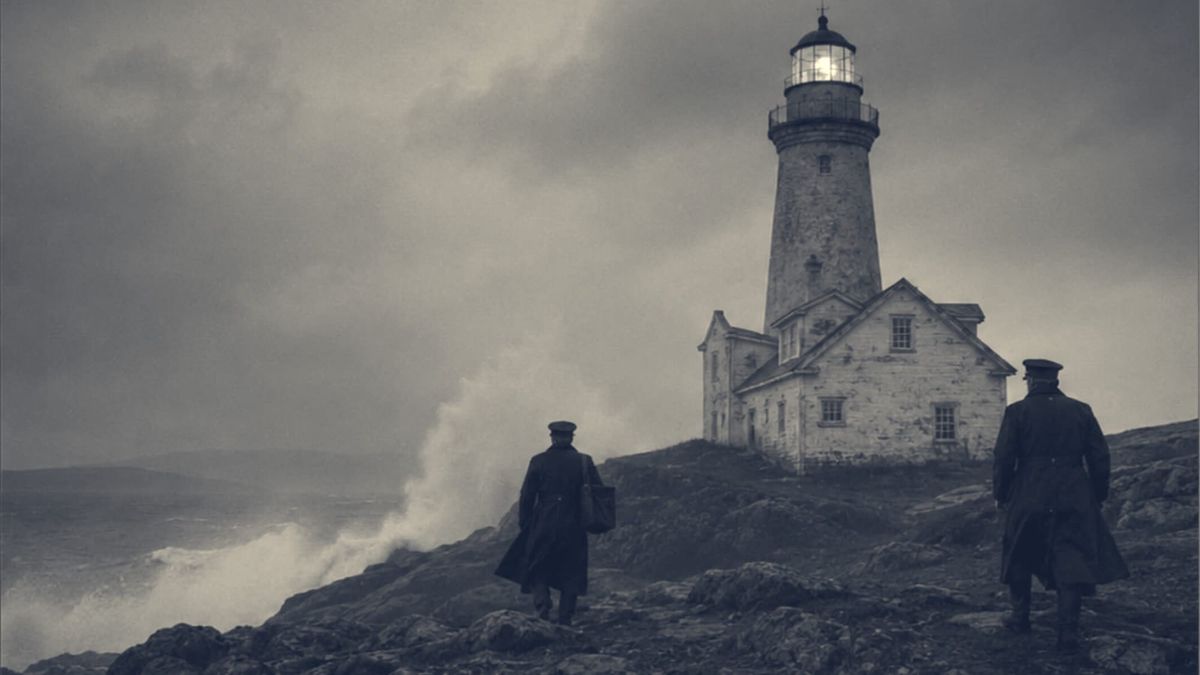
Robert Eggers’s lighthouse produces light for men we never see. The ships remain beyond the frame; its signal passes into the dark, with no one there to confirm that it has reached them.
On the island there is only the work required to keep it burning: coal, brass, stairs, buckets, sewage. Ephraim Winslow does nearly all of it. Thomas Wake keeps the lantern room for himself.
The Lighthouse grows from this division. Before the madness, the gulls, the mermaid, the tentacles, Eggers establishes an order of labour. Wake occupies the top of the tower. Winslow stays below with the pumps, the cistern, the fuel. The building gives their arrangement a physical shape. Each staircase carries him towards a boundary he has been told not to cross.
The 1.19:1 frame narrows the horizon and draws the eye upwards. This is not the generous sea of maritime adventure. It presses in at the edges, present as weather, leaking water, the iron bellow of the foghorn. Tower, stairwell, bunks, bodies folded into cramped rooms: everything on the island seems stacked. Only the lantern room remains forbidden.
Wake tends a working piece of coastal machinery as though it were his private chapel. The light ought to be impersonal, meant for sailors he will never meet. Here it becomes a privilege with a locked door. The old man strips before the lens, speaks to it, appears to receive some pleasure from it that may also be revelation. Once contact with the outer world is lost, a machine built to serve that world begins to resemble an idol.
This may be the film’s strangest insight. The lantern need not contain anything. Its purpose simply can no longer be checked. No ship appears. The relief boat fails to come. The beam continues its rotation without a visible recipient, while two men carry out duties whose connection to wages, contract, eventual return has begun to fray.
The storm does more than echo their failing minds. It dismantles the terms under which their work made sense. Days run into one another. Rations dwindle. Departure becomes a story they repeat. Maintenance remains, stripped of consequence. A task performed often enough, with no answer from the world beyond the rocks, starts to feel like ritual.
Eggers never allows this idea to settle into unbroken solemnity. The Lighthouse is filthy and frequently very funny. There is farting, drunken dancing, badly cooked food, wounded vanity, the claustrophobic resentment of two people who have already spent too long in the same kitchen. Wake and Winslow quarrel like an exhausted married couple. They threaten each other, embrace, nearly kiss, then return to violence because violence is easier to name. Willem Dafoe turns maritime speech into an instrument of command. Robert Pattinson finds the humiliation beneath Winslow’s anger long before madness offers him an excuse.
The logbook belongs to Wake’s authority as surely as the lantern key. He can call the work inadequate, place insubordination on the page, have the wages withheld. Winslow learns that doing the work is not enough. Someone above him must agree that it happened. Eggers built Wake’s voice from maritime writing and the recorded dialects of New England; at times he sounds less like a man than a surviving document with salt in its lungs.
Behind the film lies the Smalls Lighthouse tragedy. In 1801, two keepers, Thomas Howell and Thomas Griffith, were left alone off the Pembrokeshire coast; Griffith died. The case became associated with the dangers of leaving only two men at an isolated station, and Smalls was subsequently staffed by three keepers. The answer to the danger of two isolated men was another pair of eyes. Eggers removes that witness and restores the arrangement to its most unstable form.
Wake carries something of Proteus: old man of the sea, prophet, impostor, father, cook, priest. Each role displaces the last before Winslow can decide what sort of man stands before him. Winslow follows the path of Prometheus, drawn towards a forbidden fire. The myths are present, though they arrive already soiled by work, appetite, alcohol.
Once Winslow gains the upper hand, he puts Wake on a leash. There is no pause in which he imagines another order. The yard is his now, so he borrows the old man’s posture and cruelty.
He does not want the light released. He wants the key.
Eggers sometimes makes his symbols too easy to name: the tower, the mermaid, the gull, the Promethean punishment. Yet the film refuses to remain a diagram. Its symbols have passed through kerosene, sweat, mud, bad sleep. They have been shouted over meals and handled by exhausted men.
A working coastal light becomes a private privilege once its purpose can no longer be checked against the world beyond the island.
Winslow can perform the work, but Wake still controls the record that decides whether the labour happened and whether it will be paid.
Once Winslow takes control, he does not invent another order. He takes Wake’s place and borrows his cruelty.
When Winslow finally enters the lantern room, we are denied what he sees. Perhaps there was never a secret there. Wake made the machine sacred by withholding it, and Winslow mistook exclusion for a promise. Beneath the tower lies a man destroyed by the need to look upon something his own labour had kept alive.