Kaneto Shindō :: Onibaba
Folk horror, reeds, hunger, bodily erosion and postwar memory

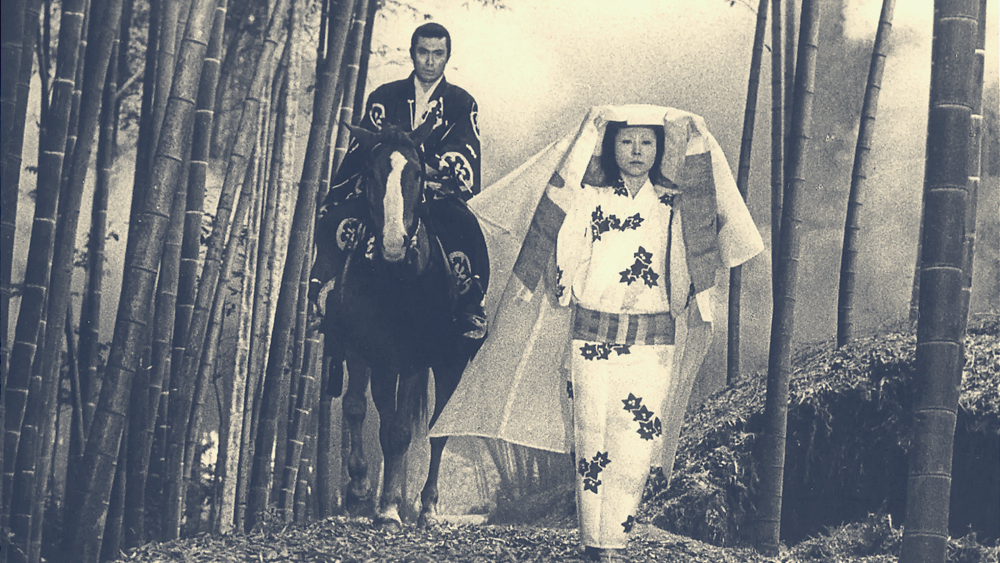
Kaneto Shindō, Onibaba, Japan, 1964. Produced by Kindai Eiga Kyōkai / Tokyo Eiga; black-and-white cinematography by Kiyomi Kuroda; starring Nobuko Otowa and Jitsuko Yoshimura.
Shot over three months among the reeds of Inba Swamp, in Chiba Prefecture, under working conditions that bordered on siege.
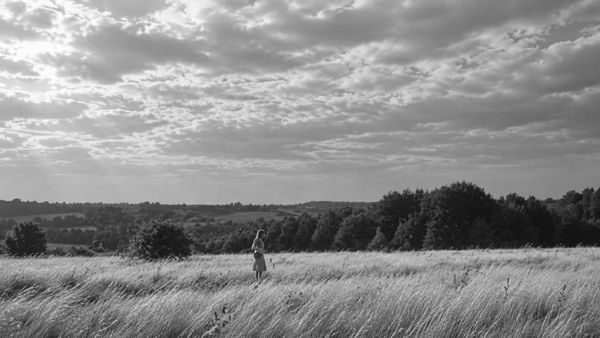
Onibaba, 1964. Kaneto Shindō films a field of susuki reeds and turns it into an organism rather than a backdrop. The grass, seven feet tall, bends and closes over the fugitives’ paths like dark water: a vegetal labyrinth that swallows samurai fleeing civil war and returns them, stripped, to a pit dug in its depths.
Two women—the mother-in-law and the daughter-in-law, both nameless, as befits figures in a rite rather than characters in a conventional plot—live from that pit. They kill, strip the bodies, sell the armour to the merchant Ushi and survive. Hunger here is no metaphor. It is the only theology left standing in a country ruined by fourteenth-century warfare.
What matters here, however, is less the plot than the ground that produces it. Shindō said he chose the field because the wind moving through the grass struck him as an emotional barometer, almost a seismograph of feudalism in its death throes. Yet the field seems older than that explanation, almost chthonic. The landscape does not merely accompany the drama. It generates it and imposes its terms.
The scrubland becomes a jurisdiction.
Then there is the pit: a stubborn black aperture guarded by the two women like a family secret. Psychoanalytic criticism has read it, not implausibly, as the repressed femininity of a patriarchal society—that which must be silenced, absorbed and digested by the earth before it can contaminate the village.
The demon mask worn by the older woman to frighten the younger, and which later fuses to her face and tears the skin when it is removed, carries within it, by Shindō’s own account, an echo of the burns suffered by hibakusha. Disfigurement is no Gothic invention here. It is a historical scar carried into myth, as though postwar Japan required an ancient demon to speak of a wound still too recent to be approached directly.
This is where the film enters the territory of hauntology. Onibaba is not simply a film set within a landscape. It is a landscape compelled to become film, a place that must narrate itself rather than remain a mute ruin.
Erosion concerns more than the soil of Chiba, where the crew lived for three months in makeshift accommodation near the set. It reaches the bodies, the faces and the moral structure of the characters. Necessity abrades them as acid eats into the mask.
Seven-foot grass closes over the fugitives’ paths like dark water, turning the field into the ground that produces the film’s violence.
A stubborn black aperture receives stripped bodies and makes survival, burial and the earth part of the same economy.
Used first as an instrument of fear, it adheres to the older woman’s face until historical injury and myth occupy the same skin.
Shindō treats nature as an agent without granting it any pantheistic consolation. The wind in the reeds redeems nothing. It records, with the dull patience of matter, the gradual unravelling of every human compact.