Robin Hardy :: The Wicker Man
Folk horror, pagan ritual, landscape and collective belief

The Wicker Man survives less as a film than as a form of collective memory resurfacing from the buried subconscious of Europe.
A police sergeant arrives on a remote Scottish island to investigate the disappearance of a young girl. Summerisle, though, runs on rules of its own: pagan rituals, folk songs, harvest rites and ancestral belief seep into every corner of daily life, and as the investigation proceeds the line between rational order and archaic memory begins to dissolve.
Fifty years on, the film keeps generating opposed readings — Christian martyrdom, cosmic sacrifice, colonial critique, ecological allegory — and part of the reason is that it was assembled, not invented. Anthony Shaffer drew his screenplay loosely from David Pinner's 1967 novel Ritual — a policeman called to a remote pagan village, a missing child — after he and Christopher Lee paid Pinner £15,000 for the rights, and Hardy and Shaffer built Summerisle's belief system through research into sources including Frazer's The Golden Bough, that immense Victorian compendium of comparative religion, fertility rites and sacrificial kings. The folklore on screen is therefore not decoration but ritual archaeology: fragments of practices gathered from different places and periods, then reassembled into a coherent, plausible whole. Summerisle feels at once unreal and documented, a forgotten fold within European memory surviving outside time.
What unsettles is the serenity. The community isn't governed by fanaticism in any modern sense; its people sing, drink, laugh, make love, celebrate body and landscape with a disarming ease. Horror doesn't enter through the monstrous — it enters through the calm with which ritual violence is folded into the order of things. Folk horror, at root, is about the collapse of an unspoken contract between people and territory; on Summerisle that contract still holds, and it goes on asking a human price.
The film's deepest provocation is not paganism but amorality. British criticism has long noted its moral ambiguity — Summerisle is no simple satanic enclave, and Sergeant Howie no unblemished hero — yet the film reaches past ambiguity toward something colder: nature recognises no human morality. The seasons are not ethical. The harvest is not just. Fertility does not tell innocence from guilt. Summerisle endures because it has accepted that impersonal logic; Howie goes on hunting for moral order in a universe governed by principles older than the Christianity he carries.
Read this way the final sacrifice loses some of its demonic charge and takes on something more tragically agricultural — a collective act born of the fear of famine, of the life cycle broken, of a bond with the land the modern world severed long ago. Summerisle is less an evil society than one still trapped inside a sacred contract with the earth.
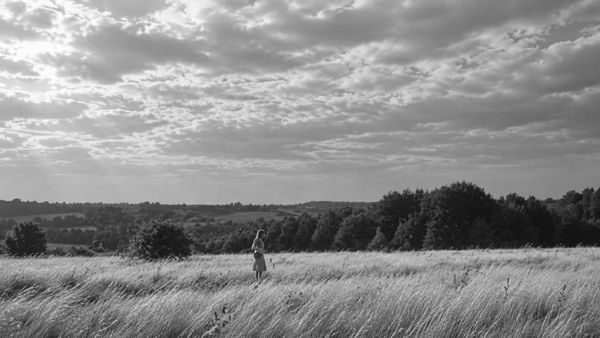
The landscape does the rest. In most horror, territory is backdrop; here the land watches the characters. The cliffs, the cold sea, the wind, the rain-beaten fields all seem quietly party to the ritual long before it declares itself — which is why the film feels more current now than in the 1970s: it speaks of communities trying to force a lost equilibrium with nature back into being, even through violence.
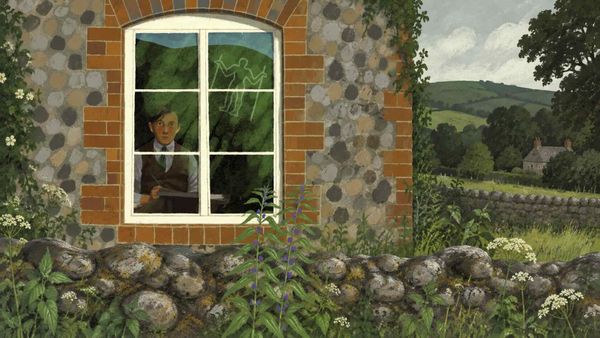
There is a quieter, psychological register too. Howie isn't only killed; he is emptied. Every certainty that defines him — religion, sexuality, law, authority — thins out as Summerisle draws him into its theatre. The detective story is turned inside out: Howie never conducts the investigation, he is its object, tested for purity and virginity from the start.
The sacrifice does not arrive suddenly at the end; it begins the moment his seaplane crosses the shoreline.
And this is why the film still disturbs — not because paganism returns, but because it hints that beneath modernity there may persist collective forms of thought individual reason can no longer hold. It is a film about religion, finally, and more about belonging: Summerisle works because everyone shares the same myth. Howie stands entirely alone.
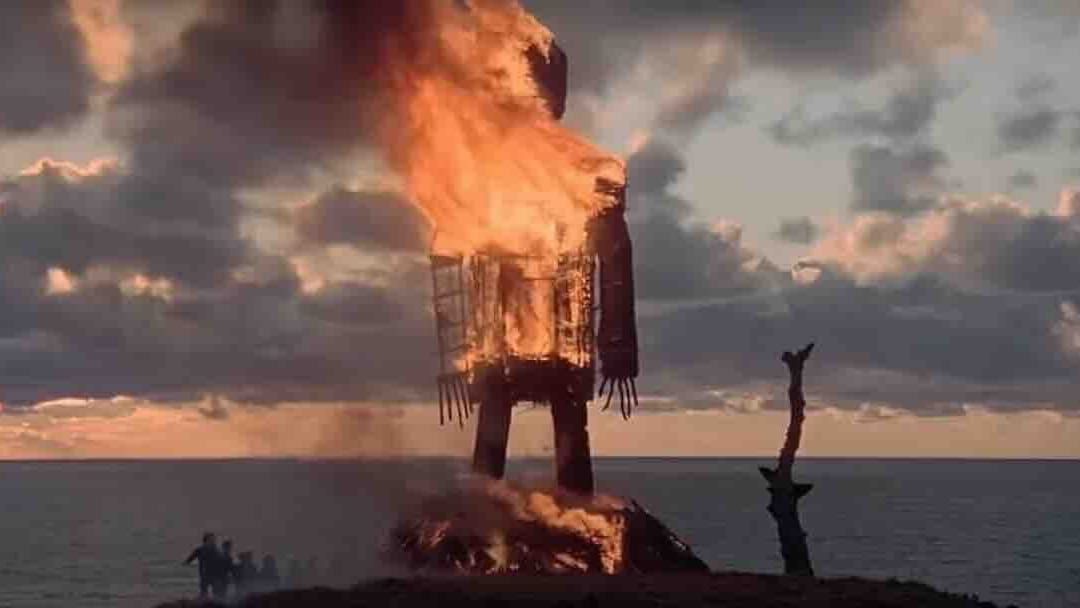
When the wicker effigy ignites against the sunset the film touches something rare — an image at once ancient and post-apocalyptic. Howie sings hymns as the fire climbs; around him the islanders go on celebrating the harvest, no hatred in their faces, only biological necessity and the fear of a failed season.
Howie crosses it believing he is beginning an investigation; the island has already begun testing the man it intends to sacrifice.
Cliffs, cold sea, wind and rain-beaten ground seem party to a ritual built around the fear that the harvest may fail again.
Howie sings hymns as the structure burns against the sunset, while the islanders continue celebrating the harvest without visible hatred.
The afterlife of the film has its own dark rhyme. British Lion — ailing and recently taken over amid fears of asset-stripping — cut the film and released the shortened version as the lower half of a double bill with Don't Look Now. Much of the material removed from the longer version subsequently disappeared. Legend still has it that discarded elements ended up as landfill beneath the M3 motorway, though the actual fate of the missing material remains uncertain. British Lion had, fortunately, sent a long version to Roger Corman in America for his opinion. The print he retained later became crucial when Hardy attempted to reconstruct the film. Christopher Lee, who waived his salary and called Lord Summerisle one of the finest roles of his career, continued championing the film for decades. A picture that so nearly disappeared now feels like rural memory itself resurfacing from the buried subconscious of Europe — the recollection of an age when survival still hung on climate, harvest and the unreadable will of the land.