Wychcombe
A novel by Antonio Martellotta. The drought summer of 1976.

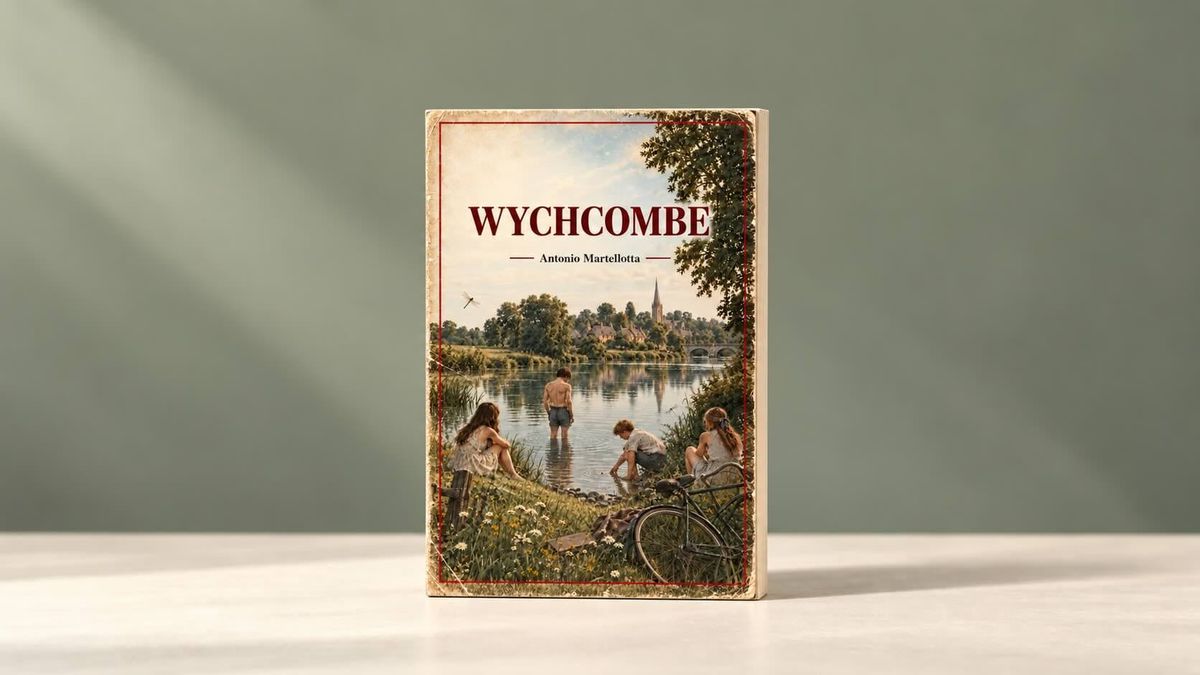
An English village in the drought summer of 1976. A boy of fifteen who cannot keep faces. Four friends, a river that has stopped being a river, and a sheet of paper folded in eight that has to be carried from one hand to another.
Andrew comes to Wychcombe every July, to his great-aunt’s house with the window over the garden. He knows the village by its voices, its hands, its shoes, its bicycles: Colin by the tick of a freewheel, June by a binocular strap patched with string, Mara by a silver ring worn on the thumb. Nobody knows that this is how he knows them. Nobody, so far, has needed to.
This summer the river is low enough to give things back. Under the alders, where the water does not move and nobody swims, a bicycle comes out of the mud with a brass plate on the mudguard, and the village stands in a circle and does not touch it. The notes Mara passes to Colin through Andrew are a game, until they are not. And when the rain finally comes, in one night, everything that was dry comes down the fields at once.
Twenty-three summers earlier, on the evening of the produce show, a boy of fifteen went down the low road alone, as far as the alders, where the water does not move, to wait for whoever would come. In his pocket he had a sheet of paper folded in eight. The village remembers it like this: that he went down, and did not come back up.
Read the opening of Chapter I
The water tower appears at the wrong window.
For an instant it rises above a line of poplars, where the ground drops away and shows the grey tank beyond the treetops; the train has already hidden it again behind the embankments by the time Andrew starts working out which side of the carriage he sat on the summer before. His mother would ask at the ticket window for seats facing the engine, that much she did, but nobody asked for the side, and now that he wants it back he finds only the window as it was then, with the tower in it and no carriage around it. He rests his forehead on the glass, which holds the heat of the afternoon. Mown meadows with the bales still scattered, hawthorn, a yard with two sheets on the line, a road that comes alongside the railway and leaves it at once. The tower appears again further on, this time where he expected it.
At Reading, on the platform, his mother gave him the ticket, two sandwiches in greaseproof paper and a sentence: tell Aunt Ida I’ll write. His father wasn’t there. His father, at breakfast, had told him to tell his mother that his father needed the car on Saturday, and his mother, washing the cup, had told him to tell his father that she was the one who needed the car on Saturday. Since January that is how they have talked at home. Andrew carries the sentences from one room to the next, carries them even when they are in the same room, and he has learnt to do it well: he knows where to take a word out so that it lands less hard, he knows the voice must be kept level, he knows to wait until the other one has put down their fork. Nobody at school knows. On the train, for the first time in months, he has nothing to carry to anyone, except that one sentence for Aunt Ida, which is light and can be handed over straight away, on the platform, and then it is done.
The suitcase under the seat won’t come out. He manages to drag it half out; a corner knocks the shoes of the man opposite, who draws his feet back and waits for the second attempt, and at the second attempt the suitcase jams. The man offers a hand. Andrew shakes his head and pulls; the man waits a little longer, and in the end he is the one who tilts it, just slightly: the suitcase comes out all at once.
On the platform the air has been standing still for hours and smells of hot iron. Along the tracks the grass is the colour of a crust of bread, and where the ballast ends someone has burnt the scrub: a straight black strip runs beside the railway as far as the bend, with a thread of smoke that does not rise. Under the canopy there is a woman with a handbag held in front of her in both hands, at waist height, the way you would hold a tray. She does not move until he has dragged the suitcase into her shadow.
‘It’s me,’ she says.
Andrew knows her by the handbag. Aunt Ida is his mother’s aunt, and since he was seven she has been his too. He gives her the kiss on the cheek that she offers by tilting her head, and he smells the wax she puts on the furniture on Fridays. Aunt Ida looks at his neck for the jumper he isn’t wearing, then lifts the suitcase a hand’s breadth, changes hands and guesses the books. Andrew hands her his mother’s sentence. She says, Good, and asks nothing more.
Ebook
€ 5,90
PDF + EPUB · DRM-free
typeset in Bembo
delivered instantly by e-mail
Secure checkout by Payhip, by card or PayPal.
Paperback
€ 12,90
Format, 129 × 198 mm
matt cover · cream paper
124 pages, set in Bembo
Printed to order. Shipping calculated at checkout.
Formats: PDF and EPUB, Paperback
Length: a short novel, 26 chapters, 124 pages
Type: Bembo, after Griffo’s roman of 1495
Publisher: Lyth Archive Editions, 2026
Readers of The Go-Between, of Claire Keegan’s Foster, of Alan Garner’s The Owl Service will know the country this book lives in: a summer that is also a reckoning, a landscape that keeps its own accounts, children who understand more than the adults have told them. Wychcombe is a story about recognition, and about the day a boy stops waiting to be recognised first.