Haroumi Hosono :: Yours Sincerely
Avant-pop miniatures where old melodies return as gestures of care.
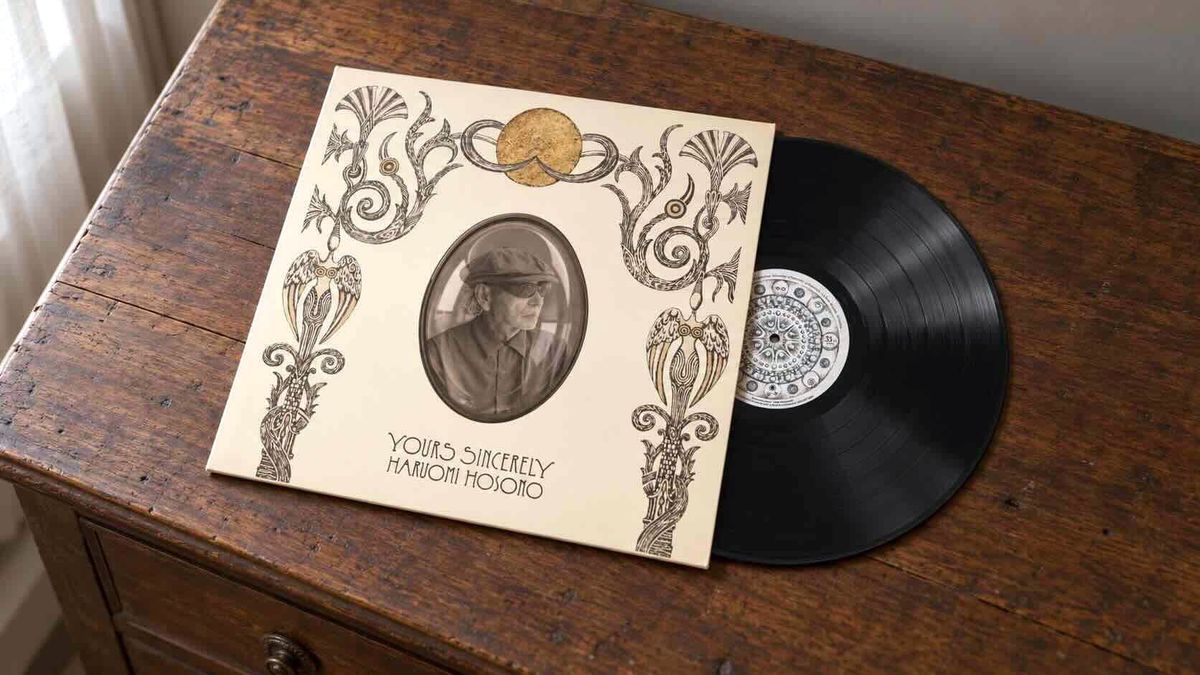
Ten small pieces reach us still carrying their earlier lives: a cue for television, a jingle for a shop window, a melody remembered through someone else's.
At twenty-six minutes, Yours Sincerely has the scale of something found in a drawer of an old house near the sea, where letters, buttons and expired guarantees sleep together under a smell of lavender. Some of this music was written for film and television, some for advertising, and one piece has waited since 1984. In his first new material for seven years, Hosono leaves those origins exposed. Each track keeps the measurements of its first job: a brief entrance, a single turn of melody, an atmosphere set down before habit can settle on it.
The provenances are on record. "Rojiura" was written in 2006 for an NHK drama and had already surfaced on Archives Vol. 1 in 2008; "Aayurveda" came out of the 2008 film Gu Gu, the Cat, and the vocal here is Hosono's own from that year, set into a new take; "Happy Holiday" was commissioned by PARCO for a 2024 campaign; "Anemo Wheel" is a television cue from around 1984, co-written with Miharu Koshi and programmed with Yasuo Kimoto. The rest was made at Daisy Bell, Hosono's own studio, and at Big Turtle, with Goh Hotoda mastering, and Hosono has described the process as working alone in silence, adding, for anyone wondering, that none of it involved AI.
He has spoken of carrying two musical worlds, the music of his former self and the unknown music his present self might still make. The record seats them at one table without forcing a chronology. Early synthesizer grammar, mid-century popular song, small ceremonial rhythms and a late, lowered voice share the same patina.
The title began as a problem of translation. Hosono wanted an English word for omoiyari, the capacity to feel with another person, which in his account includes rejoicing together and has little to do with pity; "compassion", he noted, carries suffering in its root. He settled on the closing of a letter. "Sincerely" weighs less than any doctrine, and that lightness is its accuracy: care, here, is a matter of spacing and scale, of leaving a small idea small.
"Sincerely" weighs less than any doctrine, and that lightness is its accuracy: care, here, is a matter of spacing and scale, of leaving a small idea small.
"Note of Mothership" opens with voices gathered so close, children and perhaps a mother, that it becomes hard to say where one ends. Hosono keeps the maternal image strange, near and planetary at once, while a restless electronic current stops the warmth from setting like wax.
The Moonglows' 1954 "Sincerely" slows to a drowsy sway, Hosono's baritone deep in the arrangement, his Japanese adaptation leaving the doo-wop its age: a jukebox carried into a tatami room. "Aayurveda" gives an earlier film theme the provisional architecture of a miniature chanson, light waltz and close harmony.
"M for Mandala" and "Happy Holiday" are brief by design. "Happy Holiday" began as music for a department-store campaign and keeps its bells, its bright stacked voices, its quick return to the hook; with nothing left to sell, the jingle turns private, a festive ribbon kept in a biscuit tin long after the gift was opened.
"Rojiura (Walking Vibration)" is the fullest landscape here. Written in 2006 for a television drama about pilgrims on the Shikoku circuit, it gains dry percussion, flute and Hosono's low voice, and for four minutes the album walks at the pace of the henro, through alleys and up temple steps, gaining depth while staying close to the ear.
In the last third the sequence grows fragile. "To a Wild Rose" sets spoken and sung voices before Edward MacDowell's parlour melody, turned toward a stillness that faces the sea. "Humming 'Dream of Love'" lets language go and carries Liszt through breath, closed lips and the tin comb of a music box. "Figlio Perduto" brings a processional gravity, bells tolling Beethoven's Seventh as a village band in the South might play it behind a saint on a feast day.
"Anemo Wheel" closes with the oldest material. Made in 1984 for television, with early music software and a Prophet-5, it turns around a small synthetic loop, a paper pinwheel on a balcony catching whatever breeze arrives. It belongs to the years of Japanese environmental music, when electronics still showed the edges of their tools, and its economy now sounds handmade, almost domestic. A melody, it turns out, can wait four decades in a drawer until a record of the right size comes along to hold it.
The record's kindness sometimes blunts its friction. Several pieces stop before their inner tension has unfolded, and the sequence can read as affectionate marginalia to Hosono's weightier works. That modesty is also where its precision lives. The final loop ends before it can become an emblem, and what remains is the sensation of having held ten objects briefly, each handed back with its scratches and its former use still visible. Yours Sincerely slips them into a single envelope and leaves it open on the table.