Ambient Folk 2010–2026: The Tradition Supplies the Drone
Ambient Folk After 2010: Tradition, Platforms and the Drone

By 2026 ambient folk no longer needs to resemble an acoustic guitar disappearing into fog, though a good deal of it still does, and the fog now comes as a plug-in, a cassette preset, a tag at the bottom of a Bandcamp page.
This part of the history begins without an event. Nobody met around 2010 to agree on a name, and no record announced a turn. The change is quieter and more administrative. For fifteen years listeners, curators and small labels had been connecting records made far apart. In the period that follows, those connections begin to be visible to musicians before a record is finished, in where a demo gets sent and what words are typed under a release. The evidence for that shift is thinner than the shift itself, and this essay will try to keep the two apart.
The previous part ended with those connections forming. Before 1995, people separated by geography had arrived at related problems with little sign of listening to one another: a voice giving ground to weather, vernacular melody sharing authority with drone or room sound, recording conditions becoming audible enough to alter the composition. Between the mid-nineties and 2010, CD-R labels, mail order, specialist press, blogs, reissues and file sharing put those recurrences side by side. By the end of that stretch a younger musician inherited a shelf. Fahey's catalogue was in print, Linda Perhacs had come back, and Virginia Astley no longer required a hunt for an old pressing. Jewelled Antler had let weather and place act inside a recording, and Fonal, Fursaxa, Natural Snow Buildings, Tape and Grouper had loosened enough borders that a song could share its space with hiss and unsteady distance without anyone reaching for a new vocabulary.
The account usually given of what came next is one of hybrids. An old thing (a traditional instrument, a regional song, an inherited tuning) meets a new thing: electronics, field recording, reverb, a laptop. The old thing brings place and memory; the new thing brings modernity, which is assumed to belong to nobody in particular. Most press releases in the field still run on this equation, and a fair number of reviews.
Listened to closely, a particular group of records from the last fifteen years keeps reversing it. In the work of musicians who carry a living tradition, the drone, the sustained tone and the long duration, everything a listener files under ambient, turn out to be the inherited part. What travels easily, arriving from nowhere in particular and attaching itself wherever it is needed, is the folk: a fingerpicked figure, a cassette wobble, some rain, a sleeve with plants on it. That is the claim, and its limits should be stated at once. It holds for a piper from Skye and a kamancheh player from Tehran. It says much less about a guitarist in a Lisbon flat with a microcassette recorder, and nothing at all about the line of ambient that was born modern, in Eno's studio or on tape loops, and never had a tradition to inherit from. The records in the second half of this essay are there to find where the claim gives.
I. Bellows
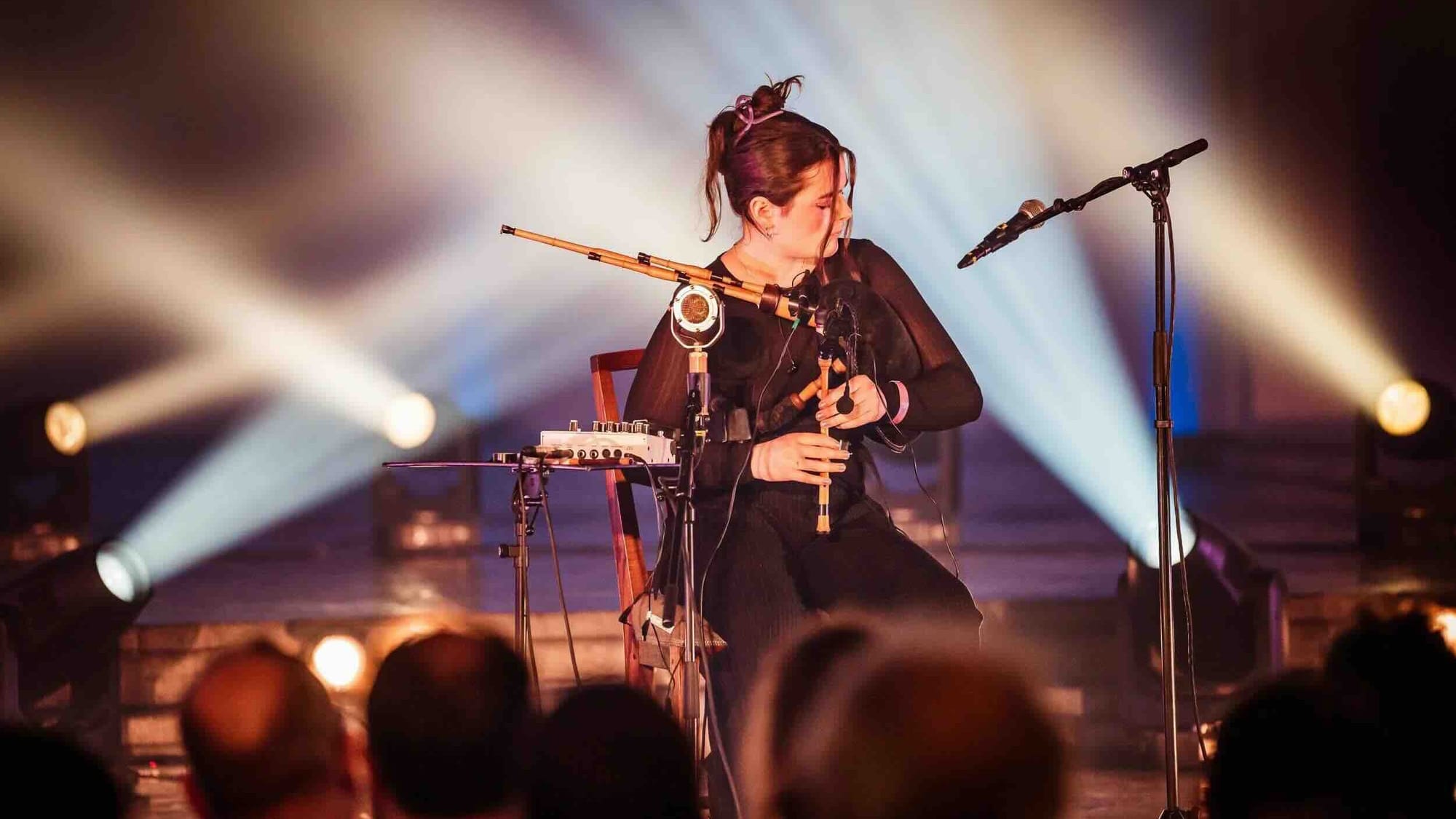
Start with an instrument that cannot stop. The Scottish smallpipes Brìghde Chaimbeul plays are bellows-blown: the arm pumps air into the bag, the bag feeds the drones, and the drones sound as long as the pressure lasts, underneath whatever the fingers are doing on the chanter. The sustain belongs to the construction.
On Sunwise, released by tak:til/Glitterbeat in June 2025, the opening "Dùsgadh/Waking" runs past nine minutes, most of them spent inside a field of pipe drones that beat against one another and shift very slowly, with melodic material taking shape the way a figure becomes visible in poor light. A reviewer can call this ambient and be understood. The word points a contemporary listener towards the right things: acoustic beating, repetition, small internal changes, the sense of time being widened. What the word cannot do is supply a history, and here the history is unusually easy to document. Chaimbeul has said that the starting point of a piece is always the pipes, finding a key or a mode and above all deciding what note the drone is going to sit on, and only then arriving at a melody. In the studio, she has explained, she tries to reproduce what a listener hears at a live show, the harmonics of drones and chanter ringing together, so that the record feels like "sitting inside the bag". Most of the tunes on Sunwise are traditional, and her main source for them, by her own account, is the field recordings held at the School of Scottish Studies in Edinburgh. The second album, Carry Them With Us (2023), had already included a track called "Piobaireachd nan Eun", a title that reaches for the ceòl mòr repertoire, the long, slowly varied form of Highland pipe music. The patience, in other words, has a provenance: archive tapes, a form with its own name, and a player who decided how far to lean into it.
The album closes on something barely a minute long, "The Rain Is Wine and the Stones Are Cheese", sung with her brother Eòsaph in canntaireachd, the system of vocables through which pipe music was taught and remembered, syllable for note, mouth to ear. It is also the most exact statement on the record about where the music comes from: the drone through the instrument, the tunes through people singing them to one another, and before that through a reel of tape in an Edinburgh archive.
After the opening's nine minutes it sounds almost like a joke, a small human voice at the end of a very large mechanical breath.
II. The Delay at the Radio Station
Saba Alizadeh unsettles the other half of the equation, the machine, and he proves something slightly different from Chaimbeul. Nothing in his case shows that the ambient qualities were inherited. What it shows is that the modern half of the hybrid has an address too.
His instrument is the kamancheh and his training runs through the Radif, the body of melodic models at the centre of Iranian classical music. That needs saying plainly, because it is a classical tradition with its own hierarchies of mastery and transmission, and an essay about folk can swallow it without noticing. The ease of the swallowing is part of what this essay is about.
The detail that matters comes from his own account of echo. When delay units reached Iranian radio stations, he has said, older masters of the classical repertoire began using the effect on broadcast recordings, and those recordings became reference points for his generation. When Alizadeh puts the kamancheh through processing, then, he is working with a sound that already has an Iranian biography: particular studios and engineers, particular broadcasts, a generation that heard the masters with echo on them. He has gone further and wondered whether the effect gave back something modern buildings had taken away, the resonance of older architecture. That one is his speculation and should stay labelled as his. Even without it, the radio story is enough.
Criticism likes technology as the universal half. The kamancheh carries Iran; the delay pedal carries the twentieth century in general. Give the delay a provenance (radio, a period, a room) and it becomes hard to believe the rest of the equipment has none. Microphones, amplification, magnetic tape, the echo chamber all entered musical cultures somewhere, through someone, for reasons that can be found. Quite often they entered decades ago and have been local ever since.
III. Kanklės Under Treatment
Merope sit between these two cases and refuse to settle. The project is built around Indrė Jurgelevičiūtė's voice and Lithuanian kanklės, with Bert Cools's electronics and guitars. Cools has resisted describing a method: a piece can begin from a traditional melody, a synthesiser patch, a recording made somewhere, or from something he can't name. On Vėjula the traditional lullaby "Lopšinė" shares a record with "Koumu Lil", where kanklės and voice are treated digitally until the instrument is difficult to recognise.
Difficult to recognise still leaves a lot. A kanklės that no longer sounds like one keeps its tuning, its way of being plucked, a line of players behind it. Folkness in Merope can live in repertoire, in a modal habit, in the Lithuanian language, in the route by which a melody reached Jurgelevičiūtė, and several of those survive processing that wipes out the timbre. Listening only to the instrument's surface misses most of where the tradition actually sits.
The global shorthand listens to nothing else. Kanklės, kamancheh, smallpipes and sean-nós each collapse into a signal meaning old thing, while reverb, synthesis and field recording answer with a signal meaning new thing. The pairing tells its story before anyone has listened, convenient for a one-line blurb and ruinous for criticism. On Vėjula, at any given moment, it is hard to say which half you are hearing.
IV. Where to Send a Demo
If the ambient qualities so often turn out to be inherited, the folk qualities increasingly arrive through circulation. The clearest piece of evidence is small, and it comes from a musician explaining an ordinary decision.
Before Hanazono reached listeners outside Japan, Satomimagae had released music through Chihei Hatakeyama's White Paddy Mountain and was playing small shows in Tokyo. Looking at labels abroad, she asked an acquaintance for suggestions, and RVNG Intl. came up. In its catalogue she found Emily A. Sprague, the singer of Florist, a band of songwriters by any definition, releasing a very different kind of electronic music under her own name. Satomimagae found the coexistence interesting enough to send a demo. Guruguru Brain answered first, RVNG afterwards, and Hanazono came out as a co-release. She tells it without any sense that it was significant.


The order is what counts, and the reading that follows is ours rather than hers. For most of the previous period adjacency was made after the fact: a reviewer or a blog set two records together once both existed. Here a label's adjacency came first and helped decide where a record would go. Sprague never had to fuse her two practices into a genre; they sat on the same label, and to someone in Tokyo looking for a place to send a demo, that coexistence seems to have worked as a measure of how far apart two ways of working were allowed to be under one roof. Satomimagae herself describes nothing more than curiosity. One anecdote cannot carry a period, and it is worth being honest that this is the only first-hand account of its kind located for this essay.
That American catalogue shouldn't be allowed to stand for the whole map. April Lee and Ricks Ang, working together in Singapore as Aspidistrafly from the early 2000s, made handmade EPs such as The Ghost of Things in 2004, then founded Kitchen. Label in 2008, the year of I Hold a Wish for You. A Little Fable followed in December 2011: Lee's voice and guitars, Ang's electronics and electric guitar, fingerpicked parts, tape loops, collaborations with Japanese musicians. They were making the records and building the cabinet at the same time, and the routes between Singapore and Japan carried the music well before any English-language genre map made those routes legible to outsiders. Guruguru Brain, set up in Tokyo in 2014, grew into something else again, a network of label work, festivals and touring across Asian underground scenes. Its roster includes Prairie WWWW, whose mix of poetry, Taiwanese musical material and ambience moved through circuits already joining Taiwan and Japan. Satomimagae lands between Guruguru Brain and RVNG, and each label accounts for about half of her.
Several maps, then, drawn in different places and read by different people. What they increasingly do, by the 2010s, is arrive before the music, carrying a rough idea of what it might be called and whom it might sit beside.
V. The Portable Half
The phrase itself gets easier to find. In May 2014 Sophie Jamieson, asked how she described her music to someone who hadn't heard it, said she usually called it "ambient folk or atmospheric folk". Melody and lyrics, she explained, kept it in folk, while electronics and synths brought in the rest. It is a practical answer to a practical question. It is also a very thin definition of folk: a tune and some words, with nothing about transmission, repertoire, place, instrument or who taught whom.
Ten years later even that much explanation can go. The Bandcamp page for Inni-K's Still A Day, released in September 2025, puts ambient folk beside sean-nós, traditional folk, Irish and contemporary folk. Inni-K has a long background in sean-nós and Irish traditional music, and fiddle, synthesiser and programming share the arrangements. Who chose the tags, and how much they believe in them, the page doesn't say. It does show the phrase sitting among ordinary search terms, next to sean-nós, a word that names an exacting practice of unaccompanied singing, with its own ornament and its own line of singers. On a single page one tag names a lineage and another names a mood.
Between Jamieson's answer and Inni-K's tag line lies the whole distance this essay is trying to measure. In 2014 the phrase still had to be explained, by a musician, to an interviewer, in terms of what the music contained. In 2025 it is a field in a form, and it can be filled in without anyone having listened to anything. What the two documents share is the thinness of the folk half: lyrics and a tune on one side, a search term on the other. The surface grammar that goes with the term is by now common property, steel or nylon strings, a long reverb, cassette flutter real or emulated, some rain, enough vegetation on the sleeve, and this essay does not claim that any record built from those parts is the worse for it. Excellent records are still made from exactly these parts. The parts just no longer tell you how a record works or where it comes from. The drone under a smallpipe tune or the echo on an old Tehran broadcast is harder to fake, because it had to pass through a particular instrument or a particular station to be there at all.
VI. Where It Gives
Two records now, chosen because the claim does not fit them, and because the ways it fails are instructive.
Gustavo Infante's Pássaros has no tradition standing behind its sustained sounds. Nylon-string guitar and voice share a domestic set-up with cassette, microcassette, reel-to-reel, loops and pedals, and Infante kept the tape noise because he felt it changed the music's sense of time. For him the hiss made time pass at another speed, and cleaning it away would take that speed with it. The ambient quality here is not inherited from anyone; it is manufactured in a flat, out of cheap and ageing equipment, by someone deciding what the noise is allowed to carry. Talk of analogue warmth gets tiresome in this context, since Infante is describing a material with a job to do. On a different record the same cassette would be decoration. The point survives the failure of the thesis: what matters is still the authority given to an object, and on Pássaros the object was bought in a shop rather than handed down.
Hana Stretton's records fail the claim from the other side. Soon came out of time alone on her grandmother's farm in Australia, with sparse voice and guitar and environmental recording, the kind of solitude the genre does well, and nothing on it sustains in the way a bag of reeds sustains. tiarn, from 2026, lets people in: an opera singer, strings, and Forest Creek Folk, a local choir of about sixty which Stretton later joined. Birds, insects, wind and coast are still there, and now so is a crowd. If anything on tiarn is inherited it is the choir, a social institution rather than an instrument, and it arrives as a mass of voices rather than a drone. Field recording is usually discussed as if the field began where society stopped; on tiarn the choir belongs to the field as much as the wind does, and the essay's neat division between a tradition that supplies the sustain and a platform that supplies the surface simply has nothing to say about it.
In an interview with Our Culture, the interviewer mentioned feeling uneasy while listening outdoors with noise-cancelling headphones that muffled the real surroundings, and Stretton suggested letting them back in. A passing exchange, and it touches a problem the claim can't reach either: a record full of one place arrives through a device designed to delete another, the one where the listener happens to be standing.
So the claim is narrower than it looked at the start. It describes musicians who inherited an instrument or a repertoire with duration already built into it, and it describes what happens to their music when a platform gives it a name. For the bedroom tape record and the field-recorded song it explains little. That leaves a good deal of the genre outside, which is a fair description of the genre.
VII. Coming Back Through the Tag
As far as the evidence goes, the genre name did not make anyone compose differently. The changes that can be shown are in circulation and listening, above all in the order in which things are met. A listener in 2026 can find Chaimbeul through an ambient playlist, somewhere between a modular drone and a guitar record with rain on it, and go back to Sunwise newly attentive to beating and duration. Following the closing song towards canntaireachd would take the same listener where the tag can't go: into a teaching system, a family, a set of syllables, a tape in the School of Scottish Studies, the pipes as they sounded before anyone recorded them. The drone they came for turns out to be the least modern thing on the record, and the folk they thought they were getting is, in the playlist, mostly a matter of texture.
The records that matter most here are the ones that make that discovery possible, and quite a few do, whatever they are labelled. Some of them, it has to be said, have plants on the sleeve.
Ambient Folk Before 1995: The Rulebook That Never Existed
Ambient Folk 1995-2010: The Network Before the Scene
Last revised: October 2026