Ambient Folk Before 1995: The Rulebook That Never Existed
A prehistory built from recurrence, not one scene or lineage.

In November 1995, an NME review of Flying Saucer Attack's Chorus mentioned the "ambient-folk-rulebook" as though somebody, somewhere, had already written one. No explanation followed. The phrase was simply left there among the guitars.
There was no rulebook. There wasn't much evidence of a movement either: no founding compilation, no manifesto, no club night, no single record around which a scene had agreed to gather. The musicians who can now be placed somewhere inside an ambient-folk history usually thought they were making something else. Folk revivalists ended up beside tape loops. Improvisers used dulcimers and violas da gamba. Singer-songwriters discovered what happened when a studio stopped behaving like neutral equipment. Birds entered recordings deliberately and accidentally.
The phrase arrived after much of this had already happened.
That delay is useful. It makes ambient folk difficult to write as a normal genre history, because the records do not line up behind one another in a convincing procession. Some had almost no audience at the time. Others were made in countries or musical cultures with little connection to the supposed centre. A few became ancestors only after a reissue, a collector or a later musician pulled them back into circulation.
What follows, then, is less a family tree than a record of recurrence: several ways in which folk material began sharing space with duration, environmental sound, drone, electronics, room tone and silence before there was a stable name for the result.
Ambient folk existed before anyone needed to call it ambient folk.
Long duration, exposed room sound, acoustic drone and environmental recording were already loosening folk form decades before the term stabilised.
I. Before the name
Sandy Bull's "Blend", recorded in 1963, is an awkward place to begin only if beginnings are expected to behave themselves. Guitar and oud circle through a piece that runs beyond twenty minutes while Billy Higgins keeps time underneath it. Duration slowly changes the function of the playing. Repetition stops announcing a return and becomes the condition in which the music exists.
Bull had absorbed Indian and Middle Eastern music long before "world music" became a record-shop category. For this history, though, the important thing is what happens to time. Folk-rooted instrumental playing is allowed to remain with a figure long after the practical needs of a song have disappeared.
John Fahey opened another route. By the later 1960s the apparent simplicity of a solo guitarist could accommodate trains, dogs, tape effects and musique concrète. The distinction between played material and recorded surroundings was already becoming unreliable. A noise from elsewhere could have structural weight. Fahey's records were still unmistakably his, still tied to American guitar traditions and to his own elaborate mythology, yet their borders had become dirty.
Calling Bull or Fahey ambient folk would tell us very little about what they thought they were doing. The later genre is more useful here as a way of noticing permissions already present: repetition without conventional development, acoustic instruments drifting away from song form, environmental sound entering the composition without first asking whether it belongs there.
A single question will keep returning throughout this history, long before anybody had a name for it: what is allowed to sit in front, and what is allowed to move forward from behind. A tabla, a bell, a length of tape hiss, a lake. The records that follow are worth tracking less as a lineage of sound than as a series of answers to that one problem of attention.
By 1969 and 1970 those permissions begin turning up inside records more commonly filed as folk or singer-songwriter music.
Nick Drake is an easy figure to misuse in this story. Pink Moon is not an ambient record disguised as folk, and its sparseness has acquired enough retrospective mythology already. What remains striking is the amount of acoustic information left exposed once arrangement has been reduced almost to nothing: string decay, breathing, distance from the microphone, the room between phrases. Silence takes on practical work.
Vashti Bunyan's Just Another Diamond Day approaches space through another scale entirely. Recorded after the journey she and Robert Lewis made by horse-drawn wagon towards the Hebrides, it remains physically small even when later listeners turn it into a symbol of lost pastoral England. Animals, domestic work, travel and weather belong to a lived itinerary. Its quietness has little interest in grandeur.
Linda Perhacs's Parallelograms, made in California in the same year, moves the other way. Acoustic song is still the base material, but voices, flute, electronic treatment and studio construction begin interfering with its solidity. "Chimacum Rain" seems to keep changing depth while it plays. Perhacs later described her work in visual and sculptural terms, and the record often behaves spatially: production is involved in determining what the song is, rather than simply arranging what has already been written.
These records have little need to resemble one another. What matters is that several familiar hierarchies have started to loosen. Song is no longer guaranteed to remain in front. Silence, sustain, room, repetition and recording technique are beginning to claim some of the same ground.
II. Three in the morning
John Martyn's One World makes the problem physical.
In July 1977, Island Records' mobile studio was installed at Woolwich Green Farm in Theale, Berkshire. Engineer Phill Brown and producer Chris Blackwell exploited the flooded gravel pit surrounding the house. A PA system projected Martyn's playing across the water and microphones picked it up at a distance, alongside lapping water, geese and whatever else survived into the early morning.
The sessions often continued between three and six. "Small Hours" carries the method furthest. Echoplexed guitar passes through an exterior acoustic field before returning to tape; the lake alters distance and decay before anybody reaches for an artificial reverberation unit. Martyn later remembered the process with characteristic simplicity and called it "real ambience."
The distinction is worth keeping because environmental sound can now be added to acoustic music so cheaply that it often functions as a preset mood. Rain, birds, a fire, some water behind a fingerpicked guitar: pastoral atmosphere can be assembled in minutes. On "Small Hours" the place is implicated earlier in the process. It affects the sound moving through it.
There is no clean division between the musical event and the air around it. Water is audible, but more important is what the water has already done to the guitar.
That same year in France, Emmanuelle Parrenin reached a comparable instability through a completely different history.
Parrenin had worked inside the French folk revival, collecting and performing traditional repertoire. Maison Rose, recorded with Bruno Menny at Frémontel and released in 1977, brought that background into contact with tape, repetition and electroacoustic treatment. Parrenin's own archival description is refreshingly plain: musique folklorique et expérimentations électro-acoustiques.
The route matters. There is no need for a story in which folk waits for experimental music to arrive from outside and modernise it. Parrenin's experimentation grew through work with traditional material itself, and through impatience with what could be done inside revivalist boundaries. Hurdy-gurdy, voice, song, electronics and tape occupy the same record without settling into a hierarchy that makes one authentic and the other an intervention.
Martyn's lake and Parrenin's studio do not sound alike. In historical terms they scarcely need to know about each other. By 1977, however, two quite separate practices show folk material being altered by the conditions around its recording: one by exterior space, the other by electroacoustic manipulation.
The later category begins to look less like a sound than a set of circumstances.
III. Other rooms
America had already produced several versions of the same uncertainty.
The Entourage Music and Theatre Ensemble recorded for Folkways in the 1970s, bringing acoustic strings, keyboards, percussion, jazz, improvisation, minimalism and music drawn from traditions outside the United States into long collective pieces. The Neptune Collection appeared in 1976. Decades later Four Tet found a copy and sampled "Neptune Rising" on Rounds, one of those small archival accidents through which an almost forgotten record suddenly acquires descendants it could never have anticipated.
The connection should not be exaggerated. Entourage were not secretly waiting for an ambient-folk audience. Their work is useful because acoustic instruments frequently cease behaving as carriers of tune and become parts of a larger, sustained field. Repetition creates duration without always producing a riff or destination.
Ernest Hood's Neighborhoods (1975) sits further away from folk convention and closer to environmental composition. Hood had spent years making location recordings. Children's voices, insects, traffic, dogs and suburban activity pass through zither and synthesiser. His phrase for the method was "musical cinematography."
It is a good description of what happens when recorded surroundings stop being scenery. The neighbourhood has timing, accidents, changes of scale. It enters and leaves without obeying the instruments.
Dorothy Carter's Waillee Waillee (1978) makes another boundary difficult to maintain. Dulcimer, psaltery, voice and old European material sit beside Robert Rutman's steel cello, whose metallic sustain can turn the air around an otherwise ancient-looking instrument into something closer to drone. Carter is a reminder that the sustained sound later associated with electronics never belonged exclusively to synthesisers. Old instruments have been holding notes for a very long time.
There was movement from the experimental side too. Brian Eno's Obscure Records released Simon Jeffes's Music from the Penguin Cafe in 1976, placing acoustic instrumentation, repetition, chamber music and vernacular forms inside the same small label ecology in which a British vocabulary for ambient music was beginning to form.
None of these examples completes a lineage. Together they show both ends of a border becoming unreliable at roughly the same time.
IV. A summer day, a London room
Virginia Astley's From Gardens Where We Feel Secure remains the clearest single object in this prehistory.
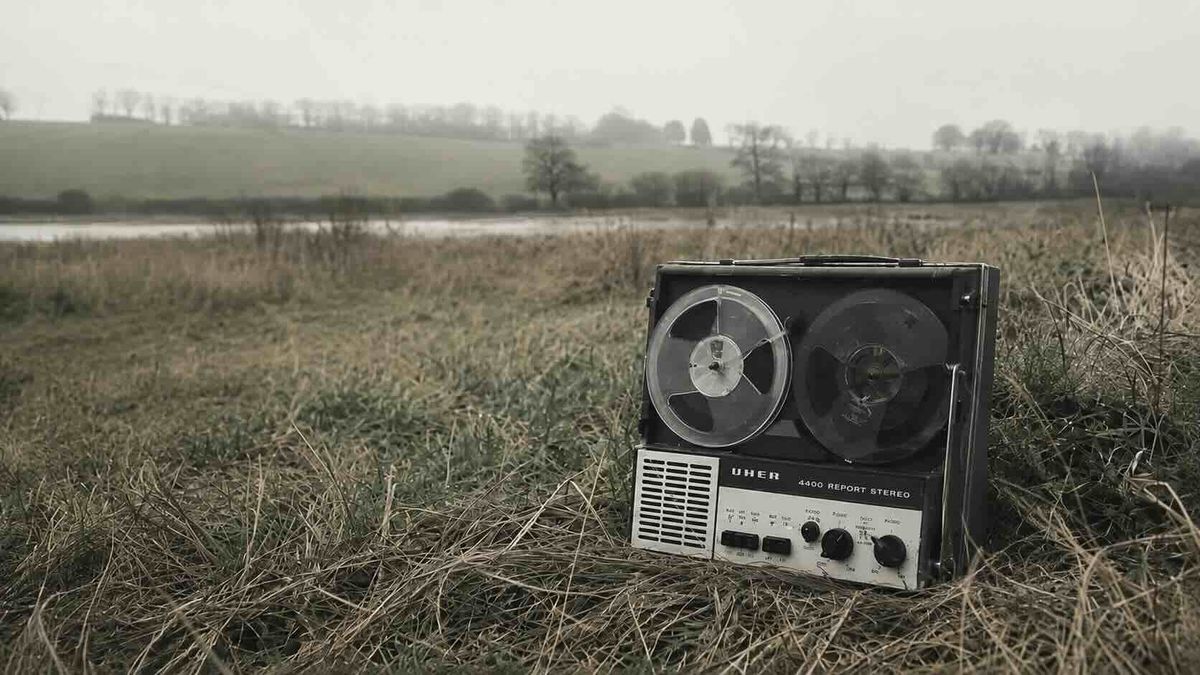
Between April and June 1982, Astley and Russell Webb took a portable Uher recorder into the countryside around Moulsford and South Stoke. They recorded birds, lambs, church bells and other sounds that would later be combined with piano, flute, guitar, clarinet and extensive tape manipulation at the Astley family home.
The album, released in 1983, is arranged around a summer day. Morning passes into afternoon and evening while the acoustic environment changes with it. The field recordings survive as identifiable things: bells still belong to a church, birds remain birds. Yet they have ceased to function as illustrative inserts. They help determine the record's clock.
Astley later acknowledged Brian Eno as an influence, particularly Music for Airports. She also remembered wanting the album to work at a quiet level, something that could be present in a room without demanding constant attention.
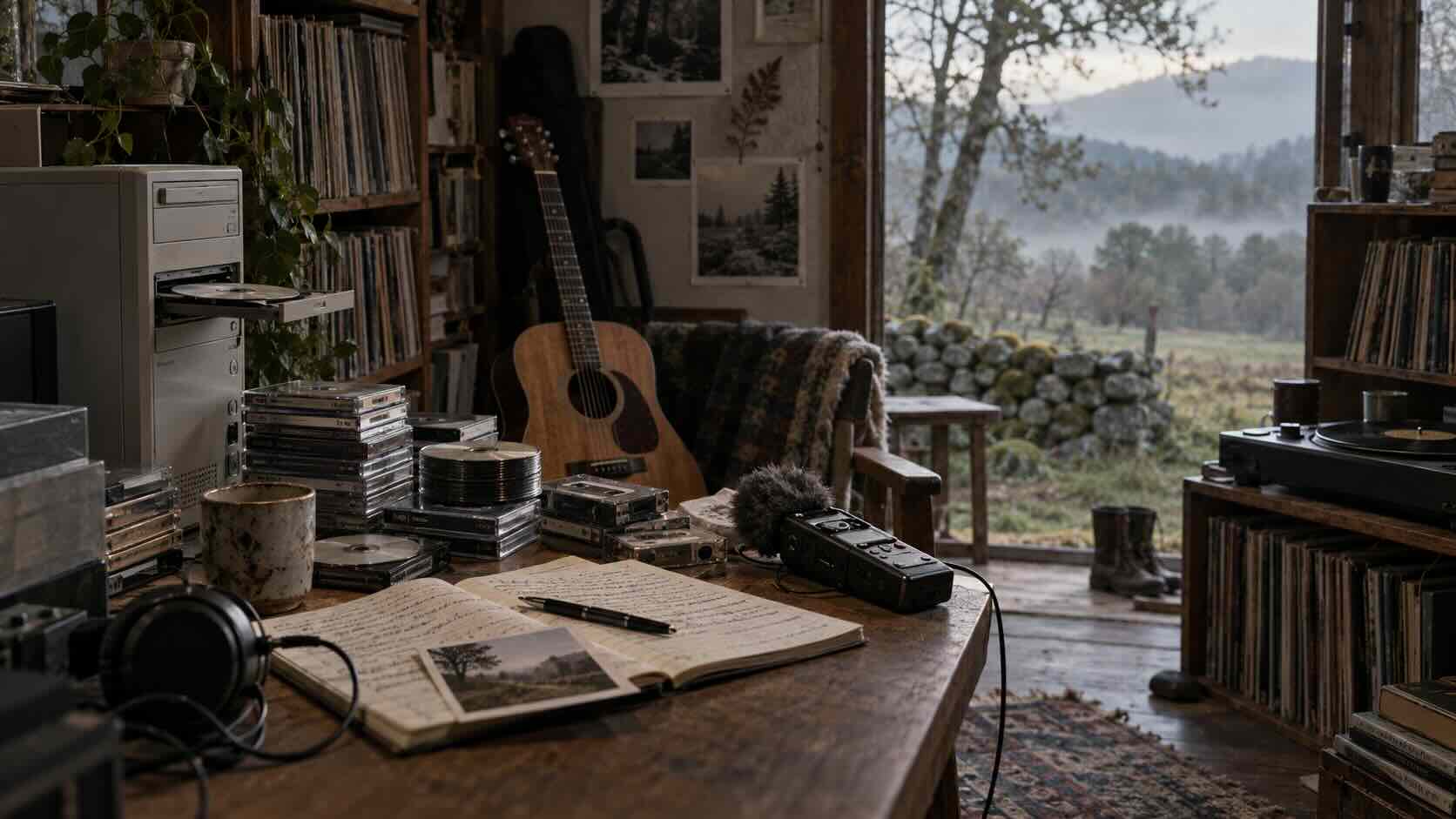
This becomes especially interesting beside the environmental recordings. The record allows attention to wander between played music and sounds whose original function had nothing to do with music at all. A piano phrase can occupy the foreground for a while; then water, a bell or an animal redirects the ear. The arrangement does not permanently decide what matters most.
Pastoralism is plainly involved, but it is not enough to explain what the record is doing. English gardens, bells and summer fields carry a cultural history much older than ambient music, and Astley knew how deliberately she was constructing her day. What feels unusual is the distribution of attention inside it.
Woo offer a useful correction to all this greenery.
Brothers Mark and Clive Ives had been recording together since the 1970s, often at home. Whichever Way You Are Going, You Are Going Wrong appeared in 1982: acoustic guitar, clarinet, keyboards, electronics and tape manipulation arranged with the intimacy of people working inside domestic limits. Small sounds stay small. Electronics do not announce a rupture in the material; they share a room with it.


The distinction matters because later ambient folk has often been photographed as landscape before it has been heard as a method. A woodland, a field and a cottage make the genre easy to package. Woo suggest a wider category of environment: neighbours, walls, nighttime volume, the dimensions of a room, the recording equipment itself.
Pastoral space is one possibility. Domestic space can do the same work.
V. Records that disappeared
Private press makes every genre history less tidy.
A few hundred copies can be enough for a record to exist historically and almost nowhere else. Forty years later a reissue or collector finds it, applies language invented in the meantime, and places it inside a lineage that did not exist for its makers. The description may be perfectly accurate to modern ears while remaining useless as evidence of what anybody called the music when it was recorded.
Iverson and Walters' First Collection, made in 1984, is one such object. Acoustic songwriter materials — 12-string guitar, mandolin, piano — share space with synthesiser and sampler textures. Later reissue culture has understandably placed it close to ambient folk and pastoral space music.
The useful fact is less glamorous. Musicians coming from Neil Young and Crosby, Stills & Nash covers could reach this combination in a California garage without belonging to a recognised movement. The technology and the acoustic habits were already available in the same room.
The problem becomes even clearer when geography changes.
In Czechoslovakia and, after 1989, the Czech lands, musicians including Oldřich Janota, Jaroslav Kořán and Irena and Vojtěch Havel developed a quiet music moving through folk, early instruments, minimalism, improvisation and spiritual practice. Journalist Pavel Klusák later used the phrase "tearoom alternative" for the loose culture that found a home in post-revolution tearooms, churches and monasteries.
Irena and Vojtěch Havel met in 1983 and made the viola da gamba central to their work. Their music developed through early music, resonant buildings, minimalism and later encounters with instruments and practices from elsewhere. The stone spaces were not interchangeable venues. Long reverberation altered the instruments and the pace at which sound could be placed inside them.
Drawing a neat influence line from British folk into this music would hide more than it explains. Similar questions were being reached through different materials: baroque resonance, restricted cultural conditions, spirituality, improvisation, architecture.
Genre history usually prefers contact because contact can be drawn as an arrow. Lack of contact is harder to use, although here it may tell us more.
VI. The map gets worse
Japan makes retrospective classification even less secure because much privately issued and environmental music from the 1980s and early 1990s only acquired an international audience through collectors, blogs and reissues decades later.
Milky Way Band's Quarter Diary, privately pressed by Athene Record Industry in 1989, is one of those records. Its current life owes a great deal to archival recovery. Folk-rock, environmental passages, spacious instrumental music and small sketches coexist without producing an obvious statement about what the album wants to be.
Its obscurity needs to remain part of the story. A record heard by very few people cannot become a historical cause merely because modern listeners recognise something in it.
Shun Komatsubara's Dear (1992) occupies another edge: fingerstyle guitar, traces of Japan's folk boom, open tunings, rural memory and occasional spatial treatment. It is less useful as a canonical missing link than as another local instance of acoustic form becoming interested in surrounding space.
Then there is Island of Bows (1994), involving R. Carlos Nakai, Wind Travelin' Band, Shonosuke Ohkura and Oki Kano, recorded at Hoon-ji Temple in Kyoto and subsequently assembled in the studio. Native American flute, shakuhachi, shamisen and koto meet inside long improvisations shaped by the temple's acoustic conditions.
Later collector writing has used "ambient folk" to describe it. That description belongs to the later listener. The recording place and the interaction between traditions belong to 1994.
Elsewhere, similarly unstable evidence survives.
Around 1990 in Australia, Louisa John-Krol and Andrew Persi recorded as Fionvarra. John-Krol later uploaded their cassette The Faerietale Woman and retrospectively described the duo's "ambient folk sound." Her description is valuable because she was one of the people making the music, although it still tells us how the tape was remembered later rather than proving a stable Australian genre term in 1990.
Svitlana Nianio's Transilvania Smile, recorded in Ukraine in 1994–95 for dance theatre and left unreleased for decades, presents a different archival problem. Piano, harmonium, traditional material, layered voice, improvisation and drone now sound close to several later folk and ambient practices. Because the recording remained largely unheard, it cannot plausibly serve as their ancestor.
Hidden recordings are useful for another reason. They tell us what was possible without transmission.
VII. Pastoral techno
By the beginning of the 1990s the traffic was moving in the opposite direction as well.
Ultramarine's Every Man and Woman Is a Star, first released in 1991 and expanded by Rough Trade the following year, belonged to electronic dance culture. Simon Reynolds later called it an early and particularly successful attempt at "pastoral techno," hearing acid house steeped in the folk-jazz atmosphere of Roy Harper, John Martyn and the Canterbury scene.
The direction of travel is important. Earlier examples in this history tend to begin with acoustic or vernacular material and discover repetition, electronics, environmental sound or enlarged acoustic space. Ultramarine could start with loop-based dance music and look back towards a British countercultural landscape.
The distinction between folktronica and ambient folk becomes useful here. Folktronica can describe a technical or stylistic fusion: folk material processed, sampled or organised through electronic production. Ambient folk is harder to locate in a particular device. Its more persistent characteristic concerns what is allowed to occupy the acoustic field and for how long.
Ultramarine sit near both categories, which is precisely why they expose the weakness of treating either as a sealed box.
VIII. Then the words appear
The sound and the terminology did not develop at the same speed.
The earliest use of the exact phrase "ambient folk music" located during this research appears in Robert Christgau's review of King Sunny Adé and His African Beats' Juju Music, published on 5 October 1982.
A critic reaches for the phrase.
Robert Christgau, writing about King Sunny Adé’s Juju Music, uses “a kind of ambient folk music”. Nearby, foreground and background have already become part of the problem.
It is an odd first sighting, which makes it more interesting. Christgau was not identifying a British pastoral movement or inventing a genre category. He was speculating about Chris Blackwell's production strategy and reached for "a kind of ambient folk music." A few lines later he described the record as disturbing the distinction between foreground and background — the same problem of attention that has been trailing this history since Bull and Fahey, now named almost in passing, by a critic who was not looking for it.
That connection is more useful than any claim of priority. The phrase appears because a critic needs language for music in which the normal allocation of attention has become uncertain.
By 11 July 1992, Music & Media could describe Máire Brennan's "Against the Wind" as "ambient folk rock." Again, there is no definition attached. Brennan's history with Clannad made the combination of traditional material, electronics and spacious studio production legible enough for the phrase to pass without explanation.
In November 1994, Music Week used "ambient folk" in its description of Youth's treatment of Capercaillie. The same year Rick Davies told Robert Rich that he had been developing "slow-motion ambient folk songs." Rich suggested a new incarnation of Amoeba, and the resulting recordings grew from Davies's reduced guitar parts alongside Rich's flute and percussion loops, sampling and extensive digital treatment.
Davies's wording is particularly useful because it belongs to musicians discussing work that had yet to be completed. The phrase had entered the workshop.
By the middle of the 1990s, then, "ambient folk" had appeared in several unrelated contexts: Nigerian juju filtered through an international Island production, Irish and Scottish traditional music, and an American experimental collaboration. That range makes it difficult to argue that the term originally belonged to one coherent sound.
It was becoming available because several kinds of music had created a need for it.
IX. Rural psychedelia
Flying Saucer Attack did not need the phrase. They had a better one: Rural Psychedelia.
Formed in Bristol in the early 1990s, FSA pushed acoustic folk, home recording, drone, feedback, shoegaze, krautrock and noise into recordings where the individual materials frequently lose their edges. Voices are half-covered. Guitar chords arrive through hiss. Recording damage and musical texture become difficult to separate.
The relationship to environment has changed since Astley's garden.
On From Gardens Where We Feel Secure, most exterior sounds remain identifiable. We hear a bird and can still point to the bird. With Flying Saucer Attack, environment begins to include the damaged or overloaded recording surface itself. Hiss, amplification and distortion behave almost like weather.
This would become important later. Jewelled Antler, parts of free folk, Natural Snow Buildings, Grouper and numerous home-recorded scenes would make combinations of acoustic material, erosion, drone and place much easier to recognise retrospectively as a field.
But in November 1995, when NME reviewed Chorus, the critic simply referred to an "ambient-folk-rulebook."
The casualness is the remarkable part. Thirteen years had passed since Christgau's earlier use. There was still no institution behind the term, yet it had become imaginable that a rulebook might exist.
X. Recurrence
Looking backwards encourages a particular kind of tidying.
Sandy Bull gives us duration. Fahey gives us environmental interruption. Drake gives us silence, Perhacs studio permeability, Martyn landscape, Parrenin electroacoustic folk, Carter acoustic drone, Astley the English pastoral, Woo the domestic room, the Havels sacred resonance, Ultramarine electronic pastoralism, Flying Saucer Attack erosion.
It is an attractive diagram and almost certainly too clean.
Several of these musicians had no meaningful relationship with one another. Some records disappeared almost immediately. Political and linguistic borders mattered. Private press restricted circulation. A work such as Quarter Diary could only become part of this history after the historical period in question was over.
Influence still matters where it can be demonstrated. Astley speaking about Eno matters. Ultramarine drawing on Martyn and the Canterbury atmosphere matters. Four Tet finding Entourage decades later matters precisely because the chronology of influence can be established.
But influence is only one historical relationship.
Recurrence may describe this material better.
Sustain an acoustic instrument for long enough and melody begins to behave like drone. Repeat a folk figure beyond its conventional duration and it becomes texture as well as tune. Record outdoors and weather, animals, traffic or water can enter the microphone. Record quietly inside a house and domestic limits alter what can be played. Put old instruments in a church and architecture lengthens them. Use tape, samplers or electronics around vernacular material and its apparent age becomes unstable.
None of those operations requires knowledge of a genre called ambient folk.
That is why geographically separate examples matter even when no line of influence joins them. They show musicians encountering similar possibilities in the materials themselves.
The genealogy exists, but much of it runs sideways.
XI. What ambient folk might mean
Reconstruct ambient folk by surface resemblance and the category becomes useless very quickly.
A quiet acoustic record with reverb cannot be enough. Otherwise large areas of new age, psych folk, American Primitive guitar, folktronica, ambient country, drone and private-press instrumental music collapse into the same shelf. Pastoral imagery is even less reliable. A forest on a sleeve tells us almost nothing about the behaviour of the recording.
A more useful definition describes a relationship.
"Folk" in this formulation can mean repertoire, instrument, technique, regional practice, remembered melody, vocal manner or simply the physical presence of acoustic playing. A pastoral subject is optional.
"Ambient" is more difficult.
Using it as a synonym for atmospheric explains almost nothing. The stronger connection concerns attention, the same one this history has been following since a solo guitarist first let a train's noise carry structural weight. Foreground becomes unstable. Something played as accompaniment can begin to occupy the ear; a room can become as important as the instrument inside it; a field recording can stop illustrating and start organising; silence can determine the scale of the events around it.
Christgau's 1982 review turns out, in hindsight, to have supplied the clearest statement of a problem this essay had already been tracking for two decades of records. His improvised phrase "ambient folk music" is followed almost immediately by an observation about foreground and background becoming confused. He was writing about King Sunny Adé, far outside the genealogy later attached to ambient folk, but he had put a name to the exact difficulty Bull, Fahey, Martyn and Astley had each been working through without one.
The historical accident may have produced the better definition.
XII. 1995, without a beginning
By 1995, most of the ingredients had been available for decades.
Acoustic drone existed without the name. Folk musicians had used electroacoustic studios and exterior spaces. Environmental recordings had become compositional material. Bedrooms and garages had produced hybrids heard by almost nobody. Old instruments had met new recording technologies in churches, houses and temporary studios. A post-communist tearoom culture had given quiet experimental music another habitat. Japanese private press had generated records whose relevance would only become visible later. Electronic dance music had begun looking backwards towards folk and pastoral counterculture. Bristol had its Rural Psychedelia.
During the same period, critics and musicians had begun reaching independently for the same two words.
Ambient folk.
After 1995, the conditions change. Reissue culture grows. Home recording becomes cheaper. CD-R networks, message boards and eventually file-sharing make it easier for previously separate traditions to encounter one another deliberately. Around San Francisco, Finland, France, Japan, Britain and elsewhere, the accidental prehistory begins behaving more like an international underground.
Even then, ambient folk never quite acquires a capital city. There is no single scene to visit, and the term remains poor at policing its borders.
Perhaps that is appropriate. Its history before 1995 suggests that the music did not emerge because musicians agreed on a new genre. It kept appearing because certain instruments, places and recording methods repeatedly created the same opportunity: to let a song loosen its grip on the space around it and to hear what else was already there.
Ambient Folk 1995-2010: The Network Before the Scene
Ambient Folk 2010–2026: The Tradition Supplies the Drone
Last revised: August 2026