John Mackenzie :: Red Shift
Love and violence recur across three eras in Cheshire.
Before Mow Cop there is a motorway. Tail-lights move through the dark, lose their scale and become stars, and Red Shift begins with a departure already under way.
There is a temptation, with Alan Garner, to begin underground. Ancient things survive beneath roads and houses, stories recur, a stone lifted from the soil turns out to have been waiting longer than anyone who touches it. John Mackenzie's Red Shift, broadcast on BBC1 as a Play for Today on 17 January 1978, seems to offer that arrangement: three periods on roughly the same few miles of country (Roman Britain, the Barthomley killings of the Civil War, the late 1970s of Tom and Jan), with an axe-head passing through them and Mow Cop holding still above.
The film starts by moving. Headlights on a motorway blur into points of light, and Phil Ryan's score gives them a mechanical pulse before the image opens towards the astronomical. Brian Baker has written about how much travelling the film contains, from trains and motorway to bicycles, and reads Mackenzie's Cheshire as a place caught between older social formations and newer systems built to carry bodies through them at speed. Garner is usually described as a writer of rootedness; in Red Shift almost nobody manages to be rooted.
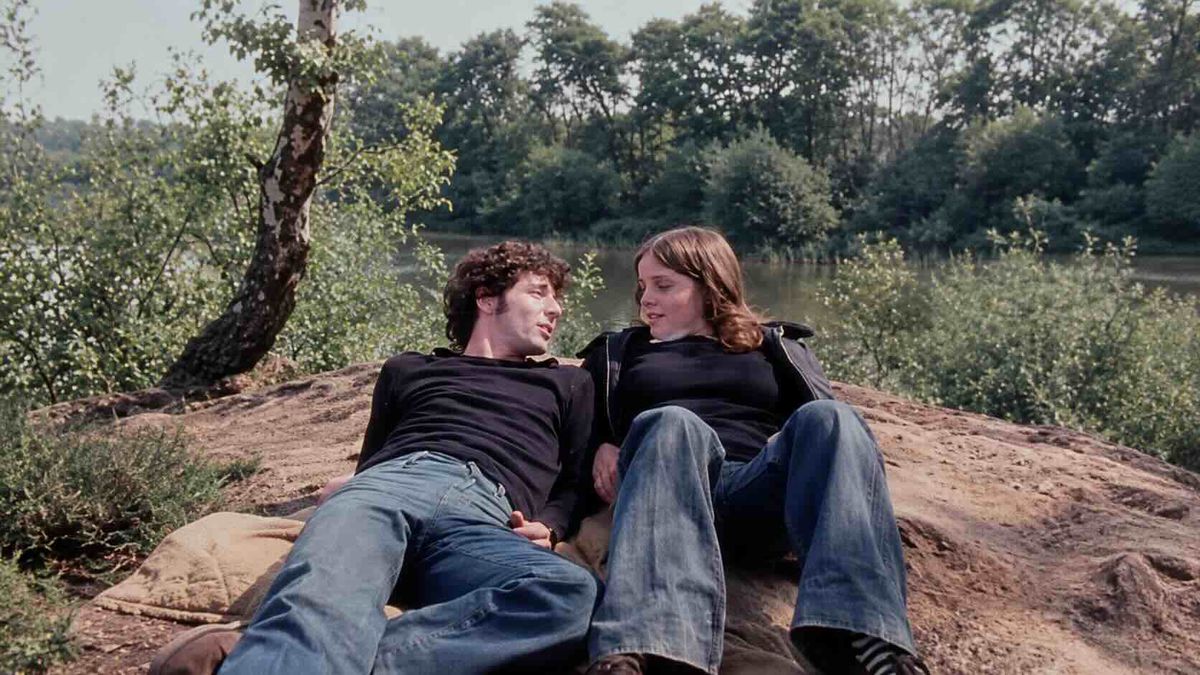
Tom lives with his parents in a caravan. Jan is leaving for London. Timetables, arranged meetings and Crewe station hold them together, and Crewe is one of those British places built for passing through. They agree to look at the same star when apart, cycle into the country, climb Mow Cop, trying again and again to get something permanent out of arrangements designed around distance.
Stephen Petcher makes Tom painful to watch because his intelligence protects him from almost nothing. He can name astronomical processes more easily than he can absorb a change in another person, and his talk turns into a defensive device: jokes, quotations, calculations, abstractions produced at the worst possible moment. Lesley Dunlop's Jan has as much feeling and a clearer sense that feeling will not hold a train back.
Read quickly, Tom becomes the latest vessel for a violence travelling through Garner's three periods, one more disturbed young man repeating an old masculine pattern, and the film supplies evidence for it. The Roman Macey and the seventeenth-century Thomas suffer seizures in which another order of experience seems to break through them, and the physical violence of the earlier stories presses against Tom's volatility in the present. Recurrence, though, accounts for very little of the film's sadness.
Across the three periods the violence changes its means of transport. In the earliest material it belongs to bodies: weapons, capture, blood, men crossing contested ground. In the Civil War it acquires machinery in allegiance, soldiers, sanctuary broken, collective punishment. By Tom's time a railway timetable can do part of the work, and so can a job in London, parents on the other side of a caravan partition, money, the simple possibility of leaving, none of which leaves a mark anyone could point to.
Red Shift now sits routinely near folk horror, and the BFI has discussed it within that television tradition. Adam Scovell has pointed out how badly it fits the usual chain. It has no isolated community slowly revealing a pagan order and no buried ceremony waiting to resume. The landscape keeps supplying connections and never explains them, and the motorway belongs to that landscape too, along with Crewe station, the caravan and the television inside it. The programme's own history drifted in a similar way: shown once in 1978, it went largely unseen until the BFI put it on DVD in October 2014.
Mow Cop is the right hill for this. The ridge lies on the Cheshire–Staffordshire boundary, the folly stands on divided land, and the hill has carried other administrative and ecclesiastical lines too, so when Tom insists on standing between counties, parishes and dioceses he is describing the ground accurately. It was quarried for millstones and marked by coal working, and belongs to labour and extraction at least as much as to legend. The famous ruin is false history to begin with. Randle Wilbraham built Mow Cop Castle in 1754 as a summerhouse made to resemble an older ruin, an eighteenth-century imitation of antiquity that weathered and was absorbed back into the landscape. Its surfaces had been lying for two centuries before Tom climbed the hill.
The axe-head is stranger. Characters handle it, bury it, recover it and load it with meaning, and it gives physical continuity to stories otherwise kept apart without explaining any of the people who hold it. It survives because it asks for almost nothing. Beside it every human attempt at continuity looks fragile, starting with a relationship that depends on Sunday trains.
A cut crosses seventeen centuries at once, while Tom cannot get from Cheshire to London without money, time, trains, suspicion and humiliation.
Oliver White's editing quickens the traffic between the three stories as the film goes on. Mackenzie gives no period a visual grammar of its own. Baker notes that the timelines share the same realist codes, so the cutting does most of the work of telling them apart, and Scovell compares the cuts to the paragraph breaks of Garner's novel. Garner later recalled eighteen months developing the adaptation with Mackenzie, three versions of the script, close to two hundred minutes shot, and six months in which Mackenzie reduced it to the broadcast film. On one point his memory is exact: the weight fell on the editing.
You can feel that weight. A face finishes an action centuries away from the body that began it. Violent moments are linked by rhythm where a script would have supplied a reason. Blue, silver and red leak across periods, and a sound starts to belong to the next scene. Historical drama usually keeps the past at a polite distance through costume, architecture and establishing shots; Mackenzie removes those guarantees. A cut crosses seventeen centuries at once, while Tom cannot get from Cheshire to London without money, time, trains, suspicion and humiliation.
The earlier sections hold violence in quantities Tom could scarcely imagine, and Mackenzie still lets the small humiliations keep their size: jealousy, parents overhearing, a missed meeting, an object sold, a sentence misunderstood. Set beside massacre, they look more exposed.
A small television flickers inside the caravan while the motorway outside carries other lives past, domestic enclosure and national infrastructure a few feet apart. The textures are ordinary (cheap interiors, platforms, traffic, scrub, wet stone), and that ordinariness keeps the programme away from the prettier descendants of British hauntology. Mackenzie shot on 16mm, and the same grain covers every century, whatever the costumes. Viewers in 1978 saw it through the videotape copy used for transmission; the BFI went back to the original film for the disc, so the film is now sharper than it was on the night it was broadcast.
Redshift lets distance be read in light: a receding source has its wavelengths stretched towards red, and Tom reduces the terror to a few words about things going farther and leaving faster. Astronomy gives him a vocabulary for something already happening at human scale, as Jan becomes observable as distance. The past in this film is receding too, and the montage cheats the distance only for the length of a television play, setting separated times side by side without giving any of them back.
Jan calls the axe-head her Bunty, a real thing, shrinking several thousand years of matter into the private language of a couple, the way lovers do with an object, a word, a place. Then Tom sells it to a museum, and the thing that crossed the film's historical distances intact ends up in an institution built to keep objects after their original relations have gone.
The axe-head survives. Bunty doesn't.
Crewe station may be the film's real centre, more than Mow Cop. The hill stacks history vertically. At Crewe the lines run off elsewhere, departures are announced, people share a platform for a few minutes and move apart. Tom tries to bend the vocabulary of departure, turning farewells into greetings, as if every separation could already contain the next meeting. By the end the universe he has been describing all along has shrunk to the width of a platform, and the distance is already growing while two people are still close enough to see each other.