Deniz Cuylan :: For Luca
Ambient folk of guitar, winds and memory, shaped around Luca.
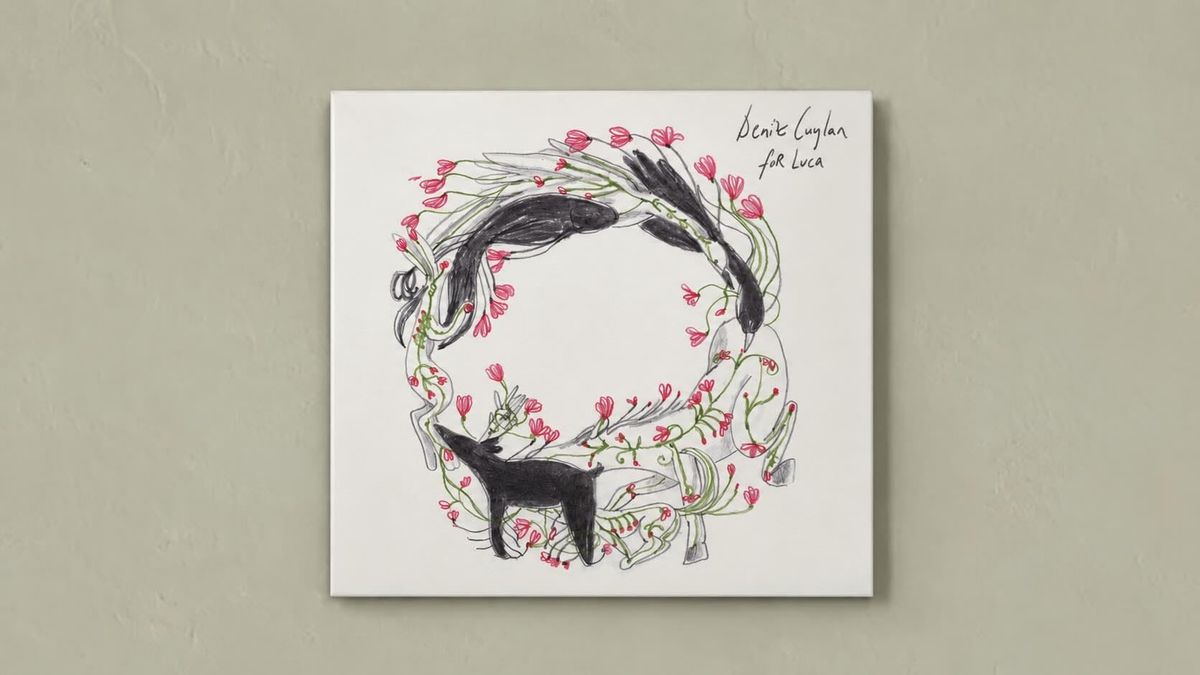
A dog arrives in a scoring musician's Los Angeles apartment and the synthesizers begin to lose ground. Somewhere between the morning walks and the new arithmetic of the household, a nylon-string guitar comes down off the wall after twenty years of silence.
Deniz Cuylan grew up playing guitar in Istanbul, then spent the better part of two decades away from it. Film and television work had taken over, and with it the tools of that trade: synthesizers, patches, the infinite undo of the studio. A dog reorders a house long before it touches anything else in a life. The walks come first, then the attention, then the plain fact of another body claiming its share of the day, and somewhere inside that reshuffle the guitar found its way back into his hands. Luca lay in the room while No Such Thing As Free Will was being made in 2021. He died at five, of bone cancer. For Luca, Cuylan's third solo album, arrives several years later, and the gap can be heard.
These eight pieces rarely behave like memorial music. The grief is there, though by now it has been through work, through distance, through other people's hands. Cuylan co-produced the record with Cem Mısırlıoğlu and left it unusually porous, with doors ajar for whoever turns up. Felbm's flute and vibraphone drift through the opening "No Such Thing", and from there the guest list grows the way a household does once it starts taking in strays.
"Lelana" is Javanese for wandering, a journey with no landing. The piece carries an old-school dramaturgy drawn from the wayang shadow theatre in which Peni Candra Rini trained. She is the daughter of a dhalang, and she learned the sindhèn's song before anything else. It surfaces in every melisma, each gesture pitched at an audience you can't see, the way a hand behind the screen moves the puppets that the lamp turns into fate. Her delivery is flawless in the theatrical sense of the word: she gives the piece exactly what it needs, with the precision of someone who learned to act by singing. Around her, Cuylan's writing drops any ambition to harmonise and turns into set design. Thor Harris's vibraphone, a western cousin of the court metallophones, shapes the space she moves through, along with the Black Box electronics and a guitar hung at the edges of the stage. She comes back on "Ali Ali", where the instruments step away and leave her almost alone with the air.
"Big Blue" works at the scale of cells. It is a close, mitochondrial weave that owes something to Björk around Vespertine, with the electronics kept near the skin and the sounds so small they seem to be heard from the inside. Sarah La Puerta's voice and the double bass settle into a slot trip-hop left empty years ago. Six Missing thicken the air, and the mallets keep opening small recesses somewhere further east.
On "Bluffs" the guitar sounds like a misprint left behind by the looping electronics, and the loops keep quoting it back to itself, slightly wrong every time. Violin, cello, trumpet and trombone move through the glitches in slow procession, post-classical ambient with its roots in folk and chamber music. "For Shirasu" belongs to Makoto Kubota's speaking voice, carried on Berke Can Özcan's drums and percussion. He talks unhurried, to nobody in particular.
Across the record Cuylan puts the recovered guitar back into circulation among the Hordijk modular, the piano, clarinets, double bass and electronics. He lets these forces keep changing the scale of things, so that a chamber swells to the size of a coastline and shrinks back within a bar. For all the guests, the record never feels crowded, because he knows how to leave air between the parts. The guitar never asks to be the centre of it. On "Viggo" Casper Clausen passes through briefly and moves on. The cameo is staged in a way that made me hear David Sylvian in his voice so clearly that I went back to the credits to check.
The grief is there, though by now it has been through work, through distance, through other people's hands.
The label calls For Luca partly a tribute to the animal who changed Cuylan's life, and "partly" is the honest word. Make every flute line or electronic sustain stand for mourning and the record shrinks. What comes through most convincingly is a change in behaviour. Attention is spread differently, and a musician used to working alone is now surrounded by other hands, breath, reeds, skins and strings.
"Asleep in the Sun" closes the album, and its title is the plainest image on the record: an animal stretched out somewhere warm. La Puerta sings again over drums, electronics, guitar, piano and the Hordijk. The guitar comes from Portishead country as surely as her voice does, and the near-jazz phrasing wanders among hums and city noise without asking to be taken anywhere.