COB :: Spirit of Love
English acid folk heard as a private hymnal, from Cornwall to Japan.
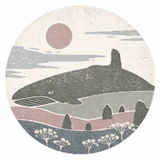

In 1972, Japanese Epic pressed this record under a title all its own: Ai no yōsei, 愛の妖精, "the fairy of love." Somewhere in Tokyo an anonymous translator, faced with an album by three penniless Englishmen, turned their spirit into a yōsei, a word that in Japanese leans towards the small creature of the woods rather than the ghost or the holy breath.
Whether he meant that or simply reached for the nearest word, the choice turns out to be a good one. For fifty years Spirit of Love has passed for a minor classic of acid folk. Heard without the weight of the Incredible String Band's name, which is how Japan heard it, it sounds like something else: the last English hymnal, written by men who no longer had a church, in which a listener in Tokyo found pentatonic scales and animism where England heard only the folk revival's strange brother.
The backstory explains the record's temperature. Clive Palmer, a virtuoso banjoist raised in the coffee houses of Soho after his mother's death, had founded the Incredible String Band with Williamson and Heron, and left it after the first album to travel overland to India, through Turkey, Iran and Afghanistan, where he played banjo on Indian national television before the money ran out. On his return he declined to rejoin the group just as it was becoming famous, and went down to Cornwall instead, to a caravan beside the Folk Cottage at Mitchell, with the poet "Whispering" Mick Bennett. There, with John Bidwell, the two first assembled the Temple Creatures, a trio built around an Indian hand organ, playing the Town Hall at Fowey, and then the group their manager Jo Lustig christened, with a press officer's pragmatism, Clive's Original Band. The songs were written almost entirely in a caravan between Truro and Falmouth, without electricity, without money, without other music around: Palmer deliberately avoided listening to anyone else's records, so that his melodies would come out intact.
This is the key the critics keep missing. The poverty of Spirit of Love is always recounted as picturesque circumstance; it was the compositional method.
The poverty of Spirit of Love is usually recounted as picturesque circumstance. It reads better as the method. Like the arte povera that in those same years was exhibiting jute and stones, C.O.B. built its sound from what the shipwreck had left behind. The record's emblematic instrument, Bidwell's dulcitar, was born of an accident: a dulcimer forgotten on the roof of a car, destroyed, rebuilt in hybrid form, half dulcimer and half sitar, with chicken wire as a structural component. The Orient Palmer had crossed on foot re-entered Cornwall as salvaged wreckage. The whole record works this way. "Wade in the Water," an African-American spiritual, is sung a cappella with producer Ralph McTell on percussion; "Scranky Black Farmer," a farmhand's ballad from Aberdeenshire, comes through a megaphone; "Banjoland" closes the side with a lone banjo and the sound of waves. Ursula Smith, cellist of the Third Ear Band, stitches the seams.
McTell, who produced the record at London's Marquee Studios, called it the most difficult recording of his life: the group was loose and undisciplined, three men out of nowhere who "somehow came up with this magical music." The difficulty was structural. McTell was trying to record songs, while C.O.B. was performing offices. "Music of the Ages," "Serpent's Kiss," "Sweet Slavery," the title track: these are psalms of a private liturgy, whose declared models stand upstream of the English folk tradition, in medieval monody, in Judeo-Christian hymnody filtered through the Moorish world, in Crusader music sung from the side of those who come home defeated and converted to nothing. The Incredible String Band had made the sacred psychedelic, and therefore ornamental. C.O.B. made it poor, and the poverty is what makes it credible. Set the two debut albums side by side and you are comparing a bazaar with a monk's cell.
Here Japan proves useful as a vantage point. Gotō Hideki, who bought the domestic Epic pressing in 1972 and kept it like a relic, has written that had this album appeared without Clive's name attached, it would be recognised as a folk classic: the shadow of the ISB trails every discussion of the English scene and crushes the work's independent standing. His sharpest observation concerns the melodies "in Japanese scales" he heard in it. He is right, and for a reason he could not have had in mind: the modal lines of Bidwell and Palmer, stripped of functional harmony, sound pentatonic to an ear in Tokyo in the same way they sound Gregorian to one in Canterbury. Devotional music that stands upstream of all traditions tends to be claimed by each of them as its own, and the Japanese title, read in that light, is less of a mistake than it first appears.
What followed was brief and consistent. A tour with Pentangle in 1972, the Royal Festival Hall, a second and even thornier album (Moyshe McStiff and the Tartan Lancers of the Sacred Heart, Polydor), the split in early 1973. Palmer became an instrument maker and went so far as to build the first Cornish bagpipes seen in several centuries; the man who had rebuilt a dulcimer with chicken wire ended by rebuilding an extinct instrument for an entire region. He died in 2014, mourned by a congregation as unlikely as it is devoted, Billy Connolly, Johnny Marr and Bert Jansch among them. The fiftieth-anniversary reissue (Bread and Wine, 2021) has put the record back into circulation without denting its secluded nature.
Spirit of Love remains what it was: a book of hours for the unchurched, cut by three men who had taken a vow of poverty without noticing. Filing it under acid folk describes the sleeve. The centre of the record is elsewhere, in the empty churches and the full caravans of 1971, and the Japanese sleeve, with its small creature of the woods, had at least the merit of looking there.
Like the arte povera that in those same years was exhibiting jute and stones, C.O.B. built its sound from what the shipwreck had left behind. The record's emblematic instrument, Bidwell's dulcitar, was born of an accident: a dulcimer forgotten on the roof of a car, destroyed, rebuilt in hybrid form — half dulcimer, half sitar — with chicken wire as a structural component. The Orient Palmer had crossed on foot re-entered Cornwall as salvaged wreckage. The whole record works this way: "Wade in the Water," an African-American spiritual, is sung a cappella with producer Ralph McTell on percussion; "Scranky Black Farmer," a farmhand's ballad from Aberdeenshire, comes through a megaphone; "Banjoland" closes the side with a lone banjo and the sound of waves. Ursula Smith, cellist of the Third Ear Band, stitches the seams.
McTell, who produced the record at London's Marquee Studios, called it the most difficult recording of his life: the group was loose and undisciplined, three men out of nowhere who "somehow came up with this magical music." The difficulty was structural: McTell was trying to record songs, while C.O.B. was performing offices. "Music of the Ages," "Serpent's Kiss," "Sweet Slavery," the title track: these are psalms of a private liturgy, whose declared models stand upstream of the English folk tradition — medieval monody, Judeo-Christian hymnody filtered through the Moorish world, Crusader music sung from the side of those who come home defeated and converted to nothing. The Incredible String Band had made the sacred psychedelic, which is to say ornamental; C.O.B. made it poor, which is to say credible. Where Williamson accumulated, Palmer subtracted: set the two debut albums side by side and you are comparing a bazaar with a monk's cell.
WHAT PLACE DID IT OCCUPY?
Cornwall / CBS / 1971
Heard for decades through the reputation of the Incredible String Band.
WHAT HAS ITS REPUTATION COVERED?
Monody / hymnody / modal lines
The devotional structure concealed by the acid-folk label.
WHY HEAR IT NOW?
Limitation as form
Poverty heard as a compositional method rather than picturesque circumstance.
And here Japan proves useful as a vantage point. Gotō Hideki, who bought the domestic Epic pressing in 1972 and kept it like a relic, has written that had this album appeared without Clive's name attached, it would be recognised as a folk classic: the shadow of the ISB trails every discussion of the English scene and crushes the work's independent standing. But his sharpest observation concerns the melodies "in Japanese scales" he heard in it. He is right: the modal lines of Bidwell and Palmer, stripped of functional harmony, sound pentatonic to an ear in Tokyo just as they sounded Gregorian to one in Canterbury. This is the property of authentic devotional musics: every tradition recognises them as its own, because they stand upstream of all traditions. "The fairy of love" was a theologically exact translation.
What followed was brief and consistent. A tour with Pentangle in 1972, the Royal Festival Hall, a second and even thornier album (Moyshe McStiff and the Tartan Lancers of the Sacred Heart, Polydor), the split in early 1973. Palmer became an instrument maker and went so far as to build the first Cornish bagpipes seen in several centuries — the man who had rebuilt a dulcimer with chicken wire ended by rebuilding an extinct instrument for an entire region, the final act of a single obstinacy: giving breath back to what time had declared closed. He died in 2014, mourned by a congregation as unlikely as it is devoted — Billy Connolly, Johnny Marr, Bert Jansch among them; the fiftieth-anniversary reissue (Bread and Wine, 2021) has put the record back into circulation without denting its secluded nature.
Spirit of Love remains what it was: a book of hours for the unchurched, cut by three men who had taken a vow of poverty without noticing. Whoever files it under acid folk is describing the sleeve; whoever hears it as the last English hymnal, written when the churches stood empty and the caravans full, touches its centre. The fairy of love, like every creature of her kind, shows herself only to those who have stopped looking in the right place.