The Island That Sang Itself into Being
Folk music, ritual, invented tradition and the acoustic state of Summerisle

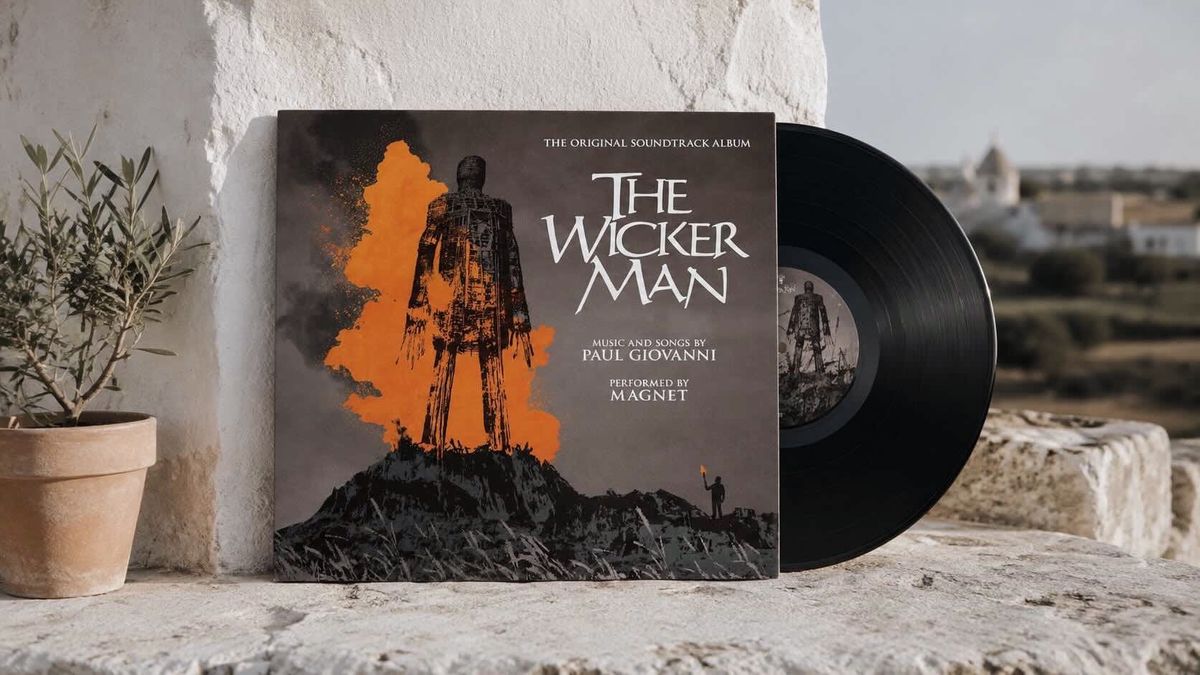
Summerisle's first act is to sing itself into being. Before its laws have been explained, before the failed harvest acquires meaning, before Sergeant Howie has set foot on the island, a song reaches the viewer from above.
The seaplane crosses a landscape of water, fields and scattered settlement while "Corn Rigs" gathers desire, memory and cultivated ground within the same horizon. The voice does not describe what Howie is about to encounter. It gives that place an initial form. Every road, room and field that follows appears to belong to a past the viewer has already heard.
Paul Giovanni’s music exercises this authority throughout The Wicker Man. Songs occupy the inn, the schoolroom, the graveyard, private bedrooms, the ceremonial square and the coast. They accompany work, sexual instruction, children’s education and the passage towards sacrifice. Even death is organised through collective singing. Summerisle possesses few of the buildings by which civic authority usually announces itself. Its infrastructure is acoustic.
The soundtrack therefore resists treatment as atmosphere. Its pastoral sweetness carries a social order. It teaches when the body may be displayed, which forms of fertility deserve celebration, how the year should be understood and what the past is permitted to mean. A person who joins the singing accepts, for the duration of the song, the cosmology within it.
Howie remains outside this form of citizenship. He can interrogate, admonish, pray and cite the authority of the state. He cannot enter the chorus. His exclusion is theological, though it is also rhythmic. He moves through Summerisle as a man surrounded by evidence whose grammar he does not possess.
I. A Geography Composed in the Edit
Summerisle claims a position among the Hebrides, yet the territory visible on screen was assembled from locations scattered across Scotland. Kirkcudbright, Gatehouse of Fleet, Creetown, Anwoth, St Ninian's Cave and the coast at Burrow Head supplied different parts of the island. The landing near the beginning also incorporates Plockton, on the western seaboard of the Highlands. These places possess their own roads, distances, local histories and geological characters, though the film removes those separations: through editing, they become contiguous, and Summerisle is therefore a geographical fiction composed from real fragments.
The soundtrack follows the same procedure. It joins periods rather than places. A thirteenth-century rota stands beside Robert Burns, Edwardian folk collecting, children's rhymes and songs written by Giovanni shortly before filming. The sources reach the film through different forms of preservation: manuscript notation, printed poetry, oral transmission, antiquarian recovery, censorship, arrangement and modern composition. On the island, these differences are concealed. The songs appear to have emerged from one unbroken local inheritance.
The geography of Summerisle and the genealogy of its music share a method. Their cuts are hidden; continuity is the result. The island feels remote because the film has removed the roads connecting its locations to the rest of Scotland. Its customs feel ancient because the soundtrack suppresses the historical distances separating a medieval lyric, an eighteenth-century poem and a piece of 1970s folk composition.
This construction does not weaken the film's imagined world; it reveals one of its most exact perceptions. A tradition able to govern a community seldom arrives intact from the past. Its fragments must be selected, arranged and attached to particular places, and repetition then gives the arrangement the appearance of inheritance.
Summerisle's plausibility depends on this concealed labour. Its landscape seems to remember because music has instructed it what to remember. A field heard through Burns becomes older than the camera image before us. A stone, a schoolroom or a Maypole acquires temporal depth from the voices surrounding it, and geography here becomes less the stable ground upon which ritual occurs than one of ritual's own products — the soundtrack supplies each location with an ancestry.
The same principle governs Howie's investigation. He approaches the island as a territory that can be searched. Locations should yield evidence; evidence should disclose sequence; sequence should lead to a crime. Yet Summerisle has already arranged its spaces according to another logic. The school, the inn, the graveyard and the orchard belong to a pattern whose coherence lies in recurrence, songs connecting them more effectively than roads — so that Howie can traverse the island without ever entering its geography.
II. The Instruments of a Local State
Paul Giovanni came to the project from New York. Gary Carpenter, recently graduated from the Royal College of Music, assisted with the musical direction and assembled the young players who would perform as Magnet. The group was formed for the film. Composition, research, arrangement and recording took place within approximately six weeks.
This compressed production left a decisive mark on the finished music. The soundtrack retains a domestic scale. Flutes, fiddle, acoustic guitars, light percussion, concertina and voices seem compatible with the island’s rooms and material economy. They could be carried through a doorway, stored behind the bar, passed from one player to another and used again during the evening.
The recordings can be intricate, though they rarely lose the sense that the music might be reproduced by the people visible on screen. This matters. A large orchestral score would have placed musical authority outside Summerisle, within the interpretive machinery of cinema. Magnet returns it to the inhabitants. The songs appear to arise from tables, bedrooms, school exercises and public gatherings.
The boundary between score and social practice becomes porous. At times the soundtrack comments upon the image. Elsewhere it belongs entirely to the scene. More often, the two conditions remain difficult to separate. Music seems to circulate through the island before the camera arrives and to continue after it leaves.
Summerisle has no clearly defined caste of professional musicians. It appears instead to possess a musically competent population. This competence gives the songs political force. They require no central stage, conservatory or sacred building. A tune can move wherever social instruction is needed, and the community carries its liturgy with it.
Robin Hardy recalled seeking songs that could be amusing, sincere and narratively useful. Some drew upon Burns; others were deliberately fashioned to resemble Victorian material. “The Landlord’s Daughter” belongs to this latter category. The Maypole song, Hardy explained, could communicate through music what might otherwise have required an extended dialogue. Opera offered the nearest model, though its procedures were reduced to vernacular dimensions.
The comparison is revealing. In opera, music can make private motive publicly audible. Desire, fear, loyalty and deceit enter a shared formal space. The Wicker Man transfers this capacity to folk song. Characters sing within situations that remain socially credible, while the songs expose the structure governing those situations. The island’s music carries the modest instrumentation of local custom alongside the narrative efficiency of theatre. Its apparent simplicity conceals administration.
At the school, a song teaches reproductive order. At the inn, another assigns a sexual identity to Willow before Howie has spoken with her. During the procession, music coordinates the movement of trades, masks and bodies. At the coast, a medieval rota gives the sacrifice its collective duration. In each case, the island’s acoustic infrastructure reaches deepest where the authority behind it must appear most local.
Summerisle’s ruling system depends upon a fiction of proximity: these are the people’s songs, the people’s customs, the people’s inherited knowledge. Their small scale is, for that reason, political. Power enters the island without announcing itself as power. It arrives instead with a tune someone already seems to know.
III. The Antiquity of Recent Things
A decade after the film's release, Eric Hobsbawm and Terence Ranger would formulate the concept of the "invention of tradition": practices claiming remote continuity may have recent origins, often arising from the need to legitimate new identities or altered relations of power. Their formulation could not have influenced The Wicker Man, though it describes Lord Summerisle's method with unusual precision.
Within the narrative, the island's religion is already a restoration. The present Lord Summerisle's grandfather is said to have reintroduced pagan belief as part of an agricultural and social project. The revived rituals helped govern the population while supporting the cultivation of crops poorly suited to the island's climate — the past becoming, in effect, an instrument of estate management.
This imagined genealogy has a parallel in the history of folklore studies. Mikel J. Koven has observed that the film's anthropological authority depends heavily upon the late-Victorian image of Celtic paganism associated with James Frazer's The Golden Bough. The rites of Summerisle do not descend directly from a recoverable pre-Christian culture. They descend from a scholarly age that arranged fragments of ritual, myth and seasonal custom into evolutionary accounts of religion — the film reconstructing, in this sense, a past that had already been reconstructed.
Its soundtrack performs a subtler version of the same act. It does not claim to recover a unified repertory. Instead, it gathers incompatible materials and allows the islanders to use them as though they belonged to one local calendar. Authenticity emerges from placement. A song belongs to Summerisle because it is sung at the appointed time, by the appropriate bodies, within a site already charged with ritual meaning — the question of origin becoming secondary to the discipline of repetition.
This is why Giovanni's newly composed songs can feel as old as the historical material surrounding them. Their antiquity does not reside in age; it resides in their integration with rooms, gestures and social roles. "Willow's Song" sounds inherited because the film gives it an architectural function, a ceremonial purpose and a listener who cannot interpret the terms of its invitation.
Conversely, genuinely old material can be made to serve recently invented needs. "Sumer Is Icumen In" enters a twentieth-century fantasy of pagan sacrifice, despite surviving within a medieval manuscript culture in which Christian and secular meanings were not separated along the lines the island claims.
Summerisle's past is therefore a curated one, surviving by selection, arrangement and repeated use — a form of authority no vocabulary of authenticity or fakery quite covers. Fragments are removed from prior contexts, assigned new functions and placed into circulation, and their repeated use produces the continuity that their origins cannot supply. The seams remain audible to anyone who recognises the sources, though within the island recognition is unnecessary: tradition survives there as practice rather than scholarship, since Lord Summerisle does not need the inhabitants to know where a song came from — only to know when to sing it.
This distinction allows him to alter the past without rewriting an archive. He controls occasions, bodies and places. Memory remains vocal, seasonal and collective, changeable simply by changing the circumstances of repetition, and the soundtrack gives this political method a sensuous form. The viewer encounters Summerisle's invented tradition as pleasure before encountering it as power. Melodies attract where doctrine might repel. Humour makes instruction convivial. Erotic invitation gives ritual discipline the appearance of freedom, and the film's unease begins exactly there: fabrication does not make the tradition ineffective, and its effectiveness may depend precisely on how carefully it has been fabricated.
IV. A Calendar Built against Failure
The soundtrack can be heard as a displaced almanac.
"Corn Rigs" derives from Robert Burns's "The Rigs o' Barley", written to the melody of "Corn Rigs Are Bonie". The poem locates an erotic encounter among barley fields on a Lammas night. Harvest, moonlight, courtship and remembered union occupy the same cultivated ground. The field shelters the lovers and preserves their encounter as memory.
In The Wicker Man, this late-summer song introduces a journey towards a May celebration. The seasonal discrepancy passes easily because the music conveys a broad sense of rural antiquity, though the mismatch discloses Summerisle's temporal method: the island does not observe the agricultural year so much as compress it. Signs drawn from distant points in the calendar gather around the crisis of the failed harvest. Lammas enters May. Summer's decline stands beside its beginning. Mating, sowing, ripening and sacrifice are drawn into a single ceremonial present.
This compression is more than picturesque confusion. It responds to the island's material predicament. An ordinary calendar would be forced to register failure. The trees have not produced the promised fruit. Agricultural time has reached a result that threatens Lord Summerisle's authority. The sequence of cause and consequence has become dangerous: if the climate cannot sustain the crop, the founding bargain between landowner, belief and prosperity begins to dissolve.
Music offers a different temporality. A song can recall one season during another. It can summon harvest before the field has yielded. It can place decline beside renewal without resolving the contradiction, repetition allowing the year to begin again before its previous failure has been understood — the island's calendar built, in this sense, against its own evidence.
Near the end, "Mirie it is while sumer ilast" introduces a more fragile conception of seasonal time. The Middle English lyric survives in a single source, written on the flyleaf of a psalter now held by the Bodleian Library as MS Rawlinson G. 22. Its seven damaged lines, accompanied by notation, celebrate the pleasure of summer while anticipating wind, foul weather and the long suffering of night. The song carries seasonal knowledge of a kind Summerisle cannot comfortably admit: summer passes, weather turns, pleasure contains its own ending, and the natural world follows no human guarantee.
Soon afterwards, the islanders sing "Sumer Is Icumen In". Within a short interval, the soundtrack places summer's decline beside its return. The year ceases to move linearly. Summer, winter, seed, heat, animal fertility and death circulate around the appointed victim, the sacrifice attempting to repair a break in this circulation, Howie's body offered as a means of returning symbolic time to material productivity — the rite seeking to persuade the land through recurrence.
Yet the songs also reveal the desperation within that act. A community confident in its agricultural order would have no need to gather the whole year into one burning image. Summerisle sings so insistently because the orchard has ceased to answer.
"Corn Rigs" undergoes a corresponding transformation. In Burns, the field retains physical density. Barley conceals the lovers; the season gives their meeting its time; memory remains attached to a particular night. Once carried into the film, the same landscape becomes a promise of general fertility, its erotic charge absorbed into the island's economy of production: the field no longer remembering two bodies, but made instead to certify a political system.
Music accomplishes this conversion before the viewer understands it. The sensual ease of the opening song naturalises the relation between land, desire and abundance. By the time the failed harvest is disclosed, the soundtrack has already taught us to feel that relation as ancient. Summerisle's calendar is persuasive because it reaches the body before it reaches argument — its seasons sung into proximity, their contradictions rendered pleasurable.
V. The Musical Administration of the Body
Summerisle’s sexuality is often interpreted as a provocation directed at Howie’s Christian puritanism. The music discloses a more organised system. Desire on the island is a form of public knowledge.
“The Landlord’s Daughter” turns the inn into a choral body. Willow is sung by the group before she has fully appeared as an individual. Male desire becomes rhythmic, communal and permitted. The song establishes the conduct appropriate to the room. It tells Howie what may be seen, said and enjoyed there, and he remains the only body unable to submit to its cadence.
This refusal is commonly treated as evidence of repression. It is also an act of resistance, though Howie does not understand the system he is resisting. To join the song would mean entering an arrangement in which desire has already been socially interpreted. Willow’s sexuality is no private matter. It belongs to the island’s ceremonial economy.
The sequence involving “Gently Johnny”, removed from the shortened theatrical version, makes this history still more visible. The song has an unstable provenance. Cecil Sharp published a heavily rewritten version after encountering material he regarded as too obscene. Later cataloguing connects it with Roud 5586 and with related texts preceding Sharp’s intervention. What reaches The Wicker Man as apparent folk survival already carries the marks of collection, censorship and Edwardian correction.
Giovanni inherits material that a folklorist had disciplined so that it might represent the people within the moral expectations of print culture. The film returns it to a communal sexual ceremony. Carnality re-enters the song, although it does so within another carefully constructed fiction.
Tradition here passes through successive forms of control: the collector removes obscenity, the filmmaker restores erotic force, and the island uses that force as instruction. The history of the song mirrors the history of Summerisle itself. In each case, authority selects which version of the past may circulate.
“Willow’s Song” carries this process into an architectural form. The song is modern, though its language, melody and instrumentation suggest remote inheritance. Willow sings from the adjoining room. The wall separates her from Howie while increasing her acoustic presence. He cannot fully see the body calling to him. The building becomes a resonating instrument.
The scene appears intensely private: one voice, one listener, one night. Yet almost nothing within it belongs solely to the participants. Willow performs an assigned role. Howie undergoes a test. His virginity must be preserved until the appointed sacrifice. The seduction seems to offer release from his rigid moral order, but it has been placed along the route leading towards his death. Desire becomes another form of surveillance.
The island does not repress sexuality in the manner Howie expects. It organises sexuality through public custom, age, ritual occasion and reproductive meaning. Freedom of display coexists with strict functional control. Bodies may appear unconstrained because the terms of their use have already been agreed upon by the community.
The school provides the clearest example. The Maypole song teaches reproduction through melody, circular movement and phallic symbol. The lesson does not remain abstract. Children repeat the island’s cosmology with their bodies as they learn it, knowledge entering through coordination. Education on Summerisle proceeds, in effect, as choreography.
At the inn, song defines convivial desire. In the bedrooms, it prepares initiation. Outdoors, it accompanies the leap over the fire. During the procession, it arranges trades, animals, masks and social ranks into a moving formation. Each place has a song because each place has a bodily task. The island’s acoustic infrastructure reaches deepest precisely where it appears most playful.
This is the source of the soundtrack’s peculiar unease. Its melodies seldom announce coercion. They offer participation. The listener remembers refrains designed to make collective murder imaginable as communal vitality. Violence arrives, in the end, through forms made to bring people together.
VI. Institutions without Walls
Every institution on Summerisle possesses a musical form. The school has a song for reproduction. The inn has a song for hospitality and sexual licence. The bedrooms have songs for initiation and temptation. The procession has music for hierarchy. The coast has a rota for sacrifice.
Together, these locations form an island-wide system of instruction. No single building contains its authority; the system moves wherever voices gather.
This mobility distinguishes Summerisle from the institutions Howie represents. His authority belongs to offices, written law, official identification, police procedure and Christian scripture. It expects stable categories. A grave should contain a body. A school register should identify a child. A shop should provide factual information. Testimony should be separable from ritual performance.
The island frustrates these expectations because its social truth does not reside in documents. It resides in coordinated behaviour.
Howie repeatedly addresses individuals who can evade, mislead or lie. The songs belong to the group. They do not need to prove their assertions. Their repetition produces the world within which every assertion will be interpreted. This is why the islanders can reveal so much without revealing the plot. Children dance around a reproductive symbol. Graves stand open. Songs refer to fertility, seasonal death and substitution. Nothing is entirely concealed.
What remains hidden is the function linking these acts to Howie, who searches for secrecy where the island practises legibility.
Lisa Colton has described the film’s music as possessing an agency of its own. Its medievalism, interwoven with folk material recovered or refashioned through later centuries, lends ritual action a sense of inherited legitimacy. The music does not merely endorse the final ceremony. It prepares the spectator to accept the island as culturally coherent long before the ceremony begins.
This preparation creates an ethical difficulty. The musical qualities associated with play, vitality and belonging also support a collective killing. The soundtrack does not place ominous dissonance beneath an otherwise attractive community. The attraction itself performs part of the work. Summerisle’s danger speaks, as a result, in memorable tunes.
Howie hears those tunes as evidence of superstition and moral disorder. He fails to recognise their institutional function. Each song assigns a relation between bodies, place and time. The island’s law is rarely stated because it is enacted musically. Its citizens know where to stand, when to move, what to repeat and whom to follow.
Howie carries the languages of state authority and private faith. Neither language allows him to perceive a community whose power depends upon synchronisation. He remains verbally forceful and socially powerless, his speech isolating him further each time he uses it.
By the time he understands the plot, the imbalance is complete. He has spent the day searching for a concealed victim inside a society that was publicly composing the route its true victim would follow. The songs have accompanied him from landing to sacrifice. They have named the island’s concerns, rehearsed its seasonal logic and placed his body within a sequence he mistakes for disorder.
Summerisle has told him the truth continuously, merely in chorus.
VII. Two Liturgies at Sunset
In the final scene at Burrow Head, the religious conflict is entrusted to incompatible vocal practices.
Inside the wicker man, Howie prays and recites Psalm 23. Outside, the islanders sing “Sumer Is Icumen In”. He seeks individual salvation beyond death. The community anticipates a seasonal renewal his death is expected to secure.
The scene appears to draw a clear boundary between Christian psalmody and pagan song. The history of the rota makes that boundary unstable. “Sumer Is Icumen In” survives in Harley MS 978, dated to the third quarter of the thirteenth century. It is a four-part rota supported by a two-part pes. On the same folio appears an alternative Latin text, “Perspice Christicola”.
The same musical structure could accommodate the arrival of summer in Middle English or a Christian meditation upon Christ’s death and human redemption. The song chosen to represent Summerisle’s pagan triumph already contains the religion the rite claims to displace.
Its manuscript page holds the cuckoo, the growth of seed and animals in heat. Beside them stands the Son surrendered to death so that others might be delivered. Seasonal fertility and Christian sacrifice occupy the same contrapuntal machinery. Howie therefore dies inside a melody carrying the memory of the Passion.
This does not convert the ending into Christian allegory. It produces a more difficult historical contamination. Neither side possesses musical purity. The islanders’ pagan song survives through a medieval religious manuscript; Howie’s prayer sounds within a ceremony that has assumed a sacrificial form recognisable to Christianity, despite the community’s rejection of Christian doctrine.
The conflict at sunset unfolds inside a single entangled history. Its two liturgies share more archive than either side would admit.
The musical structure contributes directly to the violence. In a rota, each voice enters after the previous one and takes up the same melodic line. The piece can continue while individual singers breathe, pause or begin again. No single body carries the entire duration, and the group survives its voices.
Howie has only one voice. Flame, smoke and terror progressively shorten it. His prayer depends upon breath belonging to a mortal body. The islanders need not overpower him through volume. They need only continue. The form has already decided which liturgy can outlive its performer.
This is the political perfection of the final song. The rota converts replacement into continuity. One voice follows another; the pattern remains intact. Summerisle’s social order rests upon a comparable promise. Individuals may die, generations may pass, songs may move between sources, yet the structure presents itself as unbroken.
Howie’s death is therefore completed acoustically before the wicker figure collapses. His words cease to organise the scene. His voice breaks into cries, then disappears among singing, animal noise, flame and wind. It is stripped of the interpretive authority he has attempted to exercise throughout the film, while the community remains audible.
This survival does not confirm the truth of its belief. The following year may bring another failed harvest. Lord Summerisle may become the next victim, as Howie predicts. The rite possesses no demonstrable power over climate or soil, only power over duration.
For the length of the song, the island can experience itself as continuous, united and historically justified. The rota does what the orchard cannot. It produces recurrence without requiring growth.
VIII. The Tradition That Escaped the Film
In 1973, the soundtrack did not receive the album its makers had envisaged. Its recorded afterlife began much later and followed a path resembling the fragmentary transmission of the music used within the film.
Summerisle’s acoustic world survived in separated masters, music-and-effects tracks, incomplete versions and the memories of those involved. The soundtrack became an archive of dispersed remains.
Trunk Records recovered material from the music-and-effects tracks preserved at Pinewood and issued the first album edition in the late 1990s. Dialogue, noises and cinematic residue remained embedded within the music. The record sounded less like a conventional soundtrack album than a field recording made inside a community that had never existed. “Gently Johnny”, absent from the shorter version of the film associated with those tracks, was also absent from the release.
In 2002, Silva Screen issued a more extensive reconstruction. The first eight tracks came from stereo masters preserved by Gary Carpenter. Other material survived in mono or was assembled from different sources. The songs emerged more clearly from the film’s environmental continuum.
The two editions preserve different Summerisles. The earlier release hears the island through doors, footsteps, voices, effects and abrupt transitions between music and surrounding space, retaining an acoustic ecology. The later reconstruction presents a repertory, closer to an official island songbook.
One preserves the songs as events within a place; the other grants them the autonomy required to circulate beyond that place. This distinction repeats the film’s central operation: Summerisle is first experienced as an environment, then reconstructed as tradition.
Once the music entered wider circulation, the direction of influence began to reverse. Songs composed or arranged to simulate inherited custom became part of the cultural memory through which later musicians, festivals, labels and listeners imagined British folk tradition. The fiction acquired descendants. A soundtrack that had impersonated continuity came, in time, to help produce it.
This afterlife is among Giovanni’s most singular achievements. Summerisle never existed. Its geography was assembled through editing. Its paganism drew heavily upon Victorian constructions of ancient religion. Its songs came from incompatible centuries, modern composition, altered texts and scholarly mediation. Yet music granted the island a posterity more durable than that of many real places.
The soundtrack escaped the function for which it had been created. It ceased to be evidence of a fictional community and entered the repertory of actual ones. Listeners learned the songs outside their narrative setting. Musicians revived them. The island’s invented memory became available for further remembrance.
This process complicates any simple distinction between authentic and fabricated tradition. A newly made song may acquire historical life if people continue to sing it. A genuinely old song may be severed from the conditions that once gave it meaning. Continuity arises through transmission, although transmission always alters what it carries. Summerisle survives through exactly this instability.
The island’s tradition was convincing because it had been assembled from fragments. Its later influence was possible for the same reason. Each song could detach itself from the film, enter another setting and gather new associations. The soundtrack did in the world what Lord Summerisle had done within the fiction: it took discontinuous material, arranged it persuasively and allowed repetition to create ancestry.
IX. The Land That Listens
The terror of The Wicker Man does not lie in the discovery of a cult concealed behind the rural landscape. The cult is visible almost from the moment Howie arrives. Children dance. Graves stand open. The islanders sing their theology in public. Only the exact function of these acts remains withheld. Music allows exposure without disclosure.
Each song tells the truth in a form Howie cannot interpret. It speaks of fertility, substitution, sexual instruction, seasonal death and bodies offered to secure the harvest. He hears obscenity, superstition and moral disorder. The island is reciting its programme.
Summerisle appears as a society in which memory is not preserved primarily through archives. It circulates through voices. This permits Lord Summerisle to alter the past without rewriting it. He needs only to control the occasions on which a song is repeated, the people who perform it and the place that receives it.
The landscape participates in the same system. Burns’s barley fields, the Maypole, the diseased orchard and the coast of sacrifice acquire meaning through music. Geography does more than contain the ritual. Song renders the land legible, then returns it to the inhabitants as evidence of their own antiquity.
A field can become ancestral if the correct melody is placed upon it. A season can be made to return before its failure has been understood. A recently invented song can seem older than the room in which it is sung. A medieval rota can be made to certify a modern fantasy of pagan survival. Summerisle’s power resides in these acts of arrangement.
The island does not simply preserve memory. It composes memory according to present need. Its songs join fragments whose incompatibility would become visible under historical examination. Repetition softens the joins. Place gives them authority. Bodies make them credible.
Howie enters this system with the habits of an investigator. The land remains for him a surface to be searched. Clues should be extracted from it; inconsistencies should reveal the crime. He never understands that the island has already converted its geography into a score. The inhabitants are not searching the land. They are performing it.
At the end, the sun descends behind the wicker man. The community sustains the rota while trapped animals add their cries to the tumult. Howie’s voice fails. The landscape absorbs the sacrifice without preserving the victim as a speaking subject.
Whether the harvest will return remains unknown. The music has already secured another kind of survival: Summerisle endures because its geography can still be sung.
Last revised: August 2026