M. Powell & E. Pressburger :: A Canterbury Tale
Wartime pastoral drama of memory, pilgrimage and the English countryside.
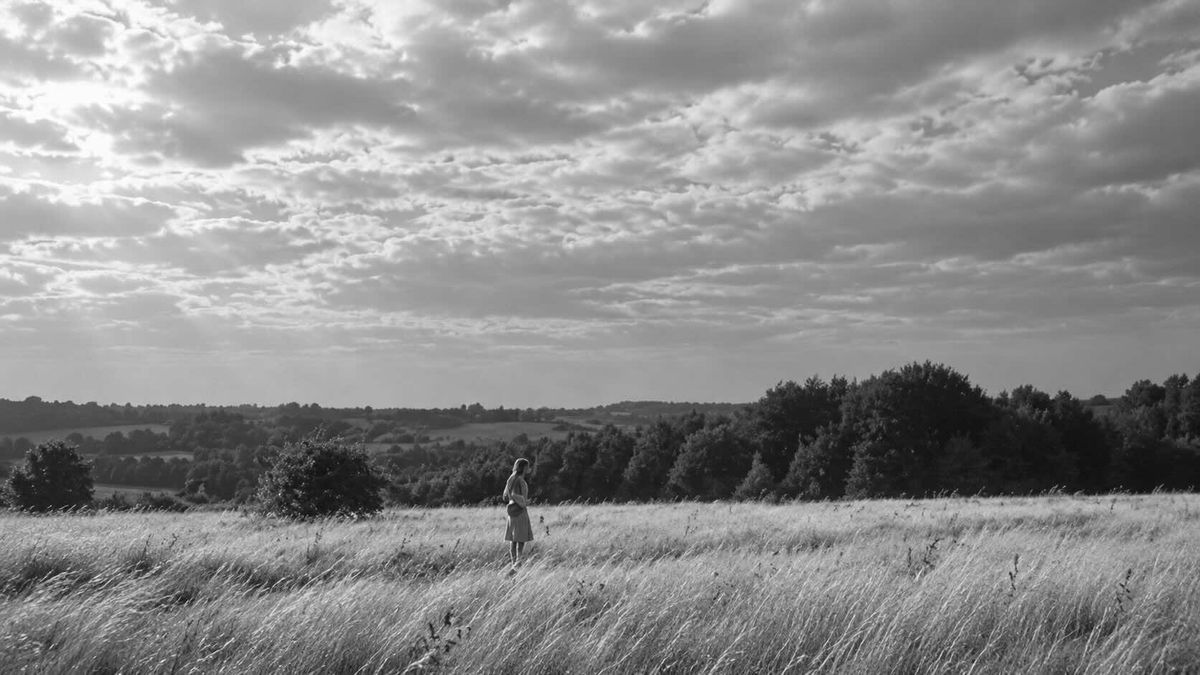
The saddest object in A Canterbury Tale, released in 1944, is a caravan with no tyres. Alison finds it in a Canterbury garage exactly where the war has left it: raised from the ground, its curtains being eaten by moths, the wheels requisitioned.
A room made for travel has survived by becoming unable to move, which is either the saddest thing in the film or just what happens to a caravan nobody drives for five years.
A Canterbury Tale begins with a journey interrupted by error. American sergeant Bob Johnson gets off at the wrong station in the blackout. Alison and Peter are already living lives rerouted by war. Bob's letters have apparently stopped. Alison believes Geoffrey dead. Peter trained for music, settled for the cinema organ, then exchanged even that compromised vocation for uniform. Chillingbourne collects people whose intended routes have broken, though nobody in the village would put it that neatly themselves.
Thomas Colpeper understands this broken movement and exploits it. His attacks with glue are usually treated as the film's eccentric mystery, an ungainly mechanism eventually overtaken by the pastoral passages. They're not that, or not only that — they're more exact, and a little more calculating, than the eccentric-mystery reading gives them credit for. Colpeper puts glue in women's hair so they will stop going out with soldiers; the soldiers, deprived of dates, attend his lectures on the Pilgrims' Way. He manufactures an audience by obstructing somebody else's movement. His antiquarianism has acquired a small technology of arrest, glue being about as unglamorous a technology as history ever produced.
This makes his encounter with Alison's caravan almost cruelly precise. Looking at the wheel-less vehicle, he tells her that everything on wheels must move sooner or later. The sentence describes the law he has spent the film resisting. He wants the old road still audible beneath the modern one, ancestors close enough to be heard around a bend, young soldiers still enough to receive his version of England. Yet the film gives Alison an object in which preservation has become something closer to paralysis — not quite the same thing, but close enough that the difference barely matters to her. The caravan is intact enough to hurt her, and past the point of being any use for what it was actually built to do.
Powell and Pressburger proceed differently. Their most famous gesture comes almost before the story begins: a medieval falcon rises into the sky and, across a cut, becomes a military aircraft. Six centuries are joined by an interruption — which is a strange thing to say about a cut most people just remember as the falcon-into-Spitfire moment and leave it at that.
Continuity exists here because one image is allowed to end.
There is a material coincidence inside that idea. Photochemical editing used film cement to join two severed lengths of motion-picture film. The strips had to be cut before they could be spliced and run again through the projector. Whether Powell and Pressburger consciously intended any relation between that process and Colpeper's glue cannot be established. The resemblance is nevertheless useful because the film keeps testing the same distinction: glue arrests movement, and a splice, cementing two cut ends back together, lets separated pieces carry on — a tidier opposition than the film probably intended, but it's there, sitting in the material history of how these things were physically made.
Even Colpeper's lantern lecture belongs to this argument. His history reaches its audience as still images projected while everyone sits facing forward. The film around him refuses such immobility. Roads turn into railway lines somewhere off past Chillingbourne; hoofbeats give way to engines, unevenly, the way these things actually happen rather than all at once. Canterbury has been bombed so thoroughly that Alison asks directions in streets she once knew. Destruction has altered the city's sightlines, and the old place survives it, more or less, though getting into it now takes a different route than it used to.
The apparent miracles at Canterbury turn out to be fairly practical once you look at them. Bob simply receives letters that had already been travelling toward him the whole time. Alison finds out, late, that news of Geoffrey never reached her — a delay, not a miracle, though it feels like one to her. And Peter goes back to the music his life had pushed aside. Nothing supernatural in any of it, really: just interrupted journeys finally arriving.
Then Alison goes back to the caravan and opens its windows. The moths have already got at the curtains, after however many months of the thing sitting there protected and unused — protected from what, exactly, if not from this. Contemporary accounts and later commentary confirm the caravan’s missing requisitioned tyres, moth damage and Alison’s return to open and air it once she receives news that Geoffrey is alive.
That modest action may contain more of A Canterbury Tale than any of the speeches about pilgrimage manage to. The windows are opened, air gets in, and an object stranded by history becomes habitable again — nothing more dramatic than that, really. Powell and Pressburger's England seems to survive on roughly the same terms: damaged roads, wrong stations, a cut that lets one image end so another can start, letters that arrive late, and whatever gets patched back together once the break has already happened.
A room made for travel survives by becoming unable to move, preserved long enough for moths to begin working on it.
Six centuries meet across a cut: one image ends, another begins, and continuity is made from interruption.
Air enters the stranded caravan again. Preservation gives way, briefly and practically, to use.