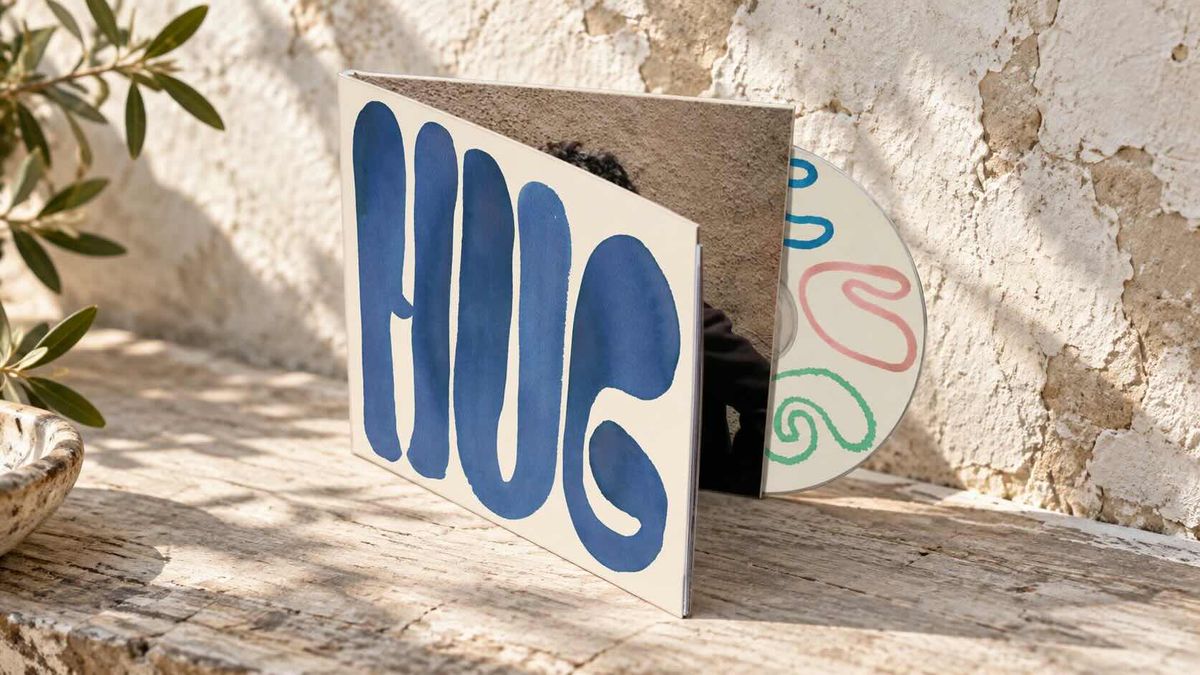
HUG :: HUG
Ambient folk of guitars, rain and frogs, where intimacy opens into distance.

In "Cow With Half Moon Parasol" the harmonics ring close to the ear, small percussion stirs beneath the surface, a kalimba gives the piece a hard, wooden luminosity, and the frogs stay somewhere beyond the instruments. The track has something of a pond watched from up close: dark water, small movements at the surface, minute life.
Devendra Banhart, Gyan Riley and Noah Georgeson recorded the album on their own at Sita Studios; Georgeson mixed it, Philip Shaw Bova mastered it, and all eleven pieces are credited jointly to the trio. Luaka Bop released it on 11 September 2026.
In "Cucullatus' Dream" the movement is so reduced that changes almost stop presenting themselves as events and begin to register as variations in depth. The notes, very slow and sunk in reverb, are touched by sparse interventions of slide guitar. One could speak of an ambient guitar minimalism, though only on condition of hearing the guitar no longer as a lead voice or as the instrument that organises the space. The distinction between instrumental gesture and field recording begins to thin.
"Arunachala" scatters small marks across the ground, environmental music: light figures, barely hierarchical, left to float in the space with no rhythmic push behind them. The title offers a geographic name, and the recording refuses every travel-diary duty that might come with it. Rises and falls of guitar scales barely moved in the air, with that particular melancholy that brings back my memory of July Skies.
Here it becomes space itself: a diffuse material, almost recorded rather than played.
The friendship: Banhart, Riley and Georgeson know each other and have worked together across different stretches of time; Georgeson and Riley go back to childhood, while Banhart and Georgeson carry a long shared history of their own. Riley has recalled being thirteen when he found in Georgeson one of the very few people with whom he could share his obsession with classical guitar; Banhart has described finally playing with Riley and Georgeson as a way of getting something childlike back. Useful background, though the record offers an idea of intimacy more interesting than the biography.
"Sarva Mangalam" is the rare vocal moment on the album. Banhart alternates a Sanskrit blessing with the Spanish words for condensed milk; the singing stays plain, and the accompaniment avoids any religious emphasis. A kind of small altar assembled from things found in the kitchen. The piece carries Banhart's acoustic guitar, electric guitars from both Banhart and Riley, Riley's slide and sonica, Georgeson's bass and percussion, Banhart's kalimba, the voices of all three. After so much instrumental music, the entry of human voices could have been the most direct moment on the record. Instead they sound almost retrieved from somewhere else. Their presence does nothing to shorten the distance.
In "Bathypelagic" the guitar work grows more intricate, several gestures stay legible on their own, crossing one another without having to fuse into a single weave: dense patterns, fingers very present, lines that interlock without turning into display.
"Forgotten Gate" reduces further still. An outside sound can seem less an additional instrumental layer than something that reaches the recording from a nearby field. HUG are particularly good at this slippage. They let sounds arrive without immediately explaining which place they belong to. A track builds its own interior, then a small intrusion quietly changes its apparent scale. The harmonica of Thorleifur Gaukur Davíðsson enters over a faintly mournful accompaniment. The timbre is thin, isolated, close to rust.
With "Near Death Ibiza" figures of classical guitar cross above a minimal low register. You hear the fingers, the articulation, the immediate physical work needed to produce the notes, and yet the composition keeps placing that physicality at a certain distance. The closer the recording comes to touch, the less certain its position becomes.
"Petrichor" can look like a point of contradiction, the guitar turning fast, precise, almost tactile while lighter textures stretch out beyond it. Bursts of near-flamenco playing crossed by finer, brighter figures.
The relation between object and environment recurs often in HUG, even if the record never really abandons the object. The guitars remain guitars. The strings keep their friction. The kalimba holds that opaque resistance of metal fixed to wood.
Which is why calling it simply "ambient", "instrumental", "minimal" or "new age", the labels attached to the Bandcamp release, explains relatively little. The album belongs to a less stable zone, the one where a folk instrument can stay recognisable while ceasing to behave like the centre of a folk song.
“Lippuvuori”: guitars bent in their intonation move over slow waves of vibraphone. For a moment the lines seem to lose their geometry, like branches seen through moving water.
Nothing in HUG ever turns properly threatening; the record is too gentle to go that far. It rarely resorts to friction to assert its differences. Some pieces reveal themselves mostly through placement, through decay, through minimal shifts of timbre. There are moments when the delicacy brushes against mannerism.
"Catatumbo" makes clear why that measure matters.
There is rain in the track, and under it something older. According to the trio, part of "Catatumbo" comes from a loop Banhart and Georgeson made around twenty years earlier in Venice Beach, when the two were living together, and never finished; for HUG it was taken up again rather than left behind as an abandoned fragment. The distance that for the whole album has been spatial suddenly becomes temporal.
By its final minutes HUG has accumulated a good number of possible places without settling in any of them. Arunachala, Ibiza, Lippuvuori, Catatumbo; frogs, rain, strings, voices. The geography has grown progressively less reliable while the touch has grown more precise.
In "Homunculus in the Foliage" the harmonies make the instruments seem temporarily unhooked from the hands producing them.
Nobody's asking, but if a year-end list ever materialises at Hwael Mag, HUG would be contending for the highest places.