Pink Moon: The Meaning Nick Drake Left Behind
Studio austerity, family memory and a record remade by posterity

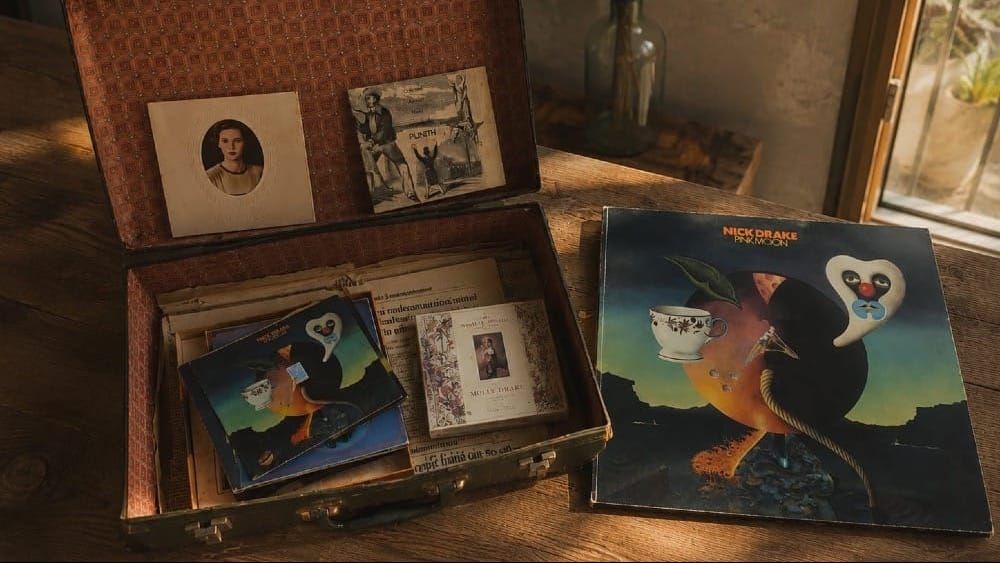
On the nights of 30 and 31 October 1971, a twenty-three-year-old man let himself into Sound Techniques on Old Church Street in Chelsea, sat down with a guitar he had tuned into one of his private open configurations, and recorded an album in roughly two hours across two sittings, with only the engineer John Wood in the room to hear him.
There was no string section waiting in an adjoining booth, no borrowed Fairport Convention rhythm section, no member of the Velvet Underground drafted in to thicken a chord change, as there had been on the two records that came before. There was, for the most part, not even a producer: Joe Boyd, who had signed Nick Drake in 1968 and shepherded Five Leaves Left and Bryter Layter into being, had relocated to Los Angeles that year to direct music for Warner Bros. films, and so the eleven songs that would become Pink Moon were made, in effect, by two men working at night in an empty studio, one of them barely speaking. Fifty-odd years on, the record still generates two kinds of question in search engines, phrased as though they were unrelated: what does it mean, and is it any good. They are, in fact, the same question, asked first in the register of interpretation and then in the register of judgment — and neither can be answered by the two nights at Sound Techniques alone. The meaning of Pink Moon was not sealed in that room. It was assembled afterward, unevenly, by a scattered cast of people who knew Drake, people who didn't, and people who found him decades later by accident: a mother at a piano, a sister keeping watch over an archive, a friend writing a song of warning, an advertising copywriter reaching for the wrong record and finding the right one instead.
I. Two Nights at Sound Techniques
The sessions themselves have accumulated their own folklore, some of it accurate and some of it flattering in ways the facts don't quite support. It is true that Drake arrived at the studio essentially unannounced, that the record was tracked with almost no artifice — voice and acoustic guitar throughout, with a single spare piano overdub laid onto the title track on the second night — and that the whole undertaking cost so little studio time that it barely registered as an event within Island Records. It is not true, however, that Drake delivered the finished tapes to the label's offices and vanished without a word, the version of the story that has circulated as proof of his mounting withdrawal from the world. Island's press officer at the time, David Sandison, later told the Drake fanzine Pynk Moon that Drake's visit had been perfectly ordinary and perfectly noticed: he came upstairs, talked with Sandison for a while as he usually did, and left — only for someone on the front desk to ring up an hour later to say that Nick had left his tapes behind. The myth of the silent, spectral delivery is more useful to the legend than the truth of a young man who simply forgot something in reception, and Hwael Mag would rather keep the duller, more human version, because it says something closer to the record's actual temperature: not a farewell rite, but an errand that got away from him.
That the record sounds so bare was not simply something that happened to Drake in October 1971; he had said as much himself seven months earlier, in the only interview he ever gave. Jerry Gilbert of the weekly Sounds spent an afternoon with him in March that year and found the exchange almost unworkable, recalling long afterward that he didn't think Drake made eye contact with him once across the whole conversation. What did emerge, in fragments, was closer to a plan than a mood: Drake told Gilbert he was already thinking about the next record as something he would make with "just doing something with John Wood, the engineer at Sound Techniques" — no arranger, no session players, no Boyd. The austerity that would read, once the record was out, as a symptom of collapse had in fact been sitting in his head for the better part of a year, arrived at in conversation with his engineer rather than forced on him by circumstance.
Wood, who worked with Drake across all three albums, told much the same story from the other side of the glass, insisting for decades afterward that the received image of a man too depressed to function does not match what he witnessed in the room. Drake, in Wood's account, was focused and quietly proud of what he was making — a claim corroborated by the fact that he was exacting enough to cut a fully realised outtake, a rendition of the eighteenth-century French air "Plaisir d'amour", and mark the tape box with a handwritten instruction: do not use. The recording sat unreleased for over three decades until it surfaced on the 2004 compilation A Treasury, a small, telling fragment of a session usually described only in terms of what it lacked. Drake was not merely emptying himself onto tape in two exhausted nights; he was still making editorial choices, discarding a piece of period elegance that didn't belong beside "Place to Be" and "Know", however beautifully he had sung it.
The album's public reception, when it appeared on Island in February 1972, was thin and ambivalent rather than hostile. Mark Plummer, reviewing it for Melody Maker that April, found himself distracted by the ascetic mysticism already gathering around Drake rather than settled on the songs themselves, writing that music this privately presented "neither does nor doesn't come over." Creem's Colman Andrews, later that year, landed closer to what would become the consensus, calling the record "a triumph of style over sententiousness, of sound over sense" — seductive, in his word, without quite explaining why. Rather less predictably, the biographer Richard Morton Jack turned up a third review while combing archives for his 2023 book Nick Drake: The Life — in Penthouse, of all places, rather than anywhere in the folk or rock press, a detail that fits comfortably into no version of the story, official or mythologised, and is offered here mainly because it refuses to. Island, for its part, spent almost nothing promoting the record beyond a run of print advertisements consisting of the sleeve image alone, no copy, no interview, nothing to anchor a listener's first encounter beyond the object itself. Sales were negligible. For a quarter of a century, that near-silence was as much a part of the record's identity as anything sung on it.
II. The Colour of the Moon
The title itself is borrowed, according to Drake's own explanation to friends, from folklore rather than astronomy in any strict sense — a pink moon being the name given, in the old dictionaries of country lore he read, to the blood-tinged cast a full moon takes on during certain eclipses, an omen rather than a weather report. The song built around that image is barely two minutes long and offers almost nothing in the way of narrative, which has made it exceptionally easy to pour meaning into and correspondingly hard to pin down. Read one way, with the archaic "ye" lending the verses a King James solemnity, it announces catastrophe: something is coming for everyone, "no matter who you are," regardless of how tall you stand against it. Read another way, the same lines describe not doom but a kind of levelling mercy, an acceptance that touches everyone equally and asks nothing of them first. Drake did not resolve the ambiguity in interviews, because he rarely gave any, and the ambiguity has proven durable precisely because his death two and a half years later made the darker reading feel prophetic in retrospect — an interpretive trap that Wood, among Drake's closest working collaborators, spent much of his later life trying to talk people out of, insisting that a record can sound bleak without being a suicide note, and that Drake's state of mind that October was closer to concentration than collapse.
The clinical record, when it finally surfaced, complicates Wood's account without quite contradicting it. A 2025 paper in the journal Human Psychopharmacology, drawing on archival material gathered for Morton Jack's biography — including, for the first time, Rodney Drake's private diaries — reconstructs a course of treatment considerably messier than the single word "depression" usually implies. Admitted to a local psychiatric unit at twenty-three, Drake was assessed by a consultant who suspected simple-type schizophrenia; a social worker attached to the same unit favoured psychotherapy over medication and referred him toward a Laingian therapist connected to R. D. Laing's Philadelphia Association, an appointment he never kept; a regional specialist recommended electroconvulsive therapy, administered once; and a private London consultant, preferring the diagnosis of depressive illness, prescribed a combination of amitriptyline, trifluoperazine, orphenadrine and diazepam. Drake resisted all of it, telling his doctors that taking medication was "against my principles," and in February 1973 — a year after Pink Moon's release and some twenty months before his death — he had already survived one deliberate overdose of thirty-six diazepam tablets, a crisis rarely mentioned in accounts that treat November 1974 as a single, isolated ending rather than the second of two attempts. Nobody, it seems, had told the family that the drug eventually prescribed for his depression could be fatal in a comparatively modest excess; his father, unpersuaded that "depression" was an adequate word for what he was watching, joined the National Schizophrenia Fellowship for support. None of this settles what the record means. If anything it multiplies the plausible readings, since an album made by a man whom three different specialists could not agree on how to treat is not obviously the work of simple despair, or of psychosis, or of an artist coolly choosing austerity for its own sake, and the surviving evidence does not clearly favour any one of the three over the others.
Whatever the song means, the household that produced it is not a mystery, and it deserves more attention than it usually receives in accounts that treat Drake as a self-generated phenomenon. His parents, Rodney and Molly Drake, met in Burma, where Rodney worked as an engineer, and the family settled in 1951 at Far Leys, a Georgian house in Tanworth-in-Arden with a grand piano in the drawing room that Molly used constantly. Both parents wrote songs; Molly's were unpublished, performed only at home, delicate and melancholy things that she sang to her children long before either of them could have called it an influence. It took until 2013 for that material to reach the public, when Cally Callomon — by then the manager of the Drake estate — produced a release of Molly Drake's home recordings, engineered, in a detail that closes a strange loop, by the same John Wood who had recorded her son. Joe Boyd, hearing the results, called the collection "the missing link in the Nick Drake story," and it is difficult to argue with him: the harmonic restlessness and the plainspoken sorrow that critics have spent fifty years attributing to Nick Drake's singular sensibility turn out to have been sitting in the family sitting room the entire time, sung by his mother at the same instrument he would later abandon in favour of guitar. Drake's older sister, Gabrielle Drake, became a professional actor and, after their parents' deaths, the custodian of his estate and reputation — the person who has spent, in her own words, nearly fifty years protecting her brother's legacy, and whose consent underwrites nearly every posthumous release that has appeared since.
Against that domestic backdrop, the arrangement of collaborators around the first two albums looks less like scaffolding and more like a series of relationships Drake chose to withdraw from one at a time. Robert Kirby, a fellow Cambridge student Drake met in January 1968, arranged the strings and woodwind on Five Leaves Left and Bryter Layter with a chamber-pop sensitivity that gave those records their lushness; on Pink Moon, Kirby was not even consulted. Bryter Layter had also brought in members of Fairport Convention, two Beach Boys session players, and John Cale of the Velvet Underground, who arranged and played on "Northern Sky" and "Fly" — a genuinely eclectic cast that made the record sound, at moments, like a party Drake was reluctantly attending. It is Drake's original discovery, though, that explains how any of these people arrived in his orbit at all: in December 1967, playing an unpromising slot at a Vietnam benefit marathon at the Roundhouse, Drake caught the attention of Ashley Hutchings, then Fairport Convention's bass player, who took his number and passed it to Boyd with a one-line recommendation. Boyd rang him, asked for a tape, and later said the resulting four-track demo — recorded in Drake's own college room — "hit me like a sledgehammer." Within months Drake had a management, publishing, and production contract, and within the year he had recorded Five Leaves Left. By the time of Pink Moon, every one of those figures — Kirby, Cale, even Boyd himself — had receded from the picture, leaving only Wood, which is either the logical endpoint of an artist paring his sound down to its essentials or the sound of a support network quietly thinning, and probably both.
One friend outside that professional circle registered the thinning explicitly. John Martyn, an Island labelmate who lived nearby in Hampstead and whom Drake would occasionally babysit for, wrote "Solid Air", the title track of his own 1973 album, as a direct address to Drake — "a mesmerising murmur of empathy, frustration and foreboding," in the words of one later account, composed while Drake was still alive and clearly struggling. Martyn and Drake were near-opposites in temperament, the one gregarious and loud, the other retreating under blankets in company, and by most accounts Martyn never told him outright what the song was about, unsure whether Drake even registered it as being addressed to him. It remains the clearest piece of testimony from someone who watched the isolation documented on Pink Moon happen in real time, and who chose to answer it in song rather than in conversation.
III. What Survived Him
Drake died at Far Leys in the early hours of 25 November 1974, having spent an apparently contented afternoon visiting a friend and returning home to bed early. The inquest on 18 December recorded acute amitriptyline poisoning, self-administered while he was suffering a depressive illness, and returned a verdict of suicide — a finding that his family and friends contested then and have continued to question since, given the absence of any note and a recent trip to France that several people close to him described as one of the better periods he'd had in years. The coroner's own language left room for that doubt: there was, and remains, insufficient evidence to establish intent beyond dispute, which is why serious accounts of his death tend to describe it as unresolved rather than settled. He was twenty-six.
What happened to the music after that split cleanly into two very different timescales, and the earliest part of the slower one was not even conducted in English. In 1979 and 1980, while Island was still assembling the Fruit Tree box set that would gather the three albums together for the first time, a young Danish poet named Gorm Henrik Rasmussen was sitting in the drawing room at Far Leys, interviewing Rodney and Molly Drake for what became, in 1980, the first biography of their son ever written — published only in Danish, built on eight years of correspondence and monthly telephone calls with Rodney that Rasmussen kept up long after the book appeared, and not translated into English until 2009. For nearly three decades, in other words, the fullest account of Nick Drake's life that existed anywhere was one almost none of his English-speaking listeners could read. Island released the odds-and-ends collection Time of No Reply in 1986, and by 1992 the smaller, English-language readership that had formed in the meantime was large enough, and specific enough, to support an entire tribute album, Brittle Days, on the UK label Imaginary — fifteen tracks by acts like the Changelings, the High Llamas, Loop, and Clive Gregson, each interpreting a different corner of the catalogue years before anyone outside that circle had heard of Nick Drake at all. Then, in December 1999, an American advertising agency working on a Volkswagen Cabrio spot needed a piece of music for a commercial they had already named "Milky Way," built around footage of young people driving at night under the stars. Their first choice, the Church's "Under the Milky Way," fell through, and the replacement arrived almost by chance: someone on the account brought "Pink Moon" in from a personal record collection at the last minute, and it was used instead. The effect on Drake's sales was immediate and, by the standards of a dead cult artist with three commercially unsuccessful albums, extraordinary — UK sales of the record rose nearly fivefold in the first ten weeks of 2000 alone, and annual sales in the United States climbed, according to reporting in the New York Times, from roughly six thousand copies a year to more than seventy-four thousand, with CDs eventually stickered "as featured in the VW ad" to catch buyers who knew the song before they knew the name attached to it. It is a strange, slightly humbling detail that the largest single act of rediscovery in Drake's afterlife came from an advertising copywriter reaching past the record he meant to use, rather than from any critic, biographer, or musician.
The pattern repeated itself, independently, in a country that had barely registered him the first time round. Nick Drake meant almost nothing in France until October 2007, when the French Red Cross launched a television campaign — the supermodel Adriana Karembeu, in the charity's uniform, collecting donations at a red light, under the slogan "Sans vous, comment ferions-nous?" ("Without you, how would we manage?") — scored with "Place to Be", from the same record, rather than with "Pink Moon" itself. A year later Henry Chartier published Nick Drake: l'abécédaire, the first book on Drake ever written in French, and by most accounts the country's introduction to him. Two advertisements, on two continents, eight years apart, selling two entirely different things — a convertible car, a blood donation — had each done more to install Drake in the public ear of their respective markets than three decades of critical advocacy managed on either side of the Channel.
Other chance encounters followed a similar pattern of arriving from outside the usual channels of music criticism. The Dutch director Jeroen Berkvens made the earliest of the two English-language documentaries, A Skin Too Few: The Days of Nick Drake, in 2002, weaving interviews with Molly Drake, Gabrielle Drake, Wood, and others who had known him into a quiet, landscape-heavy portrait for VPRO television; two years later, BBC Radio 2 produced Lost Boy: In Search of Nick Drake and brought in a narrator who was, by his own account, simply a fan of the records: the actor Brad Pitt. Stewardship of the catalogue since has fallen to Cally Callomon, a former Island A&R man and sleeve designer who now runs Bryter Music on Gabrielle Drake's behalf, and who has described his job in frankly ambivalent terms — caught, as he put it, between fans demanding that everything in the archive be released and fans insisting that nothing Drake didn't personally sanction should ever see daylight. The publishing rights eventually moved to Blue Raincoat, and a companion book co-edited by Gabrielle Drake and Callomon was, for a decade, the closest thing to an authorised account of a man who left remarkably little in the way of interviews or explanation. That changed in 2023, when Richard Morton Jack's Nick Drake: The Life became the first biography made with the full cooperation of the family and the estate, built in part on Rodney Drake's private diaries — the same paper trail a Danish poet had once tried to reach by telephone, one monthly call at a time.
The musical inheritance has proven harder to police than the archive, because it travelled by ear rather than by contract. Elliott Smith's hushed, close-mic'd confessional folk owes an audible debt to the record; Beck built both Sea Change and Morning Phase around a similar palette of unadorned acoustic melancholy; Peter Buck of R.E.M. has named Drake among his formative influences, alongside figures as varied as Jeff Buckley and Robert Smith of the Cure. None of them needed the Volkswagen advertisement to find him — most had discovered Pink Moon through exactly the kind of word-of-mouth, secondhand-record-shop circulation that sustained his reputation through the years when Island's own marketing department had given up on him — but the ad is what handed the same record to everyone else at once, converting a private discovery into a shared one almost overnight.
None of this — the mother's piano at Far Leys, the sister's fifty years of custodianship, Martyn's unspoken tribute, the copywriter's last-minute substitution, the actor reading a script for a radio documentary about a man he never met — was contained in the two hours of tape John Wood carried out of Sound Techniques in October 1971. Drake made the record; he did not make its meaning, which kept accumulating for decades after he was no longer there to have an opinion about it, assembled by people who loved him, people who were paid to notice him, and people who simply happened to be in the room, or the studio, or the advertising agency, at the right moment. "Pink Moon" promises, in its two minutes, that something will find everyone eventually, regardless of how tall they stand against it. It turned out, in the end, to be true of the song itself.
The Sons of Pink Moon: Who Inherited Nick Drake's Hush
No Place to Be: The Hidden Geography of Nick Drake’s Pink Moon
Further Reading & Sources
Sources: Nick Drake, Pink Moon (Island Records, 1972); Jerry Gilbert’s 1971 Sounds interview; John Wood and David Sandison recollections; contemporary reviews in Melody Maker, Creem and other music press; John Martyn, “Solid Air”; coroner’s and family documentation; Gorm Henrik Rasmussen, Pink Moon; Volkswagen/Arnold Worldwide “Milky Way” campaign material. Secondary sources include Joe Boyd, White Bicycles; Patrick Humphries, Nick Drake: The Biography; Trevor Dann, Darker Than the Deepest Sea; Richard Morton Jack, Nick Drake: The Life; Gabrielle Drake and Cally Callomon, Nick Drake: Remembered for a While; David S. Baldwin on Drake’s psychiatric treatment; Jeroen Berkvens, A Skin Too Few; BBC’s Lost Boy; Henry Chartier, Nick Drake: l’abécédaire; and selected studies on posthumous reputation, archive stewardship and musical afterlife.
Editorial Note
This essay separates Pink Moon itself from the mythology created after Nick Drake’s death. Session testimony, the surviving clinical record and later interpretations are treated as distinct forms of evidence. Drake’s illness remains part of the history, while disputed accounts of the 1971 sessions are kept separate from John Wood’s description of deliberate musical reduction and exactitude. The album’s later meaning is also distinguished from its authorship: family, biographers, broadcasters, filmmakers and advertising shaped its afterlife rather than its original composition.
Last revised: July 2026