Nick Drake :: Pink Moon
Fingerstyle folk, open tunings, close vocals and radical subtraction

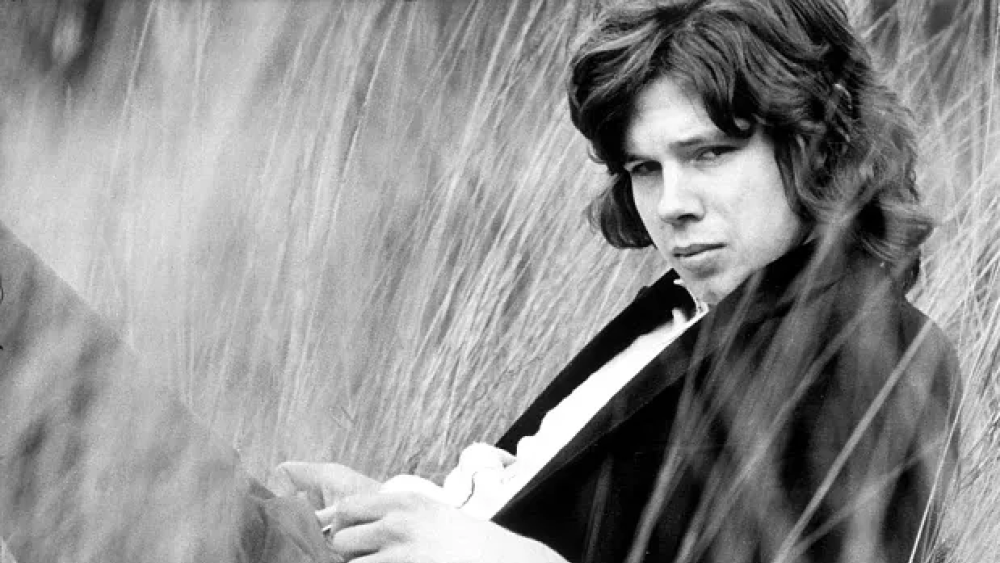
Time becomes something to listen to, and being alive no longer requires ornament.
When Pink Moon appeared in February 1972 it passed almost unnoticed. Too quiet for a loud era, Nick Drake offered no defence of it — no interviews, no promotion, no attempt to carry it into the world. There was nothing to add. The record runs barely twenty-eight minutes, recorded across two late-night sessions with the engineer John Wood, the only other person in the room: voice, acoustic guitar, and almost no production at all.
After the fuller arrangements of Bryter Layter, this feels like an existential choice before it feels like an aesthetic one — subtraction. Not only the strings and the ornament removed, but the mediation itself: the distance usually set between songwriter and listener. What is left is an exposed surface, though "sparse" or "minimal" undersells the gesture; it feels closer to a relinquishing of control, a deliberate surrender.
The proof is the album's single exception. Across the record there is exactly one overdub — a lone piano figure on the title track, played by Drake himself — and it is the most famous moment he ever recorded. Everything the album takes away is measured against the one thing it allowed back in. Subtraction here is not an absence; it is a decision, made audible by its only counter-example.
And to reduce Pink Moon to a document of depression misses what actually lingers. The isolation is real, and a quiet sense of distance moves through the whole record — but what stays with you is the absence of drama. Drake never raises his voice, never climbs toward a climax; everything holds low, restrained, close to meditative. Past and present fold into one another, and the songs move the way time moves on a solitary walk: the words appear and vanish in the same instant, thoughts overheard rather than declared. Nature fills the album without ever turning comforting — trees, moonlight, seasons, empty roads act as interior coordinates rather than scenery.
Nothing is performed; everything is simply exposed.
Those who knew him then tell of Drake driving for hours without a destination, as though motion were the only way not to be trapped inside something immobile. Pink Moon carries exactly that: it is not a static record, even in its stillness. Beneath the surface, everything keeps moving.
And the movement is in the hands. Drake finds depth through microscopic shifts in touch and pressure; the timbre changes from note to note; his open tunings set adjacent strings ringing against each other, producing the suspended unease that runs under the whole album. The recording sits close enough to catch the faint sound of fingers arriving a fraction before each note, so that technique itself becomes emotional texture. The irregular fingerpicking is structural, the chord cycles rarely resolving — the same hypnotic, pastoral suspension — and the voice, soft and impossibly close, never tries to lead the music. It simply stays inside the sound.
Too uninterested in being a product to sell as one, Pink Moon found its listeners only later, becoming a touchstone for the stripped-back folk of the nineties and for much of today's introspective songwriting. What it left behind is a proof that has not aged: that a life, and a record, can subtract almost everything and still be whole — everything except one note of piano, kept because it was true.
Pink Moon: The Meaning Nick Drake Left Behind
The Sons of Pink Moon: Who Inherited Nick Drake's Hush
No Place to Be: The Hidden Geography of Nick Drake’s Pink Moon