No Place to Be: The Hidden Geography of Nick Drake’s Pink Moon
Reading Nick Drake’s Pink Moon as a map, away from the biography that followed
Recorded almost entirely alone with the engineer John Wood at Sound Techniques in London, Pink Moon appeared in February 1972 as Nick Drake's third album. What its words mean has usually been decided by something that happened more than three years after they were written.
Its eleven pieces occupy less than half an hour, and ten of them contain words. Drake died at Far Leys, his parents' house in Tanworth-in-Arden, in November 1974, and since then it has been extraordinarily difficult to hear the record without letting that room and that morning travel backwards into it. The title becomes a warning, the ground a grave, the weakening body a diagnosis, and every fall anticipates another. It is an understandable way to listen, and it may have concealed the album.
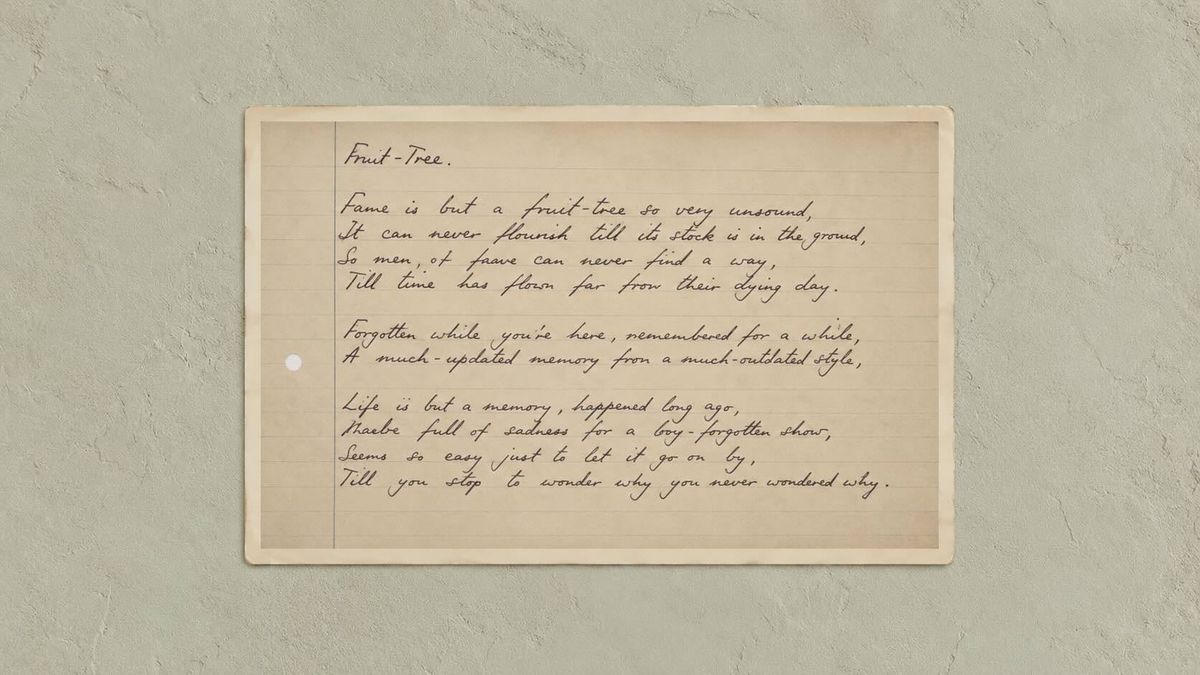
There is a peculiar verb at the start. What Drake sees is something written, so the moon enters the record as an announcement already circulating in language. Something has been inscribed, something is coming, and human height will offer no protection. The archaic "ye" pushes the little song further from ordinary speech, and it can sound biblical, proverbial, balladic, even faintly comic. Drake seldom explained his songs. Cally Callomon, who manages Bryter Music on behalf of the estate, has said that he placed unusual value on the listener's interpretation and deliberately left gaps and ill-defined areas.
A remarkably stable reading has formed in those gaps all the same. English-language criticism has repeatedly heard the pink moon as catastrophe or death, Russian and Chinese accounts say the same, and a Korean translation takes it as the destiny of mortality. The longer history of how that meaning accumulated is traced in Pink Moon: The Meaning Nick Drake Left Behind. No surviving statement from Drake establishes the equation, and the often repeated claim that a pink moon is by nature a baleful phenomenon is less secure than its repetition suggests. The song itself gives us something simpler: an event approaches from above, and nobody is tall enough to escape it.
I. A record full of coordinates
Listen without beginning from biography and another vocabulary becomes conspicuous: hill, sun, sea, door, stars, road, ground, floor, Northern Line, steeple, moon, dirt, flowers, morning. None of these words is rare, but they accumulate. Drake keeps locating consciousness by giving it something above, beneath, beyond or around it, and the songs keep asking where a person stands.
In "Place to Be", youth is remembered through a green hill and sustained sunlight, and age brings darker water, weakness and a need to be given somewhere to exist. The emotional condition has dimensions.
Even truth possesses a location. It hangs at a door.
Bent Sørensen, in a scholarly study of Drake's lyrics and existential depression, takes the truth hanging at a door in that song towards the Hanged Man of the Tarot and folds it into a larger mortuary reading. It is ingenious, and there is no evidence Drake intended it. The ordinary object is the one that gets passed over. A door is a division made architectural, with one side and another, and before the album has travelled very far, knowing has become a matter of where one stands in relation to a threshold.
"Road" extends the problem horizontally. Someone else has access to sun and stars, and Drake's speaker asks for a road adequate to carry him through, a surprisingly modest ambition. Robert Kirby remembered Drake as capable of much happier periods than the later mythology permits, and Callomon has called "Road" a pragmatic, life-affirming song. Its virtue may simply be that it continues.
II. The grammar of choosing
"Which Will" removes most of the landscape and leaves a run of alternatives, which one, which love, which call, and the song's essential word is "which". Another person's selection determines the speaker's remaining position. Then comes "Horn", with no words at all, placed just where a question has been asked repeatedly. It needs no programme to do its work there.
When speech returns in "Things Behind the Sun", Drake produces perhaps the album's densest map: people looking down, the ground, people living on the floor, flight, sun, star, rain, autumn, farmers. Readings of it usually concentrate on its warning against conformity, yet the argument is made through altitude, with the addressee who may learn to fly and the star that stays overhead. Drake distrusts the people who stare and turns observation back on them, since to see differently is to risk occupying a different level from the crowd. Whatever the things behind the sun are, staring at the most visible object in the sky will not reveal them.
III. Underground
Then the album enters London. One piece of the geography of "Parasite" can be placed on an actual transport map, the Northern Line, with stairs leading towards it, station light, polished shoes, a church steeple. Drake's verb for going downstairs gives the movement the character of navigation: he sails downward. The record has travelled from a moon and stars to a subterranean railway.
A parasite belongs to its host and is foreign to it, living inside a system that remains someone else's. Drake's figure stands towards the town in much the same way. He can circulate through its infrastructure and watch its shoes, bars and churches, and he cannot establish a place within it. The songs have wondered where a person might stand in relation to a lover, a road, a truth, and here the question goes to the modern city. What the lyric describes is a failed habitation.
IV. The floor before the grave
Once Drake's death is known, downward movement becomes almost impossible to regard innocently. Sørensen's study is sophisticated and still moves towards existential depression and death; popular criticism goes further and treats the album as approaching an ending already known to the listener, and knowledge of his death encourages people to discover premonitions everywhere.
Suppose that on this record a floor remains a floor, and ground, dirt and flowers stay what they are. The album grows stranger, though hardly happier, and the downward movement starts to resemble contact with matter. "Harvest Breed" is the place to test this. The title is odd English. Harvest names a gathering-in, a season and what that season yields, breed can mean kind, lineage and generation, and Drake sets them side by side without settling their grammar. The lyric brings the body down towards earth and flowers. It is the penultimate song, and "From the Morning" comes straight after it, a sequence that deserves more attention than it usually gets.
V. A calendar hidden in the record
The title already belongs to a calendar. In the seasonal names of the eastern United States a pink moon is April's full moon, called after the early flowering of Phlox subulata, the low wildflower sometimes known as moss pink. The colour belongs to the ground, in a piece of folk timekeeping that dates the sky by what happens beneath it. There is no evidence Drake knew this. He was an English songwriter, and the phrase may have reached him already detached from its origin, which limits any claim about intention and leaves the root where it was.
Another structure may cross the vertical one: moon, sun, flowers, rain, autumn, farmers, harvest, ground, morning. No known notebook of Drake's diagrams the album as a seasonal cycle, though works can acquire structures their makers never set down. It would mean the record holds two kinds of time. In human time people choose, affection grows uncertain, cities fail to confer belonging and routes have to be found. Natural time keeps another rhythm, in which rain comes, autumn comes, harvest comes and morning comes, and it maintains processes that neither console Drake nor require him. The landscape stops working as a projection of his psychology and acquires a chronology of its own.
VI. What rises
Everything depends on the final song. "From the Morning" begins with a day emerging from the ground, lets night fall, and later reverses the album's dominant movement, as a collective voice rises from the ground and is dispersed everywhere. Part of this passage later became Drake's epitaph, and a grave inscription chosen after a death cannot safely tell us what a lyric meant before it. In 1971 the sentence was still a lyric.
Inside the album it does a great deal of work. The problem that dominated the record was singular, where can I stand, and the answer arrives as "we".
Callomon, responsible for the estate and with no critic's stake in redeeming a tragic ending, hears hope, warmth and joy in the song, qualities he says are too rarely attributed to Drake. A Japanese writer hears the last track as hopeful too and notices how its ending moves back into "Pink Moon", making the record cyclical. Neither observation proves the architecture proposed here, though they make it less lonely.
VII. The pink moon after Nick Drake
There is nothing foolish about hearing menace in the title song, because the menace is audible. The trouble starts when the impression is converted into evidence. Drake left very little commentary, those responsible for his work stress his reluctance to close meanings down, and Kirby cautioned against turning him into a permanent patron saint of depression. That later image travelled far beyond Drake himself, and its musical inheritance, the close voice, acoustic space and idea of solitude, is followed separately in The Sons of Pink Moon: Who Inherited Nick Drake's Hush.
Pink Moon clearly contains isolation, exhaustion, damaged attachment and extraordinarily severe forms of self-regard. The useful question is whether depression exhausts what its landscapes are doing. I do not think it does.
Last revised: September 2026