A Name Under the Record
An essay on attention, editorial risk and the human work of discovery.

At the foot of a Bandcamp page, below the tracklist, the credits and the price in whatever currency the label chose, runs a strip of small square portraits under the words supported by. Nearly all of them belong to listeners. On certain records, lately, one belongs to a magazine.
The instructions on The Tonearm's contact page are mostly the ordinary hygiene of a small editorial operation. Music goes to needledrop@thetonearm.com. Attachments are deleted on arrival, unheard. A reply is possible rather than promised, and the editors ask senders in advance to take the silence gracefully. Then comes a stranger request: if you are sending music, they would love a Bandcamp download code. Not a deal-breaker, the page says, only a good way to send a record, because if the magazine ends up covering it, the purchase surfaces in the release's supported by section, among the listeners who paid.
A few lines of administrative prose, and they carry most of what this essay wants to argue. A publication that acquires the record the way a listener acquires it, and accepts a visible trace of the acquisition in the margin of the object itself, is reviving a habit older than any of the interfaces involved: the habit of signing for one's choices.
The condition it works in has become familiar to the point of invisibility. Anyone with a connection can summon, before breakfast, more music than a provincial record shop once held in its entire stock; Bandcamp opens another shelf at every refresh, YouTube remembers the cassette somebody digitised eleven years ago, Discogs will identify the pressing and the matrix number. The material problem that organised a century of listening, how to get hold of the thing, has thinned almost to nothing. What thickened in its place is a problem of expenditure: which sliver of the flood deserves an hour of a finite life, and, harder still, who will answer for the recommendation.
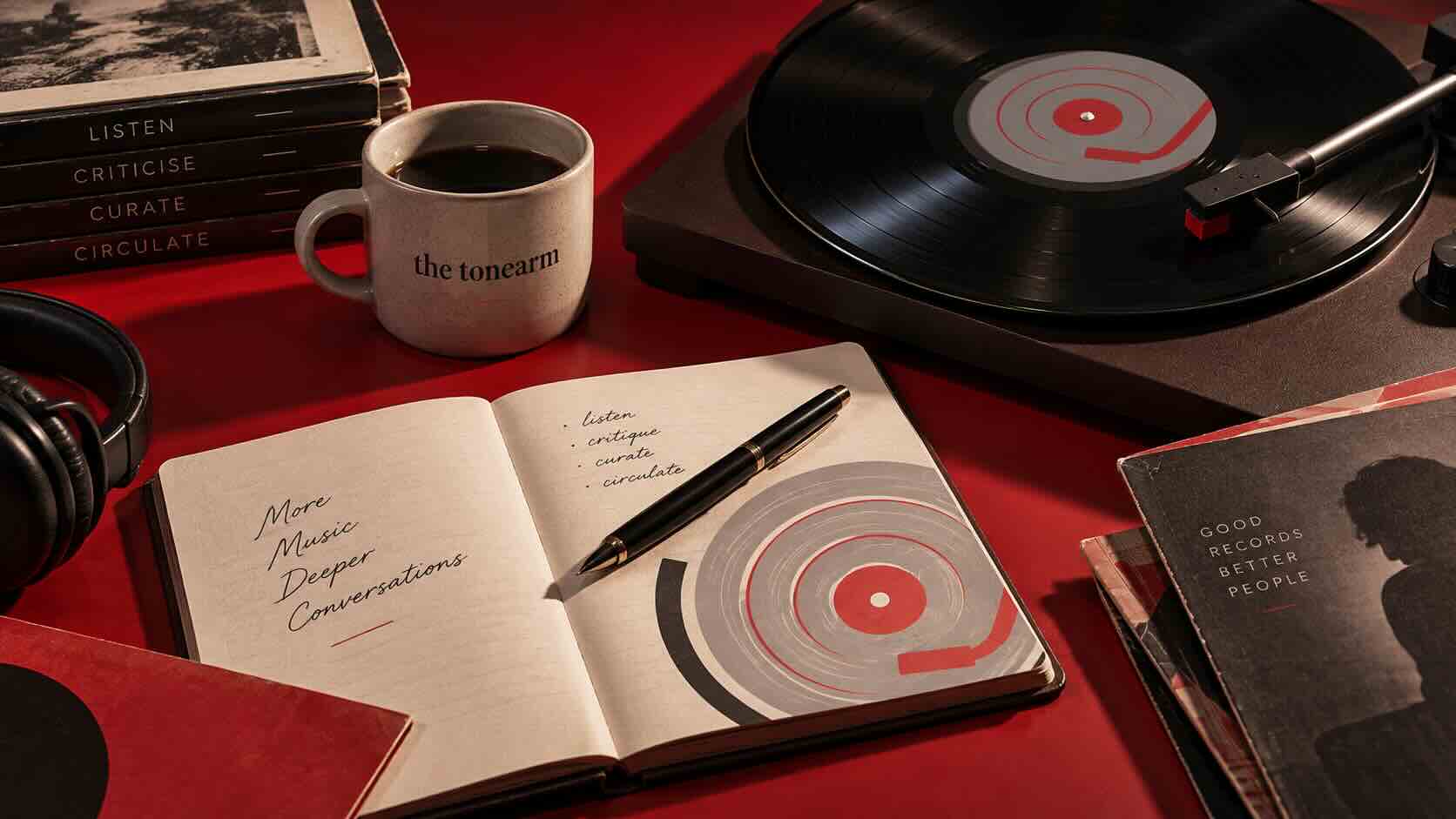
The Tonearm, the American online magazine and podcast co-published by the music-industry veteran Lawrence Peryer, has been building itself on that second question since taking its present name. Its promise of "zero-algorithmic discovery" would hardly distinguish it on its own; distrust of the algorithm has become a genre of promotional speech, available to record shops, newsletter writers and, in their gentler moods, the streaming platforms themselves. The distinguishing part sits lower down, where the rhetoric turns into money spent, and the money spent leaves a signature.
I. The long tail, twenty years on
In October 2004 Chris Anderson gave Wired the essay that became The Long Tail, an intoxicating account of what digital abundance would do for niche culture. Once shelf space stopped being scarce, everything could remain perpetually available, and the aggregated demand for thousands of minor works might come to rival the hits. The availability arrived beyond argument. Circulation was supposed to follow it, and this is where The Tonearm's founding diagnosis begins: musicians working outside the larger channels remained poorly served by online journalism and streaming discovery even as their records became technically reachable by anyone alive. A record present in a database has satisfied the logistics of access and nothing more. Between existence and circulation stands a question no database can ask on its own behalf, which is why anyone should spend an evening with this particular thing.
Search requires a prior term. Recommendation systems solved that by supplying the terms for us, out of listening history, behavioural resemblance and statistical adjacency, and their usefulness is real; so is their tendency to make the musical world feel larger while trimming away certain kinds of distance. The magazine's answer to abundance involves no fantasy of mastering it. Its front page in September 2026 moves from Peryer's conversation with David Katz, whose new book re-cuts the history of dub through its engineers and studios, to Dave Segal on the electroacoustic illusionist Robert Aiki Aubrey Lowe, to Bill Cooper on the pianist Sova, who leaves the creaks of the upright audible in the takes, to Carolyn Zaldivar Snow on Windy & Carl recording with Optigan Conservatory, to MuMu's family album. A reader expecting a genre will find the connective tissue weak, and the weakness looks deliberate. The house phrase is "unexpected music and culture"; the about page celebrates "the beautiful unpredictability that happens when human curiosity guides discovery instead of data-driven probability".
Unexpectedness could harden into a style of its own, one more procession of approved obscurities, since independent criticism runs its own dull prestige economy in which the rarer record automatically outranks the familiar one. The archive complicates the suspicion. Bob Ezrin has sat for the podcast; so have producers, jazz elders and figures with long industry lives, sharing the page with self-released drone. What the editorial method actually refuses is something narrower and more interesting: it declines to accept existing visibility, in either direction, as the first measure of worth.
II. The signal path of money
Someone has to pay a writer to spend several days with a musician whose name may produce almost no traffic. Someone decides that a record deserves two thousand words before knowing whether two hundred people will read them. The decision is small enough to miss, and it is the entire hinge on which a publication like this turns, because every serious piece of music writing consumes a resource that cannot be duplicated, a writer's hours, long before the finished article exists to earn anything back.
The Tonearm has made the underlying arithmetic unusually visible. Its support page declares no advertisers, no investors, no paywall. "Everything on this site is free," it says. "That's the point." The stated aim is to "keep the lights on, pay our writers fairly, and grow (not scale!) with time". Scale is the word through which internet businesses learned to treat human activity as a technical problem: a system scales when output can rise faster than the friction of producing it, which is why automation courts every trade whose hours refuse to be copied. Music criticism is nearly all friction. Listening happens in real time, transcription eats afternoons, and the knowledge that lets an interviewer ask one precise question about a 1974 session took a couple of decades to acquire. The refused word amounts to a refusal of the whole dream.
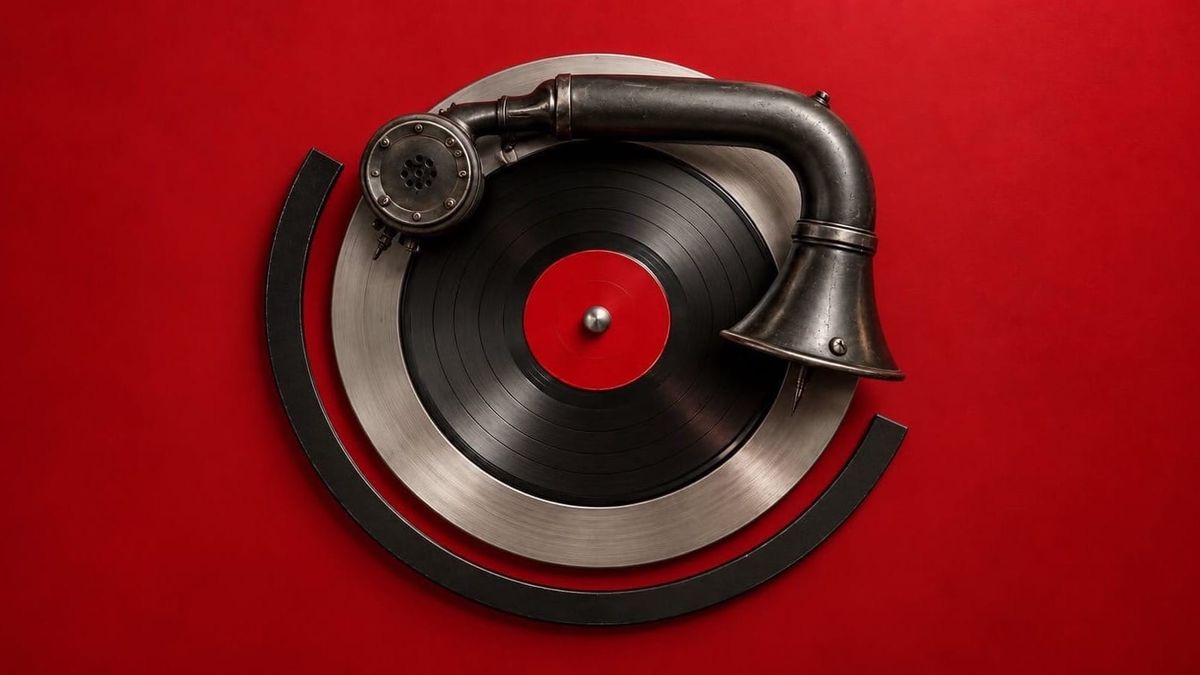
The membership tiers reward a closer look than pricing tables usually deserve. The free tier is called The Groove and includes everything the magazine publishes, together with the Sunday newsletter. Ten dollars a month buys The Stylus, a hundred buys The Cartridge, and neither unlocks a single article withheld from anyone else; the upper tiers offer proximity instead, quarterly video happy hours, surprises in the post, small-group conversations with the editors, a permanent name on the supporters page. Read in sequence, groove, stylus, cartridge, tonearm, the money has been named after the pickup chain of a turntable, the series of parts that carries vibration from vinyl to amplifier, with the paying reader installed as a stage in the signal path. And the arm that names the whole enterprise is, on any turntable, the calibrated component: it holds the stylus in the groove at a tracking force measured in single grams, enough weight to stay in contact with the surface, little enough to spare the record.
The model itself is old, and the site says as much. Eighteenth-century publishing called it subscription; Pope's Iliad reached print because a few hundred readers paid in advance, and their names were then printed inside the volumes they had made possible. Public libraries and listener-supported radio have run on versions of the arrangement for generations: the contribution finances the institution's continued existence, since the article a reader happens to open was never the thing priced. The Bandcamp margin completes the circuit by reversing the old courtesy. Where the subscriber's name once stood at the front of the financed book, here the publication's name settles quietly under the artist's work.
Availability solved the wrong scarcity.
A record can exist everywhere and still circulate almost nowhere. Search solves access; human attention decides what travels.
Databases, platforms and search engines remove much of the old logistical difficulty. Knowing that something exists is no longer the achievement it once was.
A searchable entry exists. No commitment has yet occurred.
None of this confers immunity. Underwriters have interests, supporters can vanish, and a community of readers will reward familiar values as reliably as an algorithm rewards familiar behaviour; independence is maintenance, a condition serviced daily rather than certified once by deleting the ad server. The architecture still matters. A magazine financed by attention sold to advertisers has a structural reason to seek predictable attention. This one has arranged its finances so that attention can, at least in principle, be spent on the unpredictable.
III. Attention before demand
Across most of the network, measurable relevance precedes editorial investment. An artist begins to move, numbers accumulate, a release develops velocity, and coverage follows the graph. The Tonearm tests the reversal, often enough for it to constitute a method: attention granted before relevance has been established by the market. Call it editorial expenditure without prior demand. Under that arrangement obscurity stops functioning as a verdict and becomes a mere starting condition, the state in which most music, including most good music, happens to exist.
The recent archive shows what the wager buys. A profile of Zeena Parkins follows the electric harp she has been building and revising by hand for decades. A conversation with the engineer Martin Bisi treats the recording studio as a biography. These are stories with audiences; they are stories whose audiences cannot be known in advance, and that uncertainty is precisely what the commission absorbs. The bravery involved is of an unglamorous kind. Nobody gets arrested for interviewing an experimental harpist. The risk is mundane, wasted hours, modest traffic, a subject that declines to become topical, and it is exactly the kind of waste cultural ecosystems have always required. A library keeps books nobody borrows this month. A label keeps a recording in print past the week its release counts as news. A critic follows a musician before the musician has supplied any evidence that the attention will be repaid. All of it reads as loss under the accounting of immediate demand, and all of it is the redundancy a culture draws on later, in seasons nobody bothered to imagine.
Human recommendation, meanwhile, carries biography, prejudice, fatigue, fascination, private knowledge and accident. Recommendation engineering has spent twenty years treating those as defects to be filtered out. Here they are load-bearing. The next article may concern a form of music the reader has spent a lifetime avoiding, chosen by a person whose taste may simply be peculiar, and the proposition survives because a human curator can do the one thing the pattern-matcher cannot: give reasons for violating the pattern. The anomaly becomes the opening paragraph.
Attention behaves like tape. It is material, it degrades, it does not copy without loss.
IV. Tape time
One recent piece condenses the whole project. "From Dub to Dust — Billy Polo at the VP Records Vault" follows an engineer through one of reggae's great tape archives, and much of its subject is the magnetic tape itself: reels shedding oxide, binders drinking humidity, restoration as slow triage, the thinning generation of people who still know how to handle the medium at all. Read against the magazine's economics, the piece starts to resemble a self-portrait. Its survival depends on a small number of people paid to keep their hands on it.
The publication's own history runs on the slower clock it writes about. The podcast began in February 2020 under the name Spotlight On and had passed three hundred episodes before the print operation took the Tonearm name; by late September 2026 the feed stands at episode 323, with Bob Ezrin, David Katz, Azar Lawrence and Martin Bisi among recent guests. Conversation preceded the magazine, which explains why the interview, and its patience with how work actually gets made, feels like the native form here, with the review arriving as a guest. Peryer's professional past sits close to the machinery of the industry, so the old adversarial fantasy of the critic, purity on one side and commerce on the other, was never available to begin with; the arrangement is entangled and says so, which is a more honest starting point than the theatre of distance the trade press maintained for decades while running label advertisements beside its reviews.
What the entanglement has to keep earning is the right to refuse. A magazine that understands itself as infrastructure for independent music must still be able to say that a record does not work, and admiration for the ecosystem cannot be allowed to insulate the objects inside it. The tension has no clean resolution, and the magazine is most interesting exactly where it stays unresolved. Meanwhile the interviews keep doing quieter structural work: a musician who has spent thirty years revising an instrument carries time differently from a release cycle, and letting that temporality into the article frees criticism from the calendar of announcement, single, premiere, review and disappearance, a rhythm invented for shipping schedules and inherited by writing as though it were a natural form. Recommendation ends the moment it succeeds, one more adjacent thing supplied. What a magazine like this practices is closer to mediation, which lengthens the approach, so that by the time the sound arrives it lands in a field already occupied by a person, an archive, a disagreement, a technique. Efficiency culture files the detour under friction. The detour is the criticism.
V. A name under the record
The deepest convenience the algorithm ever offered was never speed. It was the removal of responsibility from cultural selection. A recommendation arrives with its authorship dissolved into the aggregate, and there is nobody to argue with, nobody who owes an account of why this and why now. Editorial culture requires the accountable sentence, I chose this, and here is why, together with everything the sentence exposes: the choice may be poor, the taste provincial, the blind spots real.
The Tonearm should be examined by exactly those standards as its archive grows. Which geographies recur. Which kinds of musician remain absent. How often "independent" names a material condition and how often only an aesthetic. Who can afford to stay visible long enough for human curiosity to reach them, and which letters to the needledrop address never get an answer. Such questions have force precisely because there is a model to question: the contributor page can be read, the archive can be searched, the interests accumulate in public, and the bias, unlike a recommender's, acquires a shape someone can point to.
There is no shortage of sound, and there may never be again. What grows scarce in such a landscape is a person willing to stop, choose one object from the flood, and remain beside it long enough for a second person to see why it was chosen. The contact page is candid about how much of this choosing stays invisible: most of what arrives goes uncovered, and a reply is nobody's right. What the chosen records receive is modest and oddly durable, a few thousand attentive words, and, where a code was enclosed, that small square in the Bandcamp margin, legible for as long as the page stays up, showing that a magazine was here, listening, and left its name.
Last revised: September 2026