morimoto naoki :: Kou
Minimal ambient shaped by light, repetition and everyday detail.

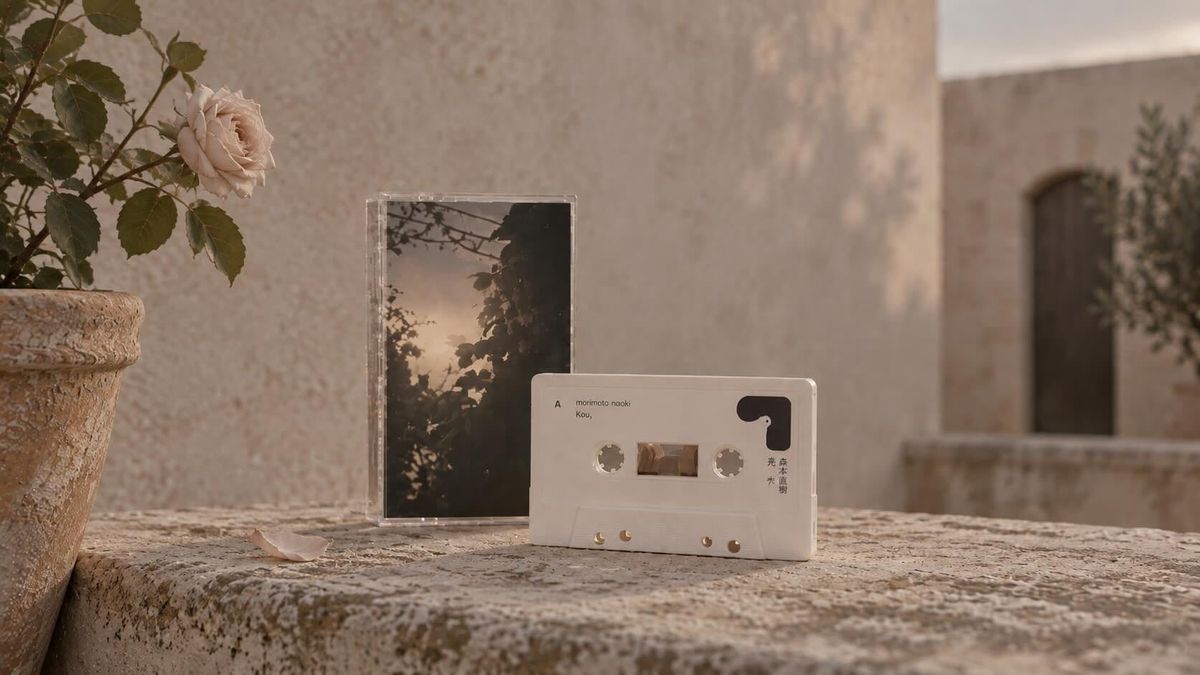
Kou begins with almost nothing in the room: a few tones, a little air, light changing on a surface.
Morimoto Naoki has spent years working near a precise threshold: the point where a sound stops behaving like an instrument and starts resembling something that simply happened. Kou, Japanese for "light", states its programme with a sobriety worth taking seriously; the accompanying note describes an illumination that has nothing of the spotlight trained on the extraordinary, a gentle, sunlike warmth wrapping everything equally, until the ordinary shows it can be precious without being exceptional. It reads like label poetics and is in fact an accurate description of a recording problem. The tracklist works as a small optical lexicon, Halo, Photon, Kageboshi, the last naming the shadow-silhouette a body casts, so that even shadow becomes a phenomenon of light. The electronic tones enter without emphasis, like someone stepping into a house where somebody is sleeping; they repeat, thin out, disclose small irregularities over time, the way flaws in plaster surface. Around them, sounds of a different physical grain: plucked strings whose irregular decay carries a kind of information, finger, string, resonant wood, that a sustained electronic tone is constitutionally unable to give.
Morimoto treats sound as a handleable everyday object. His self-description as a maker of "toytronica", with its childlike echo, already declares the idea, and the discography documents it with rare consistency: Kuuhaku (Inner Ocean, 2021) set guitar, toy xylophones and small bells inside carefully measured rhythmic surroundings; kuukan no oto put the very title at the service of his central obsession, the sound of a space; the album made with the Korean roaster Ahwon Coffee turned the roasting machine, the crackling beans and the packaging line into source material, the ordinary read as a score. Kou sharpens all this into a method: the organic element interrupts the smoothness of the electronic field, bringing friction, weight, gravity.
Noray is the ambient label of the Spaniard David Cordero, a catalogue that has for years kept the Andalusian coast in conversation with a small constellation of Japanese artists, from Rhucle to Kenji Kihara to Aiko Takahashi, as if between Cádiz and Tokyo there ran a route reserved for musics that keep an ear to water and to rooms. Kou arrives there in September 2026 as a cassette in fifty copies, norelco case, download code, eleven tracks.
The microphone, or more precisely the idea of the microphone, is the record's true dramaturgy. It would be imprudent to attribute a precise technique to Morimoto until he or the label documents it, but the effect is unmistakably spatial.