Walkabout Soundtrack: The Country Beneath the Score
John Barry, pastoral scoring, colonial memory and an Australian soundscape

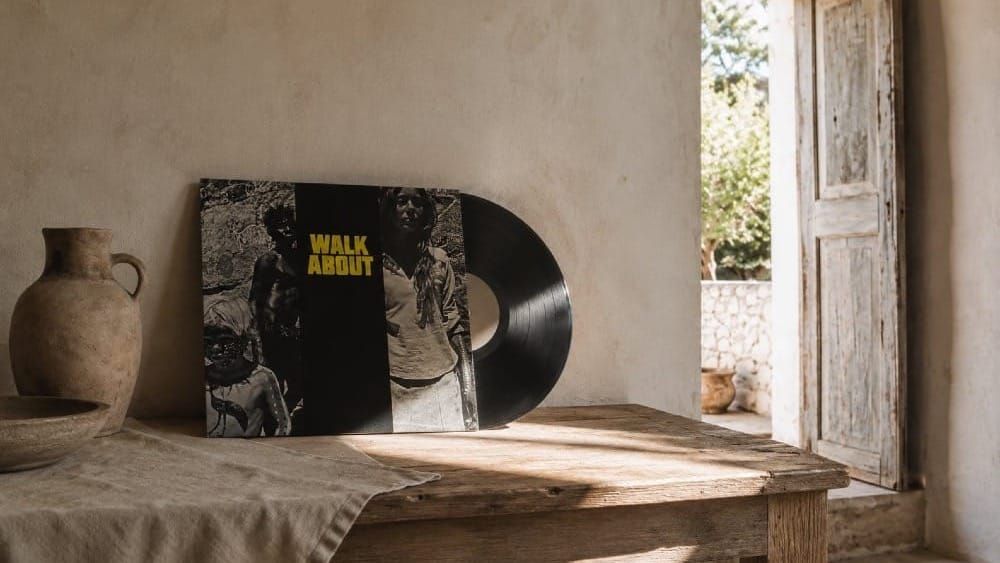
Before John Barry's first melody settles over Walkabout, the country has already begun to sound. Insects, radio static, breath, stone, Stockhausen, a didgeridoo heard across an uncertain distance — the orchestra enters late, and will spend the rest of the film learning what cannot belong to it.
There is a radio in Walkabout that goes on speaking after speech has lost its ordinary purpose, carrying instructions, songs, received opinions, the patient grammar of metropolitan life, its batteries weakening somewhere among abandoned walls while nobody answers. The voice persists, reduced to one more vibration in the heat. Roeg understood radio as a remnant of settlement, a portable jurisdiction; the girl protects its diminishing charge because it maintains a line, however frail, with the order from which she has been expelled. Through it the city enters the interior in small, absurd parcels — educational programmes, popular music, announcements detached from consequence. The machine has no knowledge of thirst. It cannot read the ground.
Barry's score inhabits this same interval, between transmission and place. His music comes from elsewhere. It has been carried in, the way a settler carries seed corn unsuited to the soil it is given.
I. A Country Assembled in the Cutting Room
The Australian interior seen in Walkabout has no single geographical body. Roeg and his crew filmed across Alice Springs, Arnhem Land, the Flinders Ranges, Lake Eyre, and the industrial country around Iron Knob and Whyalla, before returning to Sydney for the urban sequences — places separated by immense distances, joined through editing until they formed one apparently continuous passage. Red earth gives way to salt. Escarpments rise behind country belonging to another region entirely. Tropical vegetation enters the path, then disappears. The children travel through an atlas folded by memory rather than cartography, and Barry supplies part of that fold.
His recurring melody carries an emotional climate from one location to the next, lending continuity to terrain that resists it — strings drawing a line through separate geologies, woodwind giving human scale to distances that have none. A phrase returns, and the viewer accepts that these scattered tracts belong to a single inward journey. Yet the land beneath the edit remains plural. It was never the vacant totality that the colonial word wilderness proposes. Each location possessed histories, custodians, names, systems of movement, long before Roeg set his camera down there. The film's geography may appear continuous. Its cultural ground is not, and this matters most whenever the score begins to sound universal, since no melody can gather such a country without leaving something outside its embrace.
II. Before Melody
The opening soundscape refuses the comfort Barry will later offer. A fragment of Karlheinz Stockhausen's Hymnen reaches the film through electronic disturbance, its fractured broadcast material dragging the machinery of the twentieth century into the first minutes — national anthems dismembered, signals crossing borders, public language losing its centre. A didgeridoo follows. Animal calls, engines, schoolroom voices and city noise continue the passage, modernist composition, Indigenous sound, commercial radio and environmental noise all occupying the same unstable field before melody is permitted to arrive.
The delay changes everything that comes after it. Barry's music cannot claim to reveal a silent continent, because the continent has already spoken in registers the orchestra cannot absorb — clicked, droned, rasped, called across distance. Stockhausen has already broken the broadcast world into particles; the didgeridoo has already established a duration untouched by any European harmonic progress. Into this Barry enters with the unmistakable gift of lyrical order, an order that now carries the faint embarrassment of a visitor laying linen over rough ground.
The theme is among the loveliest he wrote, and that beauty ought not to be distrusted so much as placed. The divided strings rise and fall in long arcs; a restrained pulse keeps the music moving without hurrying it; wind instruments appear like figures sighted far off, briefly legible against a larger expanse. Barry gives the melody enough breadth to meet Roeg's horizons, then draws it back before grandeur can turn into possession — Criterion's Paul Ryan hears the theme as an embrace around the landscape, already tinged with the nostalgia the final sequence will make explicit. The embrace remains European, all the same. Its tenderness belongs to a culture schooled in discovering inward states in scenery, then keeping them as art.
III. The Old Nursery Enters the Heat
"The Children" sets words from Who Killed Cock Robin?, the English nursery rhyme whose catalogue of creatures gathers around a death. In Barry's arrangement the human chorus follows the insects and reptiles that witness the father's suicide; the rhyme, carried across oceans from an English childhood, reaches a place where its old pastoral menagerie acquires flesh — flies attend the body, birds cross the scorched air, lizards wait in the open. Nothing in it remains innocent.
Its antiquity once made death manageable by ritualising it. Each animal receives a task: the fly sees the blood, the fish catches it, the beetle digs the grave. Mortality enters childhood through repetition and a procession small enough to remember, and Barry retrieves that old scaffolding for a scene in which paternal order has collapsed with no such ceremony to receive it. The children have no burial rite of their own. The chorus supplies one, borrowed from a country they can no longer reach — a hand closing around something sharp before the mind has understood what it holds.
Roeg's animals offer no such obedience as the rhyme demands of theirs. They eat, mate, kill, decompose, their lives continuing beside human catastrophe with an attention entirely their own. The old pastoral passes among them like a visitor from another climate, unable to explain what it has come to witness.
IV. A Storybook Exposed to the Sun
"Stranded," "Survival Test" and "The Journey" belong to the score's most openly narrative stretch — titles alone suggesting an adventure viewed from the safe distance of an album sleeve. In the film, that safety has already burned away. Barry writes here from something closer to the younger child's scale of perception: traces of expedition, curiosity, even play, a melody giving direction to movement when the images supply only exposure. The boy asks questions, names things, keeps translating terror into incident, because a story is one of the few instruments childhood has against what it cannot yet survive by other means.
Roeg places this almost-fable beside dead animals, industrial labour, failed communication, the bodily facts of thirst, and the friction is where the unease of the score really lives. Barry's music does not misread the film so much as preserve, faithfully, the children's inherited way of misreading it — the assumption that a journey has stages, that danger precedes rescue, that a guide will appear once hope runs out. Such patterns belong to schoolbooks and imperial adventure tales, to a long European literature of children lost beyond the edge of settlement, and Walkabout lets the pattern run its course before leaving its assumptions exposed under the white Australian sun.
David Gulpilil's character arrives at the point where such stories expect providence. He finds water, gathers food, reads signs invisible to the children, and the film grants him grace, humour and physical intelligence through Gulpilil's own presence — while confining him, too, within a role built by outsiders: the unnamed "Black Boy," a figure of traditional knowledge apparently untouched by modern life. The NFSA has called this a stereotype Gulpilil would spend much of his later career complicating, a Yolŋu actor, dancer, painter and storyteller whose screen presence changed Australian cinema even when his early films gave him identities narrower than his own.
That tension survives, quietly, in the soundtrack. The white children receive the interiority of Barry's orchestra — fear, tenderness, future nostalgia, all given harmonic development. Gulpilil's character is more often reached through rhythm, gesture, bodily skill, sounds treated as environmental rather than expressive; his knowledge enters the film as action, his sorrow arrives through movement, and the orchestra mourns the encounter largely from the vantage of those who will survive to remember it. The imbalance sits close to the centre of the film, and no cue late in the score quite corrects it.
V. Three Figures at Sunset
"The Three of Us" and "Together at Sunset" hold the briefest possibility of another arrangement. For a while the children travel as a small, improvised company; water is found, food passes between hands, words remain insufficient though play and imitation begin to close some of the distance. Barry's music warms here without announcing reconciliation — his phrases seem to shelter the three figures for a few minutes, giving their movement a domestic contour, lending the terrain the outline of a home that cannot last.
Sunset matters throughout Walkabout. In the hard white hours of noon the country has little patience for human sentiment; at dusk its surfaces alter, rock takes on colour, bodies turn to silhouette, and distance softens just enough for the European eye to mistake beauty for welcome. It is here that Barry's orchestra flourishes most, the strings drawing the evening inward, turning geography into recollection before the journey has even ended, as though the music already knew that each shared gesture was passing into the past while it was still occurring.
This is where the score comes closest to the pastoral proper — an old form that has rarely described rural life with much fidelity, its true office being to provide distance from labour, power and the city, so that social conflict might appear instead as weather, song, courtship, seasonal loss. Barry inherits its elegiac branch. His country holds no shepherds, and yet the music arranges the travellers as figures within a scene whose harmony can only exist because the future has already drawn the sting from it. A pastoral displaced from England has taken up residence in Australia, and its very foreignness is what gives the music its ache: a cultivated plant set down in fierce soil, living long enough to flower, carrying somewhere in its structure the memory of rain from another hemisphere.
VI. The Album Rescued from Absence
For decades the original recording of Walkabout survived chiefly through the film and later re-recordings, until the stereo master tapes were recovered and issued by the Melbourne label The Roundtable in November 2016. The release followed the plan of an abandoned 1970s LP: twelve tracks recorded at Cine-Tele Sound Studios in London, produced by Phil Ramone, conducted by Barry.
The album is not quite the same work. Removed from Roeg's editing, the score occupies an acoustic world with far fewer interruptions — the insects retreat, the radio no longer contradicts the strings, geography loses its local resistance — and what remains is a compact suite of pastoral melancholy, psychedelic residue and childhood unease. Two pieces complicate even this apparently self-contained object: Billy Mitchel's seven-minute "Electronic Dance" and Warren Marley's "Los Angeles," neither composed by Barry, both retained in the reconstructed programme, and both preserving something of the film's original, unreconciled listening — electronic experiment, popular song, orchestral score, none of it made to agree with the others.
"Electronic Dance" matters especially. Its sitar-like colour, its studio manipulation and unstable pulse, belong to a moment when commercial recording had begun absorbing the procedures of the electronic avant-garde, often without giving up pleasure in the process; set beside Barry's finely proportioned themes it resembles heat entering magnetic tape, form buckling under a climate it was never built for. "Los Angeles" opens a different elsewhere again, bright and remote — a song named for an American city travelling through an Australian landscape inside a British film, place circulating here as recorded fantasy, the radio having made every territory capable of haunting every other. London writes Australia. Los Angeles arrives by song. An English nursery rhyme attends a death beneath foreign stars. Arnhem Land, Lake Eyre and the Flinders Ranges are joined inside a single imagined interior, and the soundtrack, for all its wealth of places, has few that truly coincide.
VII. Pastoralism Out of Place
Barry's pastoral language grew out of a recognisable European inheritance — diatonic melody, lyrical strings, the child's voice, the old association between landscape and lost time — none of it belonging inherently to England, though their conjunction here carries the sediment of English film, poetry and orchestral writing all the same. Stretched over salt pans, ancient rock, mining settlements and dry watercourses, that inheritance cannot make the terrain English; it can only disclose the English habits through which the white protagonists will go on remembering it.
The score heard during the journey seems, at first hearing, to belong to the present tense. By the film's end we understand that much of its tenderness has been travelling backwards all along, from the girl's adult life — Barry composing, in effect, the future memory of the experience, what remains of it once heat, shame, fear and responsibility have been worn smooth by years. Roeg's fractured editing behaves in much the same way: images return before their meaning has settled, a gesture takes on significance long after it occurred, the film remembering itself while it is still happening. Barry gives that unstable memory a melody able to outlast it, and the beauty of that melody is itself a kind of moral difficulty — the listener wants to enter it, and the film keeps asking, gently, what such entry would require us to forget.
VIII. The Land of Lost Content
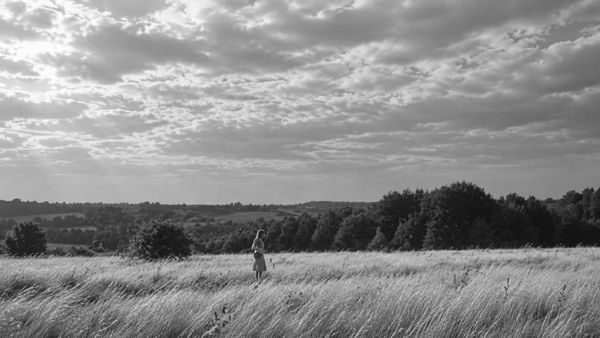
In the final sequence the girl is now a married woman standing in a Sydney kitchen, her husband talking about work, domestic life closed around her with the quiet efficiency of a room furnished before she arrived. Then memory opens. She sees the water again — three young bodies moving through it, stripped of fatigue, misunderstanding and death. The image is too perfect for Roeg to claim it occurred in quite this form. It has been remade by longing.
Barry's theme returns beneath lines from poem XL of A. E. Housman's A Shropshire Lad, first published in 1896, looking towards "blue remembered hills," "the land of lost content," and roads that cannot be travelled again — an English poem of rural estrangement supplying the final language through which an Australian journey enters memory, Shropshire passing over the Outback like a late shadow. The choice is exquisitely apt. Housman's own landscape was partly imagined, shaped by distance and loss; he wrote much of the book before knowing the county intimately, and his hills offered a country the mind could inhabit once ordinary life had grown unbearable. Roeg places that same poetic mechanism inside the girl's recollection, converting Australia into her private Shropshire — luminous because it has been lost, innocent because the dead can no longer correct the memory. Barry's theme completes the conversion. Its rising strings do not return her to the country. They build the form in which its absence can be endured, while the Aboriginal youth survives, elsewhere, only as an image inside someone else's nostalgia.
That knowledge does not diminish the melody. If anything the score grows more powerful once its limits are heard, a work of exceptional tenderness that is also, unmistakably, the sound of a European consciousness arranging an encounter after the fact, gathering its scattered guilt into pastoral elegy.
Beneath that elegy lies another country, and it was never silent. The insects continue past the final cadence. Rock holds its heat long after the orchestra has stopped. Voices travel through territories whose names the film never gives us. The radio fails, somewhere among the walls, and memory begins its long work of selection.
John Barry's Walkabout stays beautiful for exactly this reason: the music cannot close the distance it crosses. Its melodies hover over the land with grace, carrying childhood, English verse, the ache of belated understanding — illuminating, along the way, the fragile human need to make experience inhabitable. The country underneath keeps sounding regardless.
Further Reading & Sources
Primary Sources: Nicolas Roeg, Walkabout (1971), screenplay by Edward Bond from the novel by James Vance Marshall; John Barry, Walkabout: Original Motion Picture Soundtrack (The Roundtable, 2016); Karlheinz Stockhausen, Hymnen (1966–1967); A. E. Housman, A Shropshire Lad (1896).
Research Sources: National Film and Sound Archive of Australia, materials on the film’s soundtrack and on David Gulpilil; Australian Screen Online, production history and filming locations; Paul Ryan, “Walkabout: Landscapes of Memory,” Criterion Collection; selected studies on Australian cinema, Indigenous representation, sound and landscape.
Editorial Note
This article was developed as an Audible Cinema essay, combining close listening, film-music analysis, historical geography and research into the representation of Australian Country.
Hwael Mag distinguishes John Barry’s score from the film’s wider acoustic field, which also includes radio transmissions, animal calls, environmental sound, Stockhausen and didgeridoo. The interpretation of Barry’s music as a pastoralism out of place, and as a form of memory later laid over the landscape, is an original Hwael Mag critical proposition.
The essay does not treat the Australian interior as empty wilderness or culturally undifferentiated space. It also acknowledges the limits of the film’s Indigenous representation and the importance of David Gulpilil within the history of Australian cinema.
Last revised: July 2026