Nicolas Roeg :: Walkabout
Art cinema, Aboriginal sound, colonial vision and landscape as score

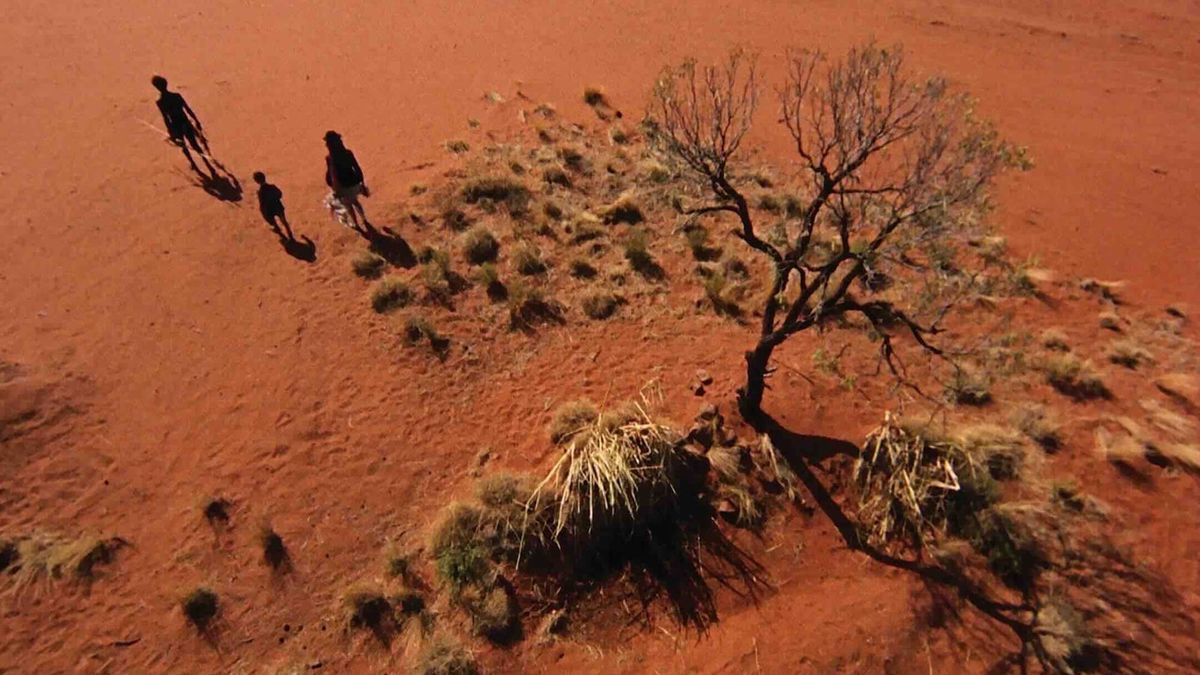
In the Australian desert, two English children survive thanks to a young Aboriginal boy on his ritual journey. Roeg films the land like a score.
Before the desert even opens, a sound: an electronic piece by Stockhausen, Hymnen, crackling like a radio badly tuned to the world, and then — abruptly, with no transition — the circular drone of a didgeridoo. Roeg sets these two sounds side by side in the opening minutes: two temporalities that never touch, the European avant-garde and an instrument belonging to a culture whose relation to land and time the film can sense more readily than it can explain. Walkabout is the film of that friction.
The plot, stripped to the bone, is almost a parable: a father drives his two children into the outback, sets the car on fire, shoots himself; the girl and the boy are left alone in a land the culture they come from has always described as empty. Their rescue comes from an Aboriginal boy — David Gulpilil, in his first film role — travelling alone through Country on what the film calls a “walkabout”. The film presents this as a rite of passage into adulthood, though that universal definition belongs more securely to the film's framing than to Aboriginal cultures as a whole. From here on the film stops telling and starts watching: Roeg's zoom, his own cinematography, pushes into close-ups of lizards, ants, bark, as if the landscape were the real narrative matter and human beings only figures crossing it.
This is where the film gives its gift and sets its trap, in the same gesture. The gift is one of the highest renderings ever filmed of landscape-as-score: Roeg watches the outback with the intensity he'd found in Australian painting — Sidney Nolan in particular was a direct influence — and records its sounds with an almost musical clarity, until the desert stops being a place and becomes a voice. Every rustle, every insect's screech is composed, not captured.
The landscape dictates the story.
The trap is the exact reverse of this enchantment. That desert Roeg fills with microscopic life and firelight is presented, in narrative terms, as empty — a land to cross, to survive, waiting for someone to name it. But the outback isn't empty: it has been inhabited, travelled, burned, mapped, named and managed by Aboriginal peoples over immense stretches of time. The film shows Gulpilil finding water and food, reading a country the children cannot read, while repeatedly translating that knowledge into grace, instinct and mystery.
That tension has not gone unnoticed in Indigenous criticism. Marcia Langton later argued that Walkabout participates in a history of representation in which Aboriginal people become figures of inevitable disappearance; other Australian scholarship has questioned the film's attraction to the “noble savage” and the apparently primordial landscape. The contradiction is already audible in the soundtrack. The didgeridoo performances are Gulpilil's own and went uncredited, while Stockhausen and John Barry entered the formal music credits. Roeg gives the Aboriginal character an extraordinary presence, and the film can still diminish the knowledge sustaining that presence.
The white hunters slaughtering animals for sport make the division especially ugly. Gulpilil's response gives the film one of its clearest moral shocks: killing for subsistence and killing as industrial recreation occupy the same landscape and have almost nothing in common. Roeg is capable of seeing that distinction with brutal clarity. What he sees less clearly is the larger system of knowledge in which the first kind of hunting belongs.
The same goes for time. Walkabout refuses linearity — the editing jumps, anticipates, doubles back, overlaps — and it is tempting to connect that form to Aboriginal conceptions of time. Better to stop before turning a complex set of cultures into a ready-made philosophy for European modernism. The film itself already does enough of that borrowing. What can be said securely is that Roeg removes ordinary chronological pressure: memory, anticipation and present sensation occupy the cut together.
That is why the ending doesn't close. The girl, now grown, in a bourgeois flat, remembers the desert and the boy who saved her life, and in that memory the longing is for something she never had, only passed through without understanding — a longing for a time and a place that were never hers, that comes back to her years later like the didgeridoo beneath the radio. The boy's journey returns him to Country; hers becomes an exile in reverse, civilisation as the place from which the lost landscape can only be imagined.
Stockhausen and Gulpilil occupy the same soundtrack without resolving into the same idea of time, place or authorship.
Animals killed for sport turn the landscape from spectacle back into an argument about what different people believe the land is for.
Years later the girl possesses the outback only as memory: a place she crossed, survived and never fully learned how to read.
After the credits, the film leaves the same residue as the rock in Picnic at Hanging Rock, where another Australian landscape swallows and doesn't give back: the sense that the land was there before us, that it will go on after, and that we — with our radios, our zooms, our enamoured cameras — were never anything but guests who mistook watching for knowing.