Ella Rae Cole :: Rocky Creek
Acoustic folk, fingerstyle guitar, Montana landscapes and family memory.
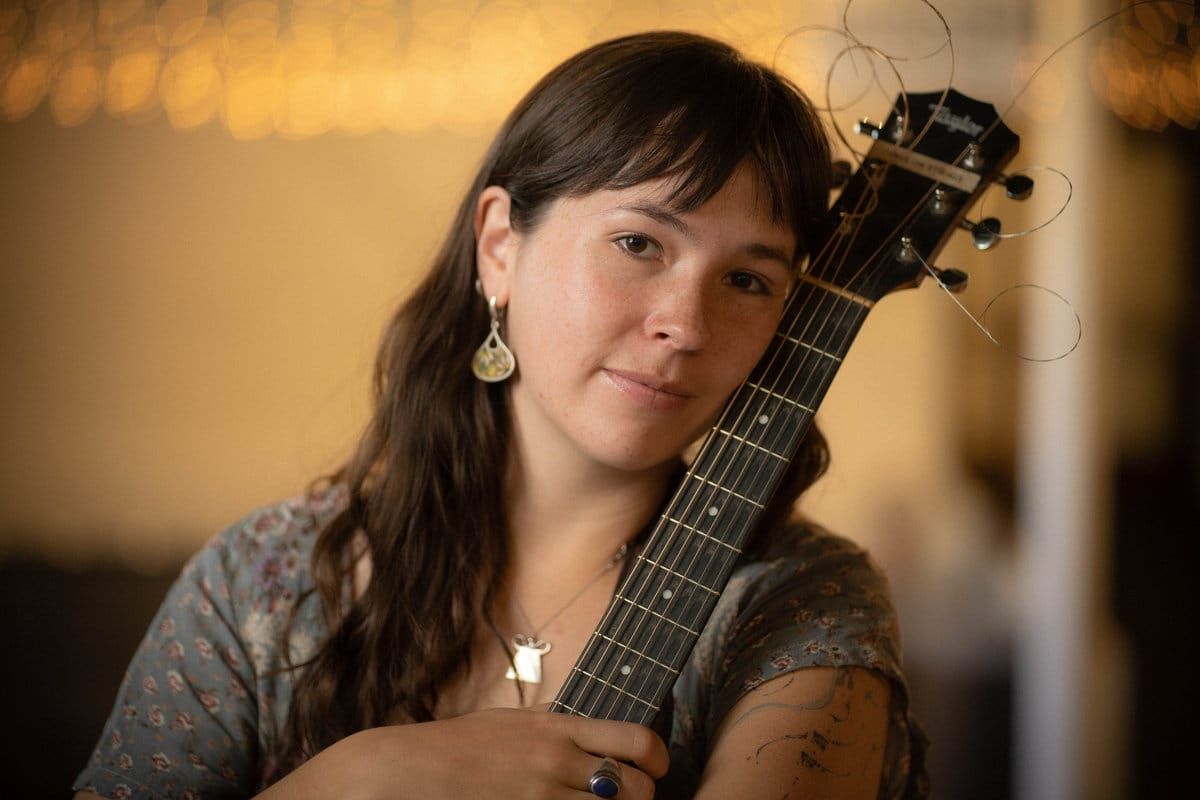
Rocky Creek was made with three condenser microphones, guitar and voice recorded in the same moment.
Rocky Creek was recorded over several years in Tyler James Haugum's home studio, with three condenser microphones and a method that today sounds almost liturgical: guitar and voice performed together, never built up in layers. Cole has said the sessions began during a period of family bereavements; the title comes from her childhood home and from what that place still keeps for her. It is her first full-length record, and it arrives the way a herbarium would: leaves gathered across different seasons, pressed by the same hand.
Cole had made this plain before the release: "See Us As Self" is a single take, one summer afternoon in Haugum's studio; "Silver", also issued as a single, one take on a summer evening in the canyon where the studio sits. These are colophon details, the kind once printed at the foot of Folkways records, and here they weigh as much as the arrangements.
A simultaneous take leaves fewer places to hide.
"Already Gone" opens with a vigil's inventory: fossil tracks, wind, armour, a dawn, a forgotten well. The watermark is that of The Innocence Mission just stepped out of their room among the trees. "Armastuslaul" is even more exposed: Cole lets the natural images do the emotional work without translating them all the way through, and the voice has the presence of someone telling stories by the fire, felt with all the senses before it reaches the ear.
"Place Yourself Here" works a held-back bossa into the weft — near-jazz chords, light syncopations, a pulse kept on a short rein — one of those better moments where Feist talks with Kings of Convenience. Then "Quiltmaker" returns to the domestic and takes the quilt as a way of thinking: knowledge as hand-stitching, inherited patterns as patches of cloth passed from mother to daughter, while the lyric keeps snagging on the uncertainty of a life only half sewn. Throughout Rocky Creek Cole writes as if understanding were a labour of the body: walking, weaving, watching, carrying, placing.
"Sea Chanty" draws on a broadside vocabulary — promise, shore, tide, path along the river — old enough to let tradition into the room without setting it in quotation marks. And yet it remains unmistakably her own song, unstable to the point of making sea and river coincide; love holds still there for a second and is already moving on. Guitar and voice arrive as you would hear them from a few feet away: the listener becomes the fourth microphone, bound by a duty not to stay indifferent to the slightest shading, the slightest flaw.
"See Us As Self" has to pass through the same fallible voice and the same guitar as everything around it — Joni Mitchell certainly, Vashti Bunyan — but her talent keeps her anchored to the present. "Silver" is the record's clearest meeting point between landscape and self-possession. The opening asks the silver to hold vision and sound together, like a photographic plate from another age; knowing the recording happened in one take, on a summer evening in the canyon, gives these images a useful concreteness. The canyon remains simply the place where voice, guitar, warmth, air and whatever else the microphones gathered came together. Curious that Cole chose perhaps the album's least oblique ballad to seat before such grandeur of stone.
Con "Turkish Song" you see the quality of an artist able to keep voice and guitar in two different registers of time: the voice closer to modern folk, the guitar drifting toward 1960–70, the two tempos trading places as in a round dance, with an effect of hauntological translation. Powerful magnetism. "Watchmen" takes up folk-jazz in its most attenuated form. "Wide Wild Eyes" closes by looking back once more: a woman before dawn, a swan on a hill, autumn, the north wind, a dried rose, someone in search of a soul — an ending out of a rural almanac, the kind once leafed through at vespers.
Cole's public description tends to place her within familiar singer-songwriter coordinates: alternate tunings, folk roots, the occasional bossa nova rhythm, a warm voice. What holds Rocky Creek together is something smaller. A guitar part has to survive beside the voice it was recorded with, like two herbs pressed on the same sheet. There are eleven songs here and very little apparatus between the person who wrote them and the microphones. For a debut, this restraint is its weight.