Colin Cant :: The Children of Green Knowe
A flooded house, family ghosts and an English winter.

The road to Green Knowe is underwater, so Tolly finishes the journey by boat. Colin Cant films the crossing as an inconvenience: wet luggage, lantern light, a hired man at the oars.
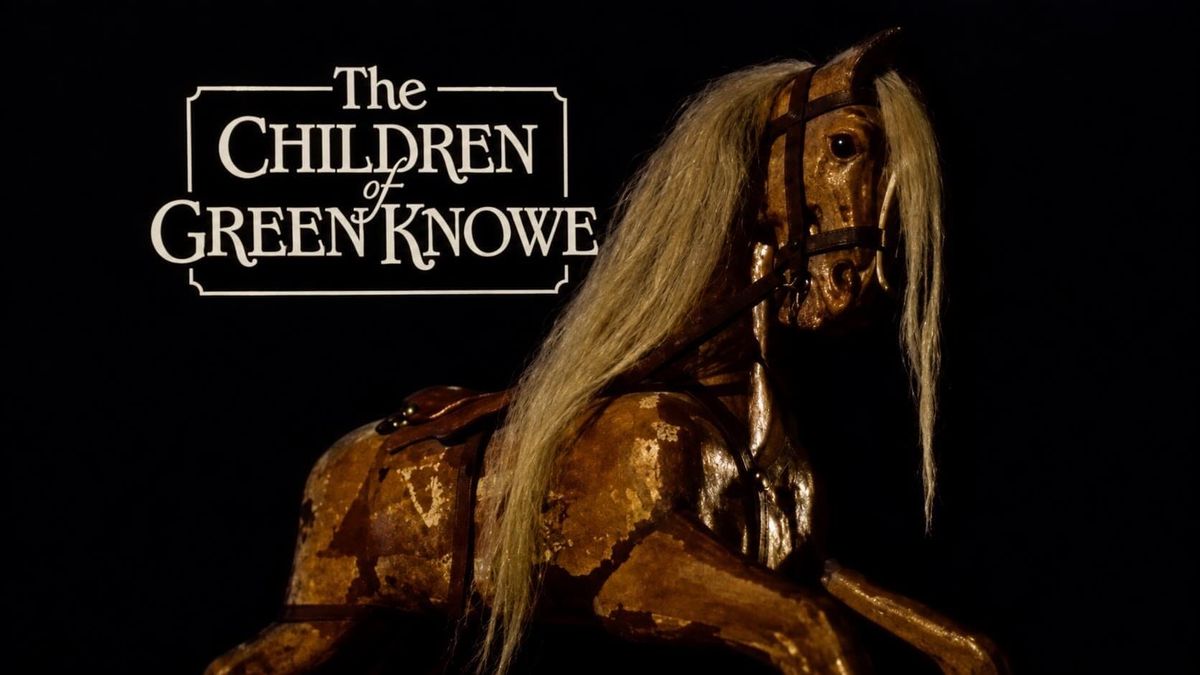
The flood comes straight out of Lucy M. Boston's 1954 novel, and the serial keeps its practical texture. John Stadelman's four-part dramatisation went out on BBC1 on Wednesday afternoons between 26 November and 17 December 1986, in the children's slot before the evening news, produced by Paul Stone in the years between The Box of Delights and Moondial. A Christmas story, then, delivered weekly across Advent, so that its first audience moved toward Christmas at roughly the same speed as Tolly, released from boarding school into a holiday for which nobody appears to have made plans.
Boston wrote the book out of a building. The Manor at Hemingford Grey, beside the Great Ouse, is a twelfth-century house whose moat, buried structures and accumulated alterations let its history be read in the fabric. She bought it in 1939 and spent years on its restoration; Historic England treats that work, together with the garden she made around the house, as the ground from which the children's books grew, and her son Peter uncovered Norman work that later centuries had plastered over. This gave Green Knowe an advantage rare among fictional haunted houses. Its past was already lying around as masonry, waiting for somebody to take the later layers off, and Boston's ghosts behave like that labour. Toby, Alexander and Linnet, dead of the plague in 1665, come through the present the way a blocked Norman window comes through Georgian plaster once the plaster has been removed; the present is under no obligation to disappear.
Cant, arriving from Grange Hill and The Machine Gunners, stages this with almost provocative plainness. There is no visual grammar for the change of period, no lens or lighting reserved for the dead. The children occupy a room or a stretch of garden, and a little later the same space holds one body fewer. Alec Christie remembered being asked, when the ghost horse Feste first appears, simply to fix his attention on the animal as if it stood there, and accounts of the production agree on Cant's distrust of conspicuous effects for the children themselves.
Wet luggage, lantern light, a hired man at the oars. Green Knowe remains reachable after the road has disappeared beneath the water.
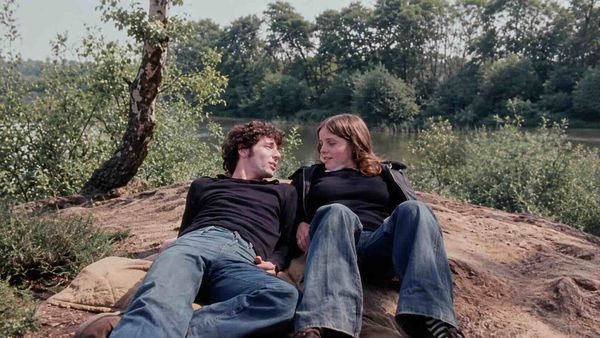
The children occupy a room or a stretch of garden. A little later the same space remains, holding one body fewer.
Seventeenth-century costume, modern child, polished furniture and winter garden pass through the same videotape image.
Daphne Oxenford plays Mrs Oldknow with the practical assurance of a woman describing rooms she knows. The part invites an elderly custodian of exposition, stationed beside the fire with the family tree, and Oxenford declines the invitation quietly. Names, clothes, accidents and possessions enter conversation with very little ceremony. Somebody slept upstairs; somebody played with a carved mouse; somebody died. History keeps a domestic scale, and the distance between those propositions is allowed to remain embarrassingly small.
Tolly learns her mode of attention across the four episodes. He begins by searching for companions and ends by noticing the house on its own terms: footsteps, a phrase of music, a movement at the edge of vision, objects whose significance has been established long before anything supernatural is asked of them. The serial's slowness, usually filed among the inherited weaknesses of children's television of the period, is where its real work gets done, because perception needs duration in order to change. Four half-hours leave Tolly a great many empty minutes, and the weekly broadcast stretched those minutes across a month of the audience's own December.
On screen the house has moved. Boston's Green Knowe grew directly out of Hemingford Grey, while the production filmed principally at Crow's Hall in Suffolk: one old moated house standing in for another that had already been translated into fiction. It suits a story in which no single building holds exclusive possession of Green Knowe, which is roughly what the novels claim about the family as well.
Peter Howell's score works nearby and mostly avoids supernatural punctuation. Howell, of the BBC Radiophonic Workshop, later named The Children of Green Knowe among the most satisfying commissions of his career and remembered it as belonging to the last stretch before institutional and technological change altered how the Workshop operated. The coincidence proves nothing, and it is hard to leave alone: music made inside an institution nearing the end of one phase of its life, accompanying a story in which vanished lives keep leaving usable forms behind.
The serial is rougher than memory wants it to be. Some performances keep the stiffness of the period's children's drama; a few historical interludes announce themselves heavily; Green Noah, the cursed tree that supplies the fourth episode's peril, belongs to a much more conventional register of menace than the quiet arithmetic of the children's appearances. The unevenness has a use. It keeps the house from becoming an immaculate container for English nostalgia. Boggis eats, luggage gets carried, rooms need fires, weather interferes with travel, and the past has to coexist with all of it.
Then there is the tape. The serial was shot entirely on videotape, and a review of the 2016 DVD regrets that such modest effects never justified choosing video over film. Forty years on, the supposed limitation looks like the production's best idea, whether or not anybody meant it as one. The dead arrive unsealed, without a prettier grain reserved for the past; seventeenth-century costume, modern child, polished furniture and winter garden pass through the same electronic surface, at the same shallow depth. Video flattens exactly the distinctions a more self-conscious period image would have underlined. The medium brought a history of its own. For much of the two previous decades the BBC had treated videotape as reusable stock, recording new programmes over old ones and losing a large part of its archive in the process.
A story about earlier lives showing through later surfaces was committed to the very material that had made overwriting routine.
At Hemingford Grey the Manor still holds objects tied to the stories. The attic keeps toys associated with the fictional children, and Peter Boston's illustrations reproduced things and spaces from the actual house, so a visitor meets a peculiar circulation in which household objects entered fiction and then acquired a second life because fiction had used them. The serial belongs to the same circulation, one more layer through which the house goes on being read.
Near the beginning Tolly crosses water because the road cannot be seen. Inside Green Knowe nothing comparable happens to time: no portal, no theatrically crossed century. He stays in one place long enough for another layer of it to show, and that patience, the patience of a restorer, is the only supernatural skill the serial asks anyone to learn.