Windham Hill: The Making of a Listening Place
Essay on Windham Hill and the landscape a label built around its music.

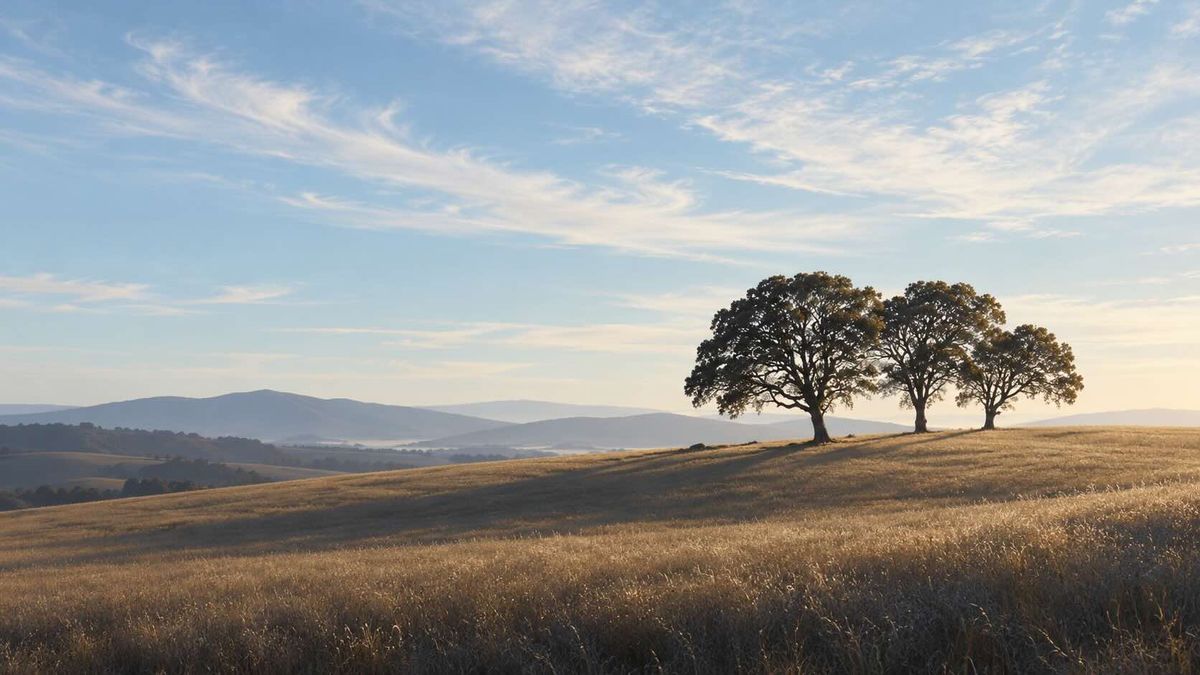
There is room to breathe on the sleeve. Inside, a good deal of work went into making that breath sound unforced.
Set a few Windham Hill records side by side and a place begins to assemble itself. Light along a ridge, a sheet of water, the white margin left standing around the photograph; then the needle drops and a guitar sits close enough that its wood seems to press against your sternum. The place has a curious solidity. You could go back there. Yet the recordings come from rooms that have little to do with one another, the players arrive from incompatible schoolings, and the acoustic promise starts admitting synthesizers and reversed tape almost as soon as it is made.
That discrepancy interests me more than another hearing of the old case against new age. The label William Ackerman and Anne Robinson founded in 1976 gave perceptual continuity to a discontinuous catalogue. A listening community formed out of production decisions, sleeves, distribution, the running order of a sampler; the feeling of standing somewhere familiar often arrived before anyone knew the names of the people standing there with you. As editorial achievements go, it was a large one. In time it also became a problem, since a public that recognises the house that well can stop looking at who lives in it.
I. Three hundred copies was already too many
Late in 1975 Ackerman is gathering money from friends to record a handful of guitar pieces, five dollars a head in the account kept by the collectors' archive Windhaming, which makes the first Windham Hill release something close to a subscription. He has dropped out of Stanford, works as a carpenter, writes guitar music for campus theatre and plays in stairwells to hear what a note does as it climbs the concrete. Scott Saxon records him at Mantra in San Mateo. The album appears in 1976 as The Search for the Turtle's Navel, later better known as In Search of the Turtle's Navel; the earliest sleeves, Ackerman recalled, were printed on a warm brown paper stock. Three hundred copies was the pressing plant's minimum order, more than the audience anyone could picture, and in his later tellings a fair share of them had already been mentally assigned to a cupboard.
John Fahey had shown that a steel-string guitar could hold the length of an LP, and that a musician could release one without waiting for a record company to notice. Takoma had made the road passable. Ackerman brought another temperament to it: melodies that seem to take shape while the hand is still finding its position, basses left to ring on, a trust in the interval over any demonstration of development. A passage can stand exposed, nearly bare, and for that reason ask for a control of touch the word "simple" quietly omits.
Of the elders, Robbie Basho weighs most. Speaking to Anil Prasad in 1998, Ackerman named him as the guitarist he had studied hardest, remembering the linear travel along the fingerboard and the debt to the sarod. Basho's own Visions of the Country came out on Windham Hill in 1978, his voice climbing, insisting, overrunning the comfortable measure we now attribute to the photographs on his sleeves; there is something exposed in that demand for vastness, close to embarrassing, and filing him as a noble precursor of instrumental guitar removes the part of his work that refuses to be reduced. That lineage puts friction back inside the later calm. Behind it stand appropriations, modal searches, idiosyncratic devotions, players who demanded a great deal of six strings.
The name had travelled as well. Windham Hill Farm in Vermont had been a refuge in Ackerman's youth; the name went first to his building firm, Windham Hill Builders, and then to the records, so that carpentry and music shared a business card for a while. Before the corporate identity there was an attachment to one place. Then that place began to mean something to people who had never set foot in it.
II. The catalogue success would leave behind
The second release, Linda Waterfall's Mary's Garden (1976), is a record of songs, which already makes it hard to believe in a label born devoted to contemplative instrumentals. Waterfall was a Stanford acquaintance who had played in Entropy Service and had the training to think in written parts. In testimony gathered by Windhaming, the producer Jim Bredouw remembers a musician who treated folk as a problem of orchestration: around the voice stood other voices, instrumental ones, each with its own errand. Histories written backwards from the million-sellers tend to file her as an early detour, though the release order puts songs, ensembles and a sociability still close to the counterculture right at the start, and the label might as easily have grown from there.
The early roster was also, to a degree the sleeves never suggest, a neighbourhood. Alex de Grassi, whose Turning: Turning Back came out in 1978, is Ackerman's cousin. Both went to Gunn High School in Palo Alto, and so did Randy Lutge, who went on to manage the New Varsity Theater, a 1927 building with an open-air courtyard where the two cousins played and local talent was given a stage. One day a young guitarist came into the lobby asking whether this was the place to play in town, offered some Neil Young, and then played something else entirely; that was Michael Hedges. Ackerman saw him perform at the New Varsity and signed him on the spot. In the version Ackerman likes to tell, the contract went down on a paper napkin. Breakfast in the Field appeared in 1981, the seventeenth release on the label.
De Grassi's debut opened a direction of its own. His phrasing distributes attention across lines that refuse to walk at the same pace: a bass can reassure while an upper figure shoves the accents elsewhere. The beauty lies in how that small instability is held, and hearing it as decorative arpeggio is enough to make part of the composition vanish.
At this stage the catalogue amounts to the people Ackerman decides to put out, with no landscape yet holding them together; the later catalogue would make some of those choices central and push others to the margin, and that retrospective selection would come to look like a founding vocation.

III. Anne Robinson and the work of recognition
The sleeve is what made the ensemble legible. A generous field of white changes the weight of the photograph, lifts it out of the shouting match of the record rack, invites the hand closer. The image holds an editorial position: it proposes a way of approaching the record before the record has a chance to speak for itself.
Anne Robinson, co-founder and the decisive presence in running the company, belongs inside that mechanism. Label histories are good at listing artists; they grow vague when asked to describe who made one release follow plausibly from the last. Continuity has to be produced, paid for, corrected. Her name recurs in the sleeve credits beside photographers and other collaborators, and the credits show how far the look was handmade. On de Grassi's Clockwork (1981), Windhaming's transcription gives graphic design, the cover monoprint and the liner photograph to an Anne Ackerman, almost certainly Robinson under the surname she was using then. The cover of that record is a print pulled by hand, an inked surface with a body of its own, sitting inside a catalogue the public would come to remember as a gallery of found nature.
The frame let a buyer take a fairly small risk. An unknown name arrived wrapped in signs already familiar, and plenty of listeners first met a guitar technique or a pianistic form because someone had made the purchase less intimidating. Nobody needs to credit Robinson with a programme of standardisation to see the other side, which is that the same mountains and water that eased a purchase could suggest the music inside had already been resolved.
Once the sleeve begins to guarantee the experience in advance, the musician has to work harder to be heard in their own difference.
IV. Autumn holds other seasons
Autumn, in 1980, changed the commercial scale of Windham Hill. Its seasonal frame gives the listener an immediate orientation; George Winston's writing gives melodies worth returning to. Repetition lets a figure be recognised while touch, the spacing of attacks and a different pressure in the low register alter its weight. Underneath, the left hand often keeps a stride pattern, the bass-and-chord shuttle of Harlem piano slowed and smoothed until it passes for weather.
Winston also arrived with a prehistory. John Fahey had recorded him first, for Takoma, on a solo debut that sank almost without trace; Windham Hill later reissued it as Ballads and Blues 1972, a label absorbing a stretch of its own family tree under a new name. His notes to Autumn complicate the Montana postcard further. He points to the Doors' first album as a model for the shape of the record, and to the instrumental break of "Light My Fire" as a source for the improvisation in "Colors/Dance". He mentions Jimmy Smith, Coltrane and Zappa. For the second part of "Moon" he cites traditional Japanese koto music; in "Stars" there are memories of Dominic Frontiere's scores for The Outer Limits. The list comes from Winston himself, in notes revised long after the record. Beside it the seasonal titles look like the part of the work easiest to hand to a buyer; Coltrane and The Outer Limits stayed under the piano lid.
With Winter into Spring and December, both 1982, the bond with the calendar tightens: a record goes back on the turntable in the same month for years while the house, and the body listening in it, change. Criticism has little to say about that private duration. Winston gave it a form, and the merit stands even where his sentiment finds us less willing.
What he did with the money is the less told part. In 1983 he founded Dancing Cat, a small Santa Cruz label distributed by Windham Hill, and after a few releases bound to his own models — a Professor Longhair reissue among them — he turned it mainly to Hawaiian slack-key guitar, recording Sonny Chillingworth, Ray Kane, Ledward Kaapana, Cyril Pahinui and others, several of them older masters who found a late audience on the mainland. So the slack-key records of Chillingworth and Kane went out through the same distributor as December.
V. Hands, tape and instruments that won't stay put
Hedges's arrival with Breakfast in the Field in 1981, and above all Aerial Boundaries in 1984, makes it impossible to dismiss the relation between calm and complexity. The guitar distributes simultaneous functions: a percussive attack sets the pulse, a string goes on sounding, the melody seems to pass through another region of the instrument. Physical effort is not necessarily put on display; sometimes it is heard best in the precision with which a gesture is cut off. On the debut, Winston himself turns up beside Hedges and Michael Manring's fretless bass on "Lenono", a pianist briefly seated inside a guitarist's first record.
Part of Hedges's later fortune converted all this into an inventory of techniques. Understandably: a gesture can be taught, filmed, slowed down. Harder to pass on is why that gesture must arrive exactly there. His hands are only part of it: according to the archive kept by his family and collaborators, "Spare Change" took 111 hours of work over a single week in Baltimore, combining recorded guitar sounds, reversed tape and altered speeds. At the heart of the record canonised as an acoustic revolution sits a stretch of electroacoustic montage.
Liz Story had studied at Juilliard and was enrolled at Hunter College when a night hearing Bill Evans at the Bottom Line turned her towards jazz; Evans suggested a teacher, Sanford Gold. Back in Southern California she took a job playing piano in a restaurant whose instrument had no music stand, and with nowhere to put the score she improvised; over months those improvisations hardened into pieces, and the tape of them reached Ackerman. In her playing the phrase tends to thicken and swerve, the harmony withholding what the melody seemed ready to concede. Mark Isham sets electronic timbres and horns at constructed depths. Shadowfax brought an ensemble thinking drawn partly from progressive rock and fusion. Later, Manring's electric bass on Unusual Weather would make any definition of the label grounded in acoustic wood look thinner still.
Behind much of this sits a decision about where the listener is placed. "Natural sound" assumes a microphone could simply leave alone what is in front of it, but every choice of distance, every balance between attack and resonance, builds a seat, often far nearer the strings than any concert would allow. Steven Miller, whose engineering and production run across solo instruments, ensembles and electronic records, is one of the names needed to understand that construction. The Windham Hill quality was largely a treatment of perspective, and its early turn to digital makes the legend of a label guarding a lost analogue purity especially thin.
Five records from the catalogue let these openings be tested at close range. Their credits hold details the label's overall physiognomy tends to make us forget.


VI. Isham, ECM and the way back from Japan
The comparison with ECM is usually entrusted to a list of generic qualities: space, photography, sonic precision. It is better to go through a piece. "Many Chinas", which opens Vapor Drawings, already belongs to the repertoire of Rubisa Patrol, recorded for ECM in 1976 by Art Lande, Mark Isham, Bill Douglass and Glenn Cronkhite. Here the link has names and a piece of music attached. The two labels could offer different kinds of belonging to the same musician and even to the same composition, and Isham carried this one across, from a quartet record into the opening slot of his own album.
Japan widens the question. The official Winston profile published by Sony Music Japan ties the popularity of "Longing/Love", known there as Akogare/Ai, to its use in television advertising for the Toyota Cresta. The music enters a circuit of modern, commercial desire by way of a car, and the nostalgia a Japanese listener attaches to it may concern a television screen as much as the American landscape the album imagines. Without research into individual reception we cannot say how far that holds for anyone in particular; the passage itself can be documented.
Traffic ran the other way too. Interior, released by YEN in 1982 with Haruomi Hosono producing, reached Windham Hill in a reorganised version in 1985. Sony's Japanese presentation of the 2024 reissues sets the two programmes side by side: the second drops "N.F.G.", moves "Reply", and lists "Hot Beach" where the first had "Cold Beach". The lists alone cannot establish what sonic difference the change of title implies; they are enough to rule out an American sleeve laid over an unchanged record. In his notes Chee Shimizu places the group among new wave, environmental music and contemporary composition. Windham Hill selected material from other musical systems and made it readable inside its own, and for a listener drawn today to Japanese ambient music the catalogue opens through an unexpected door.
VII. The sampler, the shelf and the sale
On Sampler '84 the opening move from Hedges's guitar to Isham's electronics makes the label's work audible. Sources and modes of performance change, and still the sequence solicits continuity. Every selection leaves part of the source album outside, shortens the time granted to an author, places them next to someone they did not choose. The sampler can teach curiosity, from a track back to the album and on to other collaborations; it can also be enough in itself, and then a whole musician ends up coinciding with the few minutes that best fitted the programme. Tranquillity could be an effect of the running order before it became a property attributed to each track.
Commercial new age makes sense from here. A classification by use gathers works conceived with different intentions because they serve the same hour of the day, the same activity, a certain idea of home, and it ends up passing judgement on compositions: Hedges is heard in advance as reassuring, one of Story's swerves goes unnoticed. The caricature of records for well-furnished living rooms catches a possible social association and turns it into an aesthetic verdict. A family can put Hedges on during dinner and catch a detail months later; a highly trained listener can admire the construction and hear almost nothing. This doesn't absolve every release. Smoothness weakens a piece when every element seems designed to confirm the others, and defending Windham Hill means telling those records apart from the ones in which clarity leaves a musical problem exposed.
The distribution deal with A&M in 1982 carried the label to a larger scale, making available musicians the conventional industry had struggled to place while the pressure for recognisability kept rising. In 1992 Ackerman sold his share to BMG; Robinson's stake followed in 1996, so the musician founder and the executive co-founder do not leave the story in a single gesture. In the 1998 interview Ackerman speaks of exhaustion with corporate life: an organisation that had given his music room had come to occupy most of his time. The anniversary box A Quiet Revolution, announced by Sony Legacy in 2005, arranged the catalogue as an inheritance, and its press release places "The Bricklayer's Beautiful Daughter" on the 1976 debut, when the piece belongs to It Takes a Year. A small error, and almost perfect for showing how easily origins get recomposed around whatever became representative.
VIII. Reopening the records
Today's rehabilitation risks a selection that mirrors the old contempt. The titles compatible with ambient, experimental guitar or the new appetite for Japanese archives are brought back; Winston is left to the public that always loved him. That would be a partial restitution. The history has to include the ordinary, at times sentimental bond these recordings formed with people who bought them without feeling part of any search.
A curator's route through the catalogue would start from its own exceptions rather than its centre: the songs of Mary's Garden, the hand-pulled print on Clockwork, Basho's whistling over a piano, a jazz pianist's standard tucked into a debut of miniatures, a Tokyo record re-sequenced for California, slack-key masters distributed under the same roof as December. Read that way, the house style goes back among the credits, where Robinson's and Miller's names already sit.
For Solid Colors I have in front of me a Japanese copy with its vertical obi strip. The familiar image is crossed by another language, and that band of paper is enough to recall that the same album had several commercial lives, several shelves, different introductions. One can begin there. Ease the record out of its sleeve, turn the jacket over, stop at a name in the credits that until then had slipped past. Then play the whole album, including the part the compilation never chose.
Last revised: October 2026