June McDoom :: Follow the Light
Folk and dub debut where a grandfather’s voice note sits under the harmony.
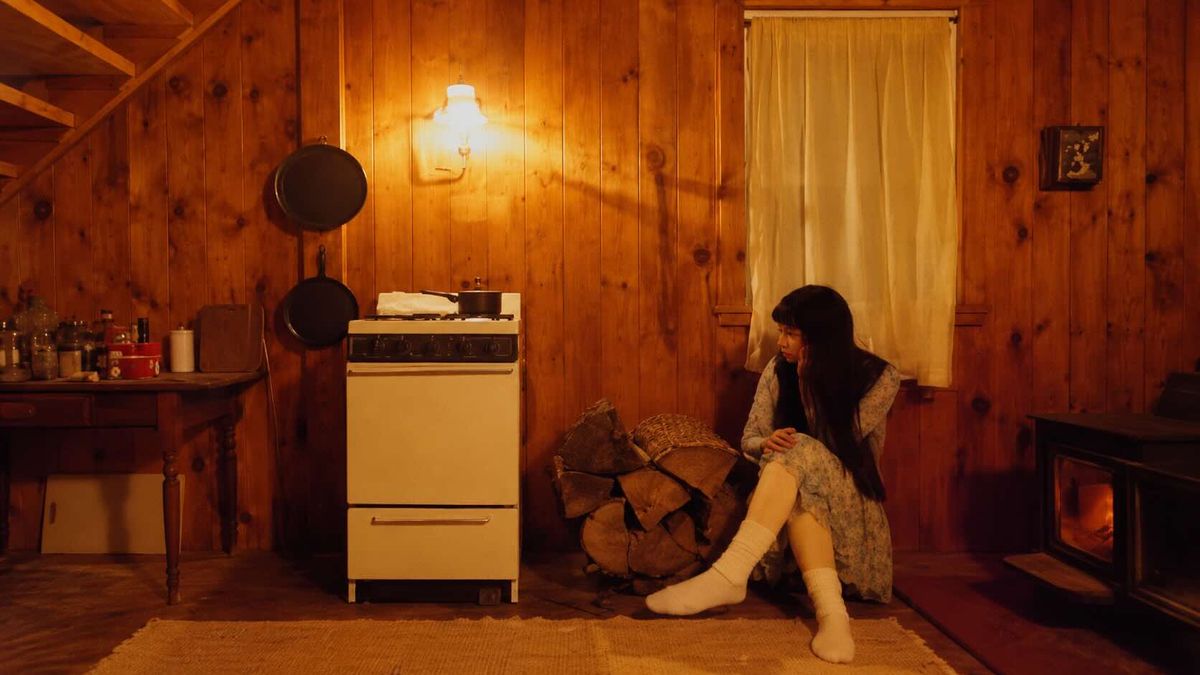
In the family house at the edge of the Everglades, the bass came up through the floor of her bedroom.
Her father, a carpenter, had built the speakers himself and kept three sound systems running in three rooms. She, meanwhile, listened to the folk records her parents called sleepy music.
Follow the Light, June McDoom’s first full-length album, released on 16 October by Jagjaguwar after the EPs issued by Temporary Residence, is presented by the label as the meeting of two musics. The house described in the notes suggests a more exact geometry: two musics separated by a floor. Bass passes through walls and boards; the high frequency of a vocal harmony stays in the room where it is born. The record is built according to the same physics, and its finest achievement lies in how the planes are distributed.
McDoom writes for voice and nylon-string guitar, then sings to Evan Wright the parts still to be developed: almost everything, the bass included, begins this way. The drums were recorded live in the Sunset Park studio of Victor Axelrod, known as Ticklah; the rest took shape in the couple’s home studio, between tape and digital, with one journey out for the harp.
“Without You” was born with the drums running from beginning to end, more present; McDoom then steeped it for a long time in the Cocteau Twins’ Victorialand, a record made by two people, and out of it came a song in which the harp and a dub bass keep the same breath. The lyric speaks of how insubstantial life becomes without the people we love.
A harp, a voice and strings rarely meet in the same ear, and on “Outside the Window” they arrive together, giving the song a far-off quality, at once botanical and marine. The sensation is of being crossed by a slow current, the way seaweed is crossed by the tide.
For most of its length “Get Out of My Life” is a nineties folk pop song, with percussion that leans towards Kate Bush. Then, late, a reggae rhythm slides in underneath and a recorder takes a solo, and so the school classroom walks into the sound system room. The record often carries two inheritances up to the border, and lets the background noise that every era drags behind it do the mediating.
Among the records McDoom named as references during the recording is Popol Vuh’s Hosianna Mantra, and in particular “Maria (Ave Maria)”. It is German devotional music from 1972, and it helps one feel the temperature of “Memory”, written with her grandmother Aggie in mind and recorded with a nylon-string guitar, intimate as a memory held in the hand.
McDoom’s voice is a carefully tended one, emotionally close to the dream pop of the eighties, and here it receives very little reverb, staying in the foreground, dry. She has explained that it is difficult to capture, full of air, and that she combines several microphones because none of them, alone, gives back what she hears while she sings. Her grandfather needed only a phone: his voice enters “Grandpa” through a voice memo recorded on an iPhone, and it is deep to the point of the uncanny.
McDoom spent twelve-hour days at the mixing desk, and started again from the beginning when, during a visit at Christmas, her parents told her that her voice wasn’t coming through enough. The anecdote is tender, and it also says something about the record: in the middle stretch of the sequence the voices, layered by hand, occupy the spaces that dub would leave empty, and the opulence turns uniform, like a cloth too beautiful laid over every piece of furniture in the house.
“Forever” moves at an unhurried, certain pace, and it is here that the arrangements show their full measure, helped by the voice. The dub skeleton holds the rhythm and stays there, underneath, without crowding the song: what reaches the ear, in the end, is a singer-songwriter’s folk song.
Only once does dub reggae take the opening credits. “Dream Dub” lines up what the record does throughout, while harp and piano, dreamlike, keep the mesh of the rhythm wide, like a sound system loaded onto a rowing boat in the middle of a lake: the bass spreads through the water all the way to the shore.
Her parents, McDoom has said, still do not love folk. The record, though, they do, because they hear the reggae in it.