Warrington Runcorn New Town Development Plan :: People & Industry (special edition)
Hauntological electronica, postwar modernism and unfinished futures

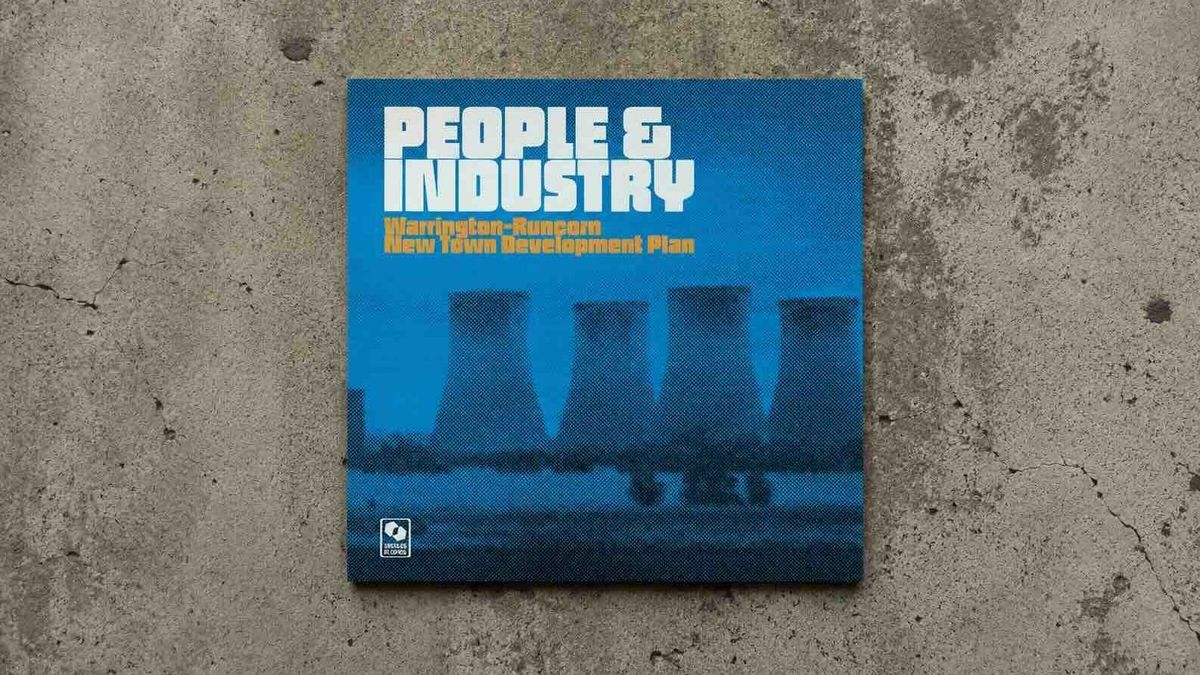
People & Industry is arguably the most overlooked record in the Warrington-Runcorn New Town Development Plan catalogue. Five years later, its Special Edition gives the album another life without pretending that the intervening years never happened.
Released on 3 September 2021, it arrived in the wake of the almost unexpected impact of Interim Report, March 1979 and found itself partly overshadowed by its predecessor, despite Gordon Chapman-Fox now regarding it as one of his most melodically inventive and compositionally ambitious works. Returning to it five years later, he found those same ideas illuminated from a different angle, enough to convince him that the album deserved a second life.
The Special Edition, released on 3 July 2026 by Castles in Space, grows out of that impulse: not simply to expand the record, but to restore the shape it had gradually assumed through years of live performance. Aerospace and Industrial Zone, previously available as bonus tracks but never on vinyl, finally find their place there alongside Polytechnic (2025 Live Version) and Standard Industrial Classification. The impression is of a record that never really stopped growing, observing the same industrial world from a different distance. Chemical plants, aerospace hubs, polytechnics and new towns become fragments of a future imagined by postwar Britain and heard now through the filter of memory. Chapman-Fox looks back without indulging in nostalgia. What interests him is a British modernism still suspended in possibility, caught mid-sentence, with everything it might still have become.
Even before this reissue, People & Industry occupied a distinctive place within the Warrington-Runcorn New Town Development Plan catalogue. While remaining rooted in Chapman-Fox's fascination with postwar British planning and municipal architecture, it also revealed one of his most melodically generous works, allowing sequenced electronics and luminous synthesiser writing to carry as much emotional weight as the places that inspired them. It is precisely that balance which the Special Edition now expands rather than revises.
That is precisely what gives the Special Edition its purpose. Rather than revising People & Industry, it reframes it. These four additional pieces are not presented as outtakes or archival curiosities, but as compositions whose place within the album has gradually become clearer through years of performance and through Chapman-Fox's changing relationship with the material. Heard together, they broaden the record's horizon rather than interrupt it, making this less a retrospective reissue than the continuation of an unfinished conversation.
Originally released as a bonus track for the 2021 edition, “Aerospace” now feels fully integrated into the record, no longer heard as an isolated extra but as part of a broader musical continuity. Throughout the piece, constantly shifting filters hold the sound in a permanent state of transformation. It is like watching sunlight move across the bronze-tinted windows of a modernist building: the structure remains fixed while the light quietly rewrites its character. Here the synthesiser stops behaving like a programmed machine and acquires the irregular grain of a living instrument.
“Industrial Zone”, also originally a bonus track, reveals a more accomplished piece of writing than its former status might have suggested. Its construction remains deliberately uncomplicated. Chapman-Fox avoids unnecessary complexity, relying instead on near-elemental melodies and a compositional language whose strength lies in restraint. The pads glance toward synthwave without borrowing its nostalgic rhetoric, while the melodic lines retain the narrative clarity of British television production music from the 1970s and '80s.
In the end, the piece quietly reaffirms one of music's simplest truths: a well-written melody still carries a power no amount of timbral sophistication can replace.
“Polytechnic” is what happens when a composition continues living long after its initial release. Written during the original People & Industry sessions, it returns five years later carrying the subtle transformations accumulated through countless performances. Chapman-Fox himself now remembers it differently, and that altered memory becomes part of the composition.
The arpeggios arrive first. They do not describe movement. They build its infrastructure.
They chase one another with the measured rhythm of reflected light, sketching geometries that seem to belong to an imagined future. When bass, pulse and synthesisers finally enter, they settle into the framework already established by those opening figures, as though the piece were discovering the form it had always contained. In the background, thin veils of noise drift through the mix like dust suspended in afternoon light, never obscuring the arpeggios, which continue renewing themselves through almost imperceptible variations. It becomes a mechanical choreography, constantly rewriting itself without ever disturbing its own balance.
“Standard Industrial Classification” closes the Special Edition by returning deliberately to the sonic vocabulary of People & Industry, carrying with it everything that five years of performances have quietly changed. Its opening possesses the contemplative calm characteristic of Chapman-Fox's finest work. The harmonic progression remains unexpectedly luminous, while the synthesisers and sequenced patterns draw on electro-gothic and darkwave only to strip away their habitual melancholy. What remains is their colour, separated from the emotional weight those traditions usually carry. The retro-futurist sensibility never becomes nostalgic; instead it resembles a technical drawing still under revision, uncertain whether it describes a building that already exists or one that has yet to be constructed. The piece ultimately asks what the continuity of British modernism might have sounded like had anyone simply allowed it to continue.
Shifting filters keep the sound in transformation while the underlying structure remains fixed, like changing light across a modernist building.
Arpeggios establish the infrastructure first, with bass, pulse and synthesisers later settling into a geometry that keeps renewing itself through small variations.
Luminous harmony and sequenced patterns return to the album’s original vocabulary while treating British modernism as a technical drawing still under revision.