Tomm Moore :: Song of the Sea
Hand-drawn Irish animation: grief, selkies, a sea of sixteen waves.
In 1963 a Japanese animated film had a song called “Haha no Nai Ko no Komoriuta”, “Lullaby of the Motherless Child”. Fifty years later, in Ireland, a mute girl has to sing to free the world from the grief of a mother lost to the sea.
The 1963 film is Toei’s Wanpaku Ōji no Orochi Taiji, directed by Yūgo Serikawa, with animation supervised by Yasuji Mori, and Isao Takahata among the assistants. Susanoo loses his mother, refuses to believe his father’s explanation and sets off to find her, in a world of angular shapes and flat colours that broke with the roundness of the studio’s earlier films. Tomm Moore named it among his inspirations when Song of the Sea reached Japan in August 2016. The film’s Ireland comes from the beach at Ventry where Moore and his son found dead grey seals, the fishermen who blamed them for dwindling catches, the selkie stories that would once have protected them. The way a child moves through grief in a world drawn flat has a Japanese precedent as well as a debt to illuminated manuscripts.
Ben is ten and lives in a lighthouse with his father, Conor, and Saoirse, who is six and was born the night their mother, Bronagh, vanished. Ben blames his sister. Conor watches the sea and does not speak. That sea, according to an interview Moore gave a Japanese website, owes its look to the budget: they could not afford to draw it by hand as in Ponyo, so they built it from sixteen watercolour wave patterns, copied and combined, like a pop-up book. The film’s water keeps returning unchanged in front of a man unable to look at anything else.
The most useful reading I found came from Russian viewers, who linger on the uncomfortable characters. The owl witch Macha shuts other people’s emotions in glass jars, and one viewer compared her to a Zen master. The grandmother, who takes the children to the city for their own good, practises what one reviewer calls an obsessive virtue. Macha and the grandmother are two old women who take pain away from those they love: the first turned her son Mac Lir to stone rather than see him suffer, the second tears her grandchildren from the coast. The first draft, Moore says, followed Kübler-Ross’s stages of grief and was too heavy. Of that scheme, only the jars remain.
The film loses something exactly where it should hit hardest. On the last night Saoirse sings, the creatures are freed, Bronagh appears to explain and say goodbye, the girl stays with her family and Conor embraces his children. A single night dissolves six years of silence, as the mother returns to give permission to stop waiting for her. The draughtsmanship and Lisa Hannigan’s voice make all of this irresistible, and I still suspect another film would have left Ben on the shore with no explanation. The same Russian reviewer suggests it can be read that way too, as the story of a family telling itself a fairy tale rather than look a loss in the face.
In the Great Seanachaí's cave every strand of beard is a story, and Ben follows one to learn where his sister has gone.
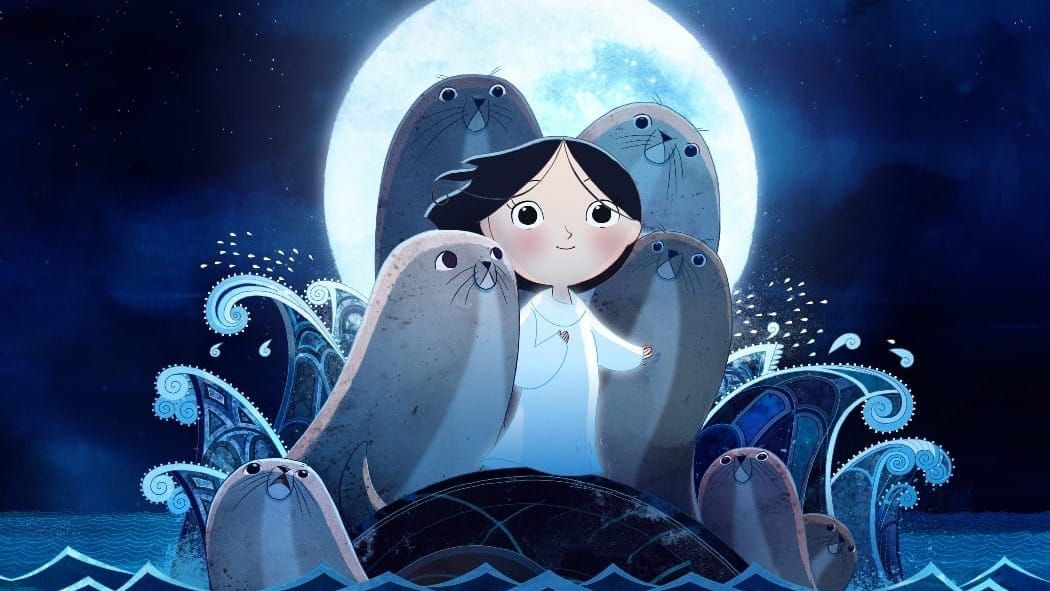
The seals help Ben recover Saoirse's coat.
On Halloween night the children run away from their grandmother and cross Dublin among masks and real creatures.
After its premiere in Toronto in September 2014, the film opened in France, North America and Denmark. It reached Ireland on 10 July 2015, with an Irish-language version.