The Electro Quartet :: Nature's World With Studio G
Library music from 1982: synth cues for nature films, indexed by keyword.
The 1982 catalogue describes “Aquarium” as rolling hills, water and clouds, without so much as a fish: two minutes of music were all anyone cutting a panorama needed.
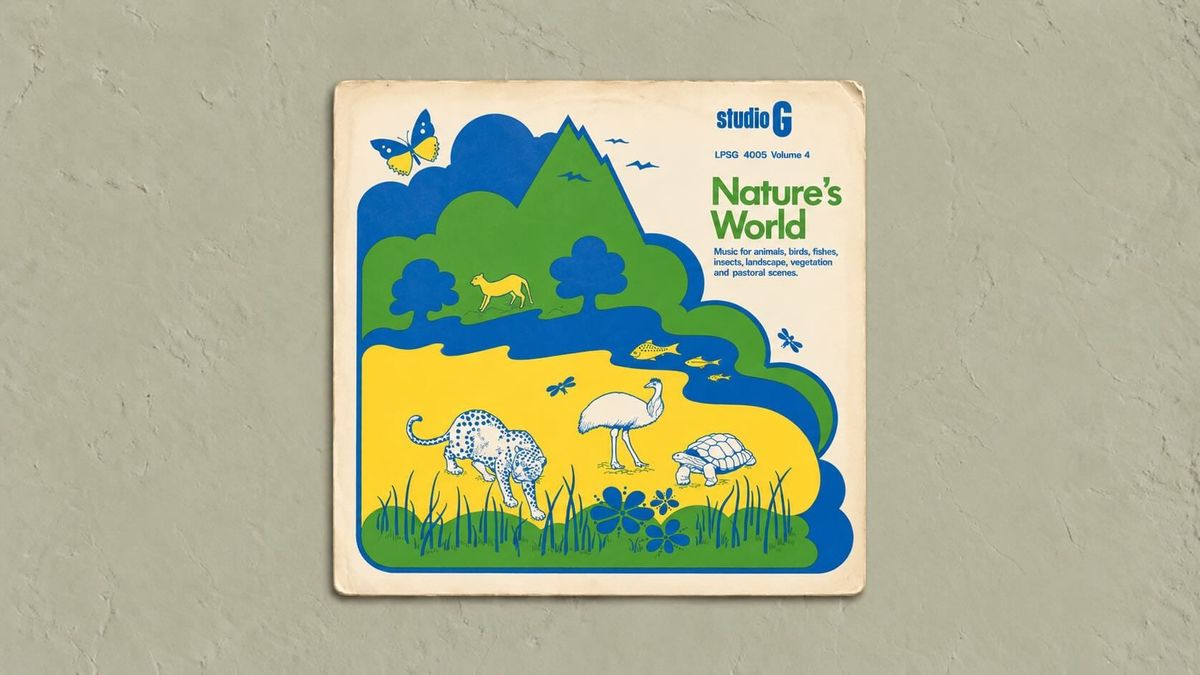
Nature’s World came out on Studio G in 1982, catalogue number LPSG 4005, and Jazz Dispensary, an imprint of Craft Recordings, reissued it on 16 October 2026 on green, yellow and blue splatter vinyl. Studio G was started in the late 1960s by a London adman, John Gale, and its records were aimed at producers and editors, people who read before they listened. Each track came with a “pictorial suggestion”, a few words to lead straight to the piece that suited the pictures awaiting music.
In the index nature is sorted by use: “Flower Garden” and “Furs And Feathers” have nearly the same entry, flowers, plants, trees, growth, and the second adds insects and birds without mentioning, despite its title, a single animal with fur. “Mountain Currents” is powerful, majestic, “Swirling Clouds” powerful, spacial, “Volcanic Journey” powerful, mysterious: for mountain, cloud and volcano the first adjective stays put and the second does the sorting.
The two sides have different composers and different lengths. James Harpham wrote the first, twelve tracks in just over twenty-one minutes, none past 2:15. James Asher wrote the second, eight tracks in twenty minutes, among them the only three to reach the three-minute mark: “Busy Bodies”, “Volcanic Journey” and “Jumbo Jive”. To me this looks like a difference of craft, with Harpham delivering one still after another and Asher, at least in those three pieces, giving the scene time to move.
Harpham’s music had reached other halls too: his biographical note mentions a Clarinet Concerto performed by Jack Brymer at the Queen Elizabeth Hall and a Fantasia on British Folk-songs given at the Albert Hall. From 1981 to 1984 he scored Tenko, the BBC drama about women held in Japanese prison camps. Asher had played drums on two tracks of Pete Townshend’s Empty Glass and in 1981, for the rival library Bruton, had recorded “Between The Icebergs”, which makes his “Arctic Wastes” look like a habit.
This is library music that comes close to jazz and plays it on dry synths, with no effects to mask the outline. Feeling and mood steer it: the tracks steal ideas from the footage they are meant to accompany, and whoever is cutting may find in them a shot they did not yet have. On the second side Asher’s pieces grow slightly more complicated and the tension climbs, at moments edging towards John Carpenter.
No credit says which machines are playing. The Electro Quartet is anonymous too: the name sits on the 1982 sleeve with no musicians beside it, the reissue sells the record under the Studio G banner, and I have found no trace of that quartet.
Anyone who follows Ghost Box and Clay Pipe will recognise in these cues the British television they remember, though nobody has shown a direct line from this record to those catalogues. One credit at least points that way: in 1983 Harpham scored The Witches and the Grinnygog, a children’s serial, a year after cataloguing mists and dewdrops.