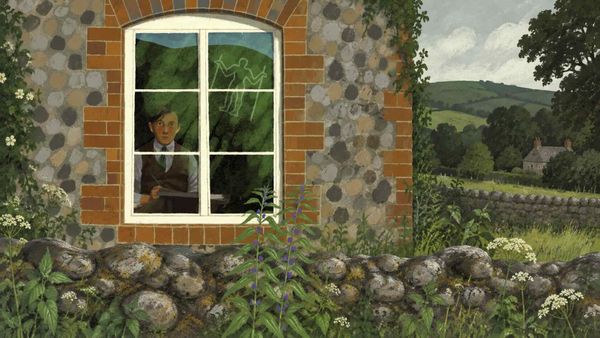
Tokyo Bedroom Orchestra :: Tsuioku / 追憶
Ambient folk, cassette loops, guitar, strings and unstable memory


Kitchen Label has spent the best part of two decades making a particular kind of quiet: the Singapore imprint run by Aspidistrafly, home to haruka nakamura and a small family of artists who treat hush as a discipline rather than a mood.
Tsuioku belongs there and, at the same time, sits a little apart. It is the new Tokyo Bedroom Orchestra album, the bedroom project of Hiro Nakamura, by day a composer for games and animation (Steins;Gate Elite, the Yuru Camp△ series), by every other hour a man who looks at the sky each morning and records what it leaves in him.
His method is a poetics of not-touching. "I almost never edit," he has said; "if I do, I might miss the inspiration." No more than five tracks to a piece, "simple is beautiful", and he prefers mixing through a cassette recorder. So the imperfections are not blemishes left in by accident; they are the record's grammar. Tsuioku, 追憶, a word that means less "memory" than the pursuit of one, the act of chasing something as it recedes, is an album built from takes he refused to correct.
It opens on "Shikijitsu" with the tape already breathing unevenly, the wow and flutter there from the first bars, the sound never quite holding still. It ought to read as decay. Instead it reads as something luminous and rural and awake, a daylight creature; when the strings arrive they slip politely to the back, careful not to disturb it. "Minamo", 水面, the surface of the water, is the softest tape here, and the loveliest: guitar and strings hover just above the water without touching it. "Shayou" opens onto what sounds like a life running parallel to our own, an organic scaffolding of sound in which a synth line holds each note a beat too long. And "Sagani" turns coarse and marine, grit, spray, dust, dense loops laid one over another until you feel yourself pulled under.
The twelve pieces are short, most sit at two or three minutes, and shorter still than they announce, leaving with a sensation of too soon: the repetition and the tape shave something off, so each one slips away a beat before you're ready. But that is the method showing its edges, a man catching a moment rather than raising a monument. The guitar, when it comes, is almost always clear and forward, opening arpeggios and slow phrases like a corolla. And yet it keeps reaching the edge of that repetition and surprising you there, the surprise made with acoustic instruments rather than effects.
Everything runs on repetition, because this is tape music.
The title track closes the record, as his records tend to close, and it is where the machine finally gives. It is not one loop that stumbles but the whole piece: the pitch sags, the tempo drops without warning, the sound drags until you half-reach for the player yourself, certain something is wrong with the tape and not the music. For three minutes it tries to spin a harmonic thread and never quite manages. What it spins instead is an emotional one. By the end you cannot tell whether you are hearing a song failing or a memory doing what memories do, slowing, warping, refusing to resolve, and staying with you precisely because it will not hold still.