The Twelve Hour Foundation :: Expanded & Repurposed
Library music, analogue synths, broadcast idents and modernist nostalgia
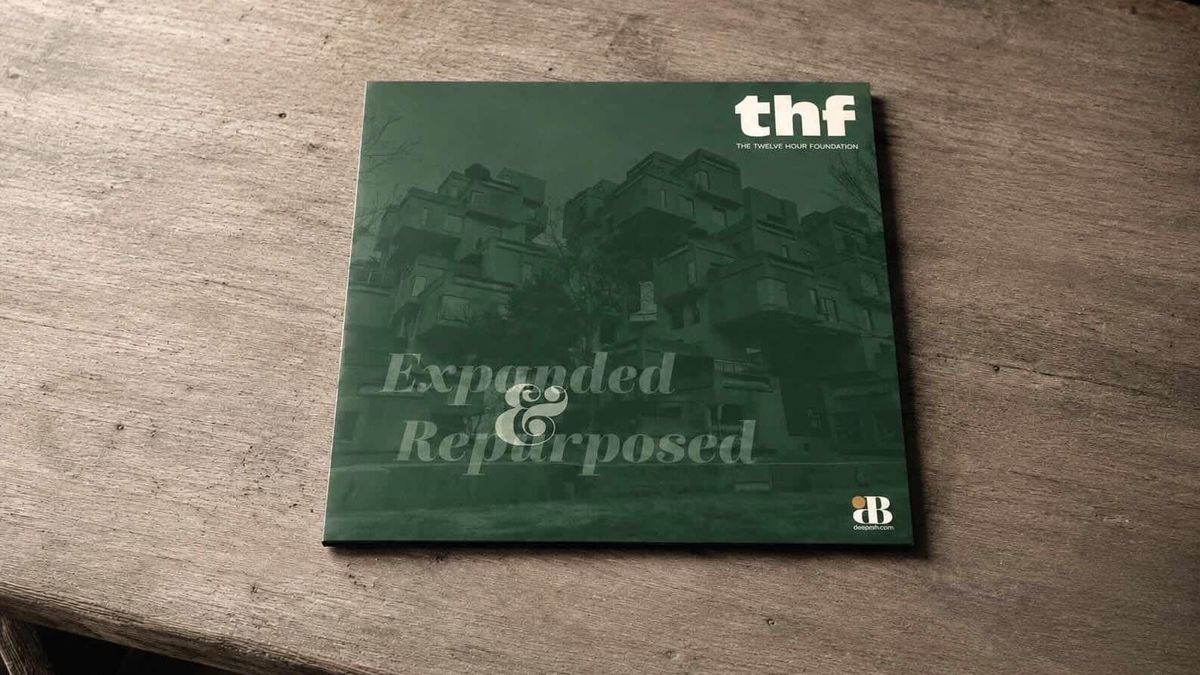
The fifth album by Polly Hulse and Jez Butler, Expanded & Repurposed grows six short idents from The Hexagonal World of The Twelve Hour Foundation into full-length pieces, all moving in 6/4 through analogue synthesisers, found sounds and field recordings.
Four tracks are new reworkings; the other two first appeared in 2022 on the lathe-cut single Quicksilver Records / Cascade. Alan Gubby plays vibraphone on “Habitat 67”. Recorded in spring 2026, the album uses field recordings gathered around Bristol and on transport networks during a visit to Canada.
Some records construct an inner landscape while pretending to describe a real one. Expanded & Repurposed belongs to that lineage of writing in sound.
“Balconville” is dependable electronic music, the kind one reaches for when certainty is part of the pleasure. A few waveforms are enough; there is no need for elaborate circuitry. It sounds like the work of a British sound laboratory in the 1970s, commissioned to produce themes, interludes and demonstration music for educational television. The timbres have something playful about them, as though they came from a small mechanical apparatus found in an attic, still in perfect working order.
“Habitat 67” announces its own Middle Ages, rebuilt from analogue circuitry and plywood. It might accompany an old television tutorial on how to assemble a miniature castle: the main gate opens, small bells are set ringing, invisible gears set towers and drawbridges in motion. Alan Gubby’s vibraphone enters after the mechanism has completed its first turn, without laying claim to the centre of the stage. It falls into step with the synthetic chimes and slightly extends their decay. Where the electronic sound stops abruptly, the real note remains suspended for an instant, a small physical residue inside an otherwise sealed machine. Everything proceeds with the courteous order of a demonstration device. Beneath the electro-kraut surface survives the melody of a rural fair, reduced to its mechanical elements and entrusted to synthesisers that might have been assembled in a 1970s classroom.
“Cinq à Sept” is modernist pop on a domestic scale, faintly eccentric. Its nostalgia does not pose for attention. It surfaces through a miniature musique concrète made from synthetic sounds that feel friendly, almost tactile. Each element darts from one point of the track to another, with the sudden mobility of a hummingbird among the first spring flowers.
“Slumgum” brings early Air to mind for a moment, though it leaves a less immediate trace. It remains a beautiful piece. The bass advances through narrow intervals, the keyboards waver slightly, while ticks and small concrete fragments enter the rhythm as components of the same device. The Twelve Hour Foundation seem to have moved their radiophonic studio a few degrees farther south. The geometries remain exact, but the sonic matter has grown denser. It retains heat, dust, perhaps a little shade.
The nostalgia of this record does not belong to a single period. “Pollen” preserves the same temperament and arranges it into compartments, like a school archive: diagrams, architectural models, classrooms, television idents, technocratic promises reduced to small sonic fossils. What is missing is not really a historical period. It is the method of that period, its almost ledger-like faith that the future could be catalogued, explained and reproduced to scale.
Something, however, always escapes classification.
A sound lasts longer than expected, a melodic figure tilts slightly, an apparently functional detail opens a brief emotional fissure.
“Winter Cluster” attempts a different taxonomy, shifted eastward. It recalls certain electronic experiments from the Eastern Bloc in the early 1980s, still untouched by the more polished seductions of Western consumer culture, built within a sonic economy of discipline and limited means. The synthetic flutes gesture towards a distant, almost incongruous exoticism. Polly Hulse’s vocoder, more withdrawn elsewhere on the album, rises beneath them without forming recognisable words. It is a faint presence, yet enough to return a human body to the track’s geometry.
Analogue circuitry, synthetic chimes and Alan Gubby’s vibraphone turn the piece into a small mechanical apparatus whose real notes briefly outlast the machine.
Diagrams, classrooms, television idents and technocratic promises are arranged like sonic fossils from a future once thought capable of being catalogued.
Synthetic flutes and Polly Hulse’s faint vocoder shift the record eastward while returning a human presence to its controlled electronic geometry.
Listening to Expanded & Repurposed is like tuning into a channel abandoned decades ago and discovering that it is still broadcasting. The album preserves the memory of music designed to accompany intervals, demonstrations, transitions from one programme to the next. The original function has vanished; the form remains. Within it survives the anonymous labour of radio technicians, library-music composers, editors and sound designers for whom every gesture had to serve a purpose.
The Twelve Hour Foundation recover that rigour without turning it into an exercise in musical archaeology. In their work, the modernist future returns at reduced scale, assembled from opaque plastics, intermittent signals and domestic materials. Amid all this discipline, the smallest detail can take far more with it than it should.