Ghosts of the Early Afternoon
Italian library music, archive film and the daylight ghosts of modernity

It always begins with a shaft of light in the dark: the projector switched on, the cone cutting through the hall, fine dust moving inside it as if it had a destiny.
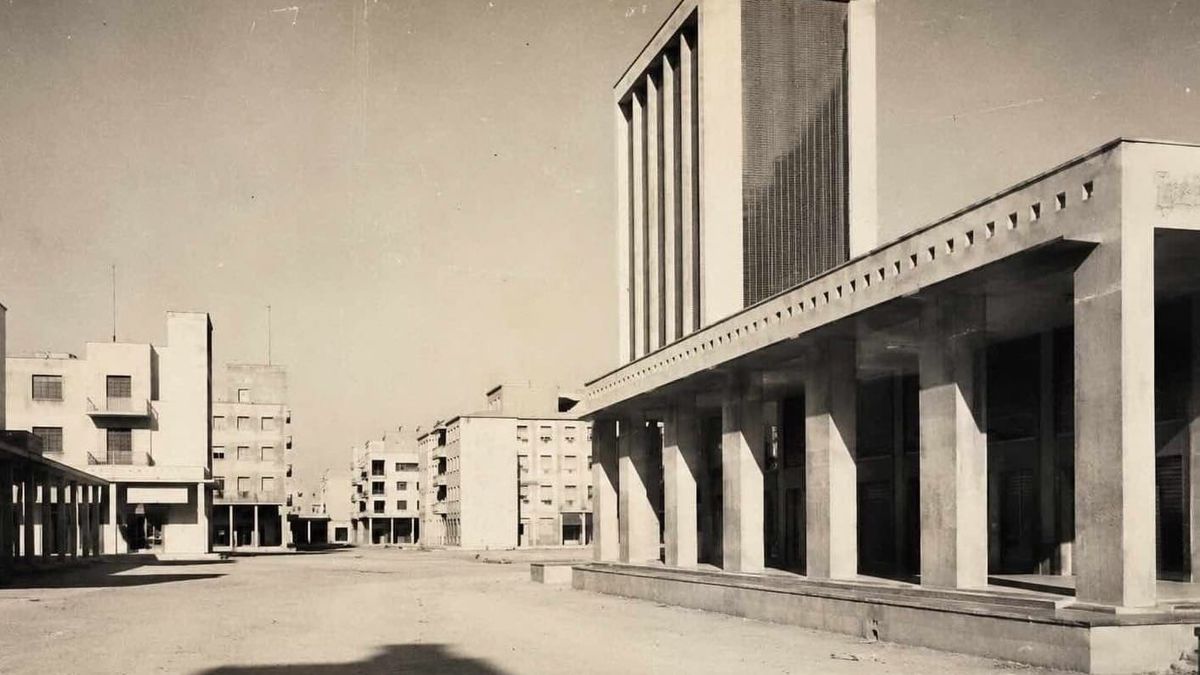
The Istituto Luce is named after that beam. L.U.C.E., L'Unione Cinematografica Educativa, spells the Italian for light. Founded in 1924 and soon taken over by the Fascist regime, the institute was meant to illuminate Italy by telling it where it was headed: harvests, land reclamation, new towns hauled out of empty marshland, trains, dams, ears of wheat against the sun. The regime filmed its future and believed every frame. That future ended in war and ruin, and I do not mourn it. The institute survived a liquidation in 1947 and went back to filming the Republic, its reconstruction and the promises of the economic miracle, until the images of both Italies came to rest in the same archive, each still announcing a future that did not arrive as promised.
I. The daylight side
The hauntology everyone talks about is English and nocturnal. It was born in foggy suburbs and in the corridors of the BBC Radiophonic Workshop, in the vinyl crackle Burial makes sound like rain on asphalt after a rave, and it is made of grey interiors, red-brick schools and a British social democracy left unfinished. Critics who turn the same lens on Italy have tended to find the opposite: a blood-red country of esoterica, giallo and Lucio Fulci, whose nostalgia is shaped by Sergio Leone and horror, by sun and violence, and whose memory is a nightmare. That reading accounts for half the country.
The other half returns in the early afternoon, with the school documentary we Italians watched as children, curtains drawn, the title music announcing a film about the wheat harvest, the trained, ringing voice blessing a new tractor as though it were the Resurrection. This Italian daylight spectre has no teeth. It is a blurred horizon, overexposed light, a little tune that keeps coming back.
II. The whistle
Nearly everyone could hum that little tune, yet few could name a single composer of such music. The first name I would give is Alessandro Alessandroni. His is the whistle in Ennio Morricone's scores for Leone's westerns, the sound that became an America imagined by Italians. Behind the whistle lies a continent of choirs, library scores and sonorizzazioni, music for films long since forgotten. In Alessandroni the sunlit, violent Italy of Leone meets the pale one, with its green agrarian melancholy, in music written for images of fields and flocks, footage meant to be seen once.
Library music proper was written on commission and issued in catalogues, to run under footage of sport, nature, industry and current affairs, often by distinguished composers who used pseudonyms because the work was purely functional. Piero Umiliani, one of whose aliases was Zalla, also wrote the one such tune the whole world knows, "Mah Nà Mah Nà", for a 1968 mondo documentary; Sesame Street and the Muppets adopted it later. His other titles read like unwitting epitaphs for an Italy already passing as it was filmed: "Nostalgia" (twice on one compilation), "Tanto tempo fa" (Long ago), "Tanto lontano" (So far away), "Viaggio nel tempo" (Journey through time).
III. Repertorio
The catalogue of the Luce archive has a word for its own leftovers: repertorio. It is what an Italian editor calls stock footage, and it is also what a singer calls the songs she keeps ready.
Under that heading thousands of reels survive, especially from the Incom newsreels, as trims, duplicates, offcuts and unfinished assemblies. Somebody shot this footage, somebody judged it useless, and somebody kept it anyway. In the 1970s the institute also began making new films out of archive footage, and by the 1990s it was doing so as a matter of course. The archive was recutting its own ghosts.
IV. The leave-taking
Since July 2012 some thirty thousand clips, mostly newsreels, have been on YouTube, after a deal with Google. At three in the morning you can watch the reclamation of the Pontine Marshes, the regime's showpiece, while the algorithm queues another dead man, and another. A click away are the classrooms and the electrified countryside of the postwar future we never quite had. The Italy that promised itself a future plays on unasked, grainy, between the memes.
The English spectre holds on, resentful of a stolen future, and goes on mourning. These Italian images of wheat under a high sun, with a whistle fading across the field, seem to ask only to be let go, in the mood the Japanese call mono no aware, a gentle sorrow at the passing of things. Perhaps our daylight hauntology is a leave-taking we keep putting off.
Last revised: July 2026