The Many Lives of The Unquiet Grave
Traditional ballad, grief, oral memory and songs carried across borders

A twelvemonth and a day is how long English tradition allows the living to grieve before the dead ask to be released from it. That is the premise of a threnody so plain in its four or five verses that it can be sung whole in under two minutes.
It is so persistent that Francis James Child filed it as number 78 among the 305 ballads he judged worth saving from an oral tradition that was, in his own lifetime, already going quiet. Singers have gone on saving it since, on their own account, long after Child stopped listening.
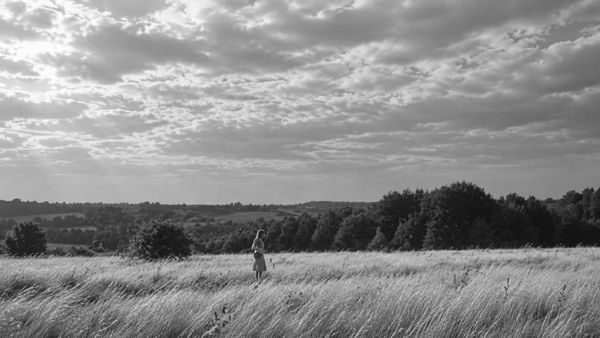
A man weeps at a grave until the twelvemonth is up. The dead woman speaks. She tells him his tears are keeping her from rest, that the ground above her is sodden with them. He begs one kiss. She refuses it: her lips are cold as clay, and a kiss from them would kill him. He says he wants to die and lie beside her anyway. She answers, gently and without cruelty, that were he to join her their two hearts would only decay together in the earth, and that the living owe the dead nothing so much as their own continuing to live. Cecil Sharp, collecting his own version early in the twentieth century, kept the closing exchange as a riddle. When will we meet again? When the autumn leaves that fall from the trees are green and spring up again. Never, in other words, said as gently as a refusal can be said.
Nothing about this reads like a text younger than the hills it seems to come from, and yet no manuscript carries it back further than the 1860s. Robert Waltz, who has spent much of a working life cataloguing ballads at Fresno State, once tried to trace a line from The Unquiet Grave to a carol copied into a Bodleian manuscript around 1500. He gave up the attempt himself, calling the resemblance “a stretch.” Ballad scholars have made a kind of peace with this vertigo. A song can feel older than its own paper trail. It can behave as though descended from something pre-Christian, as one early folklorist argued of it, and still own no proof beyond its own persuasiveness.
I. The Singer Who Kept Returning
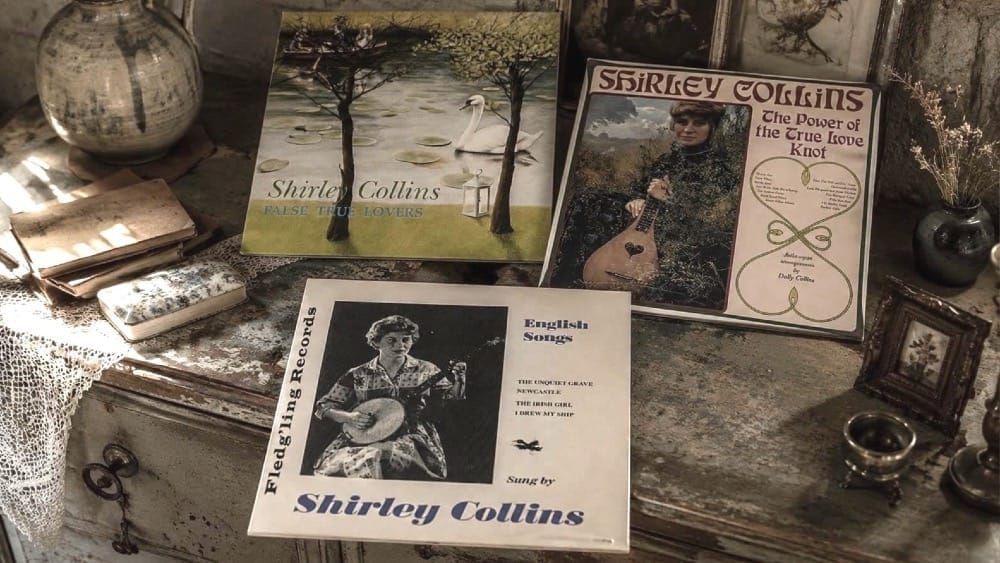
Shirley Collins recorded The Unquiet Grave at least three times that survive on record: once in 1959, for her first American-made LP False True Lovers; again on a small Collector EP called English Songs Vol. 1; and once more in 1967, on The Power of the True Love Knot, produced by Joe Boyd in the first flush of the folk revival’s turn toward strangeness. Three versions of one song across eight years is not, on its own, unusual for a singer who kept a repertoire the way other people keep a garden, going back to the same bed of earth because the soil there is good. What it confirms is durability. A song able to be sung dulcimer-plain in 1959 could later be dressed in Dolly Collins’ portative organ and reed instruments without losing the shape underneath. The ballad survives its own arrangements. Few do.
II. The Wider Family
Widen the lens and this grief that will not let the dead lie turns out to be one of the oldest habits European song has. In 1941 the folklorist Ruth Harvey laid The Unquiet Grave beside a German ballad called Es ging ein Knab spazieren, sometimes known as Der tote Freier, the dead suitor, and a Danish one, Fæstemanden i Graven, the betrothed man in the grave, adapted more than three centuries later into the 1983 short film Aage og Else. Child’s own notes for ballad 78 go further back still, tracing the same disturbance, weeping that will not let the dead alone, into Greek and Roman literature. None of these are the same song, but cousins more than twins, each shaped by its own tongue and its own dead. The family resemblance sits in the bones regardless: love is a debt the living keep trying to pay past the point where the dead can accept the coin.
A showier cousin belongs to this family without quite belonging to Child 78 itself. In 1773 the German poet Gottfried August Bürger published Lenore, in which a soldier presumed dead returns by night to carry his betrothed off on horseback, to their shared grave. It seized the continent’s imagination in a way few ballads have before or since. In Russia, Vasily Zhukovsky’s Lyudmila (1808) moved the story onto Russian soil and into a Russian idiom — it is generally reckoned the first Russian ballad written. A Lenore vogue swept Poland in the 1820s, Adam Mickiewicz among those who answered it. The dead bridegroom is a different revenant from the unquiet lover of the English ballad. He comes to claim. He does not come to release. Yet he rides out of the same stubbornness that will not let death finish what it started.
III. The East That Carried Its Own Dead
Further east and further back, a different kind of survival was underway, owed less to poets than to exile. When the Jews of Spain were expelled in 1492, the communities that resettled across the Balkans, Anatolia and Greece carried their Castilian with them, and inside it, sung and unwritten, whole romances that Spain itself had already let go of. Scholars of the Sephardic romancero have found, in Salonica and Sarajevo and Istanbul, ballads whose Spanish sits closer to the fifteenth century than anything spoken on the Iberian peninsula today. Among their recurring subjects are lovers parted and lovers returned, sung in kitchens by women who had never seen the words on a page and had no need to. A song can outlive the country that made it by five hundred years, if enough mothers refuse to stop singing it to their daughters.
Exile preserved more than old words. It preserved the ordinary circumstances in which songs remain alive. Not libraries but kitchens; not professional singers but families; not performance but repetition. By the time scholars reached Salonica or Sarajevo with notebooks in their hands, the archive already existed. It simply had no shelves. Oral tradition survives not by resisting change but by accepting just enough of it. A phrase slips, a melody borrows from another, a forgotten verse disappears while a new one quietly takes its place. The song remains recognisable because each generation leaves it almost, but never quite, untouched.
IV. The Romance Across the Ocean
The same colonial current that carried the Castilian romance east to the Sephardim had, a century earlier, carried another branch of it west. Romance del enamorado y la muerte, a sixteenth-century Spanish ballad, imagines Death arriving at a young man’s door disguised as his beloved. He is granted one hour of life, no more. His sweetheart lowers a silk cord from her window so he can climb to her before the hour ends, promising to add her own braided hair if the cord falls short. The silk snaps under his weight. Death, who has been waiting the whole time in the street below, only says the hour is up. This romance crossed the Atlantic during the colonial period and rooted itself in Chile so thoroughly that by the early twentieth century the folklorist Julio Vicuña Cifuentes was still able to write it down from singers who had it only by ear, in villages that had never seen Castile. Chile kept faith with a Spanish romance long after Spain’s own appetite for the form had thinned.
Songs have a habit of disappearing first from the places that made them. Literary fashions change quickly in capitals; rural memory has fewer reasons to hurry. A ballad that still belonged to work, courtship or mourning could remain useful long after educated readers had turned to other forms. By the time Vicuña Cifuentes travelled through the Chilean countryside with his notebook, the difficult part had already been done by generations of anonymous singers. The collector arrived at the end of the journey, not the beginning. His pages allow us to see the romance; they should never persuade us that they created it.
The unquiet dead, it turns out, need no passport.
Instead of tracing a perfect family tree, these songs reveal something less orderly and perhaps more convincing. Again and again, across different languages and landscapes, someone stands at the boundary between the living and the dead and asks for one moment more than death is prepared to allow. Whether that resemblance comes through inheritance, translation or coincidence matters less than the persistence of the image itself. Geography does not simply receive the song. It gives it another voice with which to remember.
V. What the Dead Ask
None of this makes The Unquiet Grave less English. If anything it does the opposite. It shows an ordinary grief, weeping too long over a grave, fluent enough to translate itself into German, Danish, Russian, Polish, Ladino and Chilean Spanish without once losing its meaning in the crossing. Grief, unlike most things people try to carry across an ocean, seems to need no customs declaration.
There is a comfort tucked inside all this scholarship that has nothing to do with scholarship at all. Somewhere in every one of these traditions sits a version of the same small mercy. The dead, however they are imagined, however far the ballad has travelled to find them, tend to ask the same thing of the quick. They do not ask for the last kiss, or the shared grave. They ask only that the weeping stop before it digs its own kind of grave, slowly, by hand, for someone who is still, against every proof offered by a twelvemonth and a day, alive.
Shirley Collins sang those last lines three times across eight years and never once made them sound like an answer. They were never meant to be one — a small kindness wearing the shape of a refusal, the only kind the dead know how to give.
Further Reading & Sources
Sources: Francis James Child, The English and Scottish Popular Ballads (1882–1898); Cecil J. Sharp, English Folk Songs from the Southern Appalachians and related manuscript collections; Robert B. Waltz & David G. Engle, The Traditional Ballad Index; Ruth E. Harvey, "The Unquiet Grave" (1941); Gottfried August Bürger, Lenore (1773); Vasily Zhukovsky, Lyudmila (1808); Ramón Menéndez Pidal, studies on the Romancero Hispánico; Julio Vicuña Cifuentes, Romances Populares y Vulgares (1912); selected studies on the Sephardic romancero, Judeo-Spanish oral tradition and the transmission of European ballads.
Editorial Note
This article was developed through interdisciplinary research combining folklore studies, historical geography, literary history, oral tradition and the history of vernacular song. Rather than tracing a single genealogy, Hwael Mag follows the movements of cultural memory across languages, landscapes and communities, treating ballads as living forms shaped by place as much as by time.
Last revised: July 2026