The Face that Keeps Growing Back
Folklore, medieval carvings, invented tradition and recurring green figures

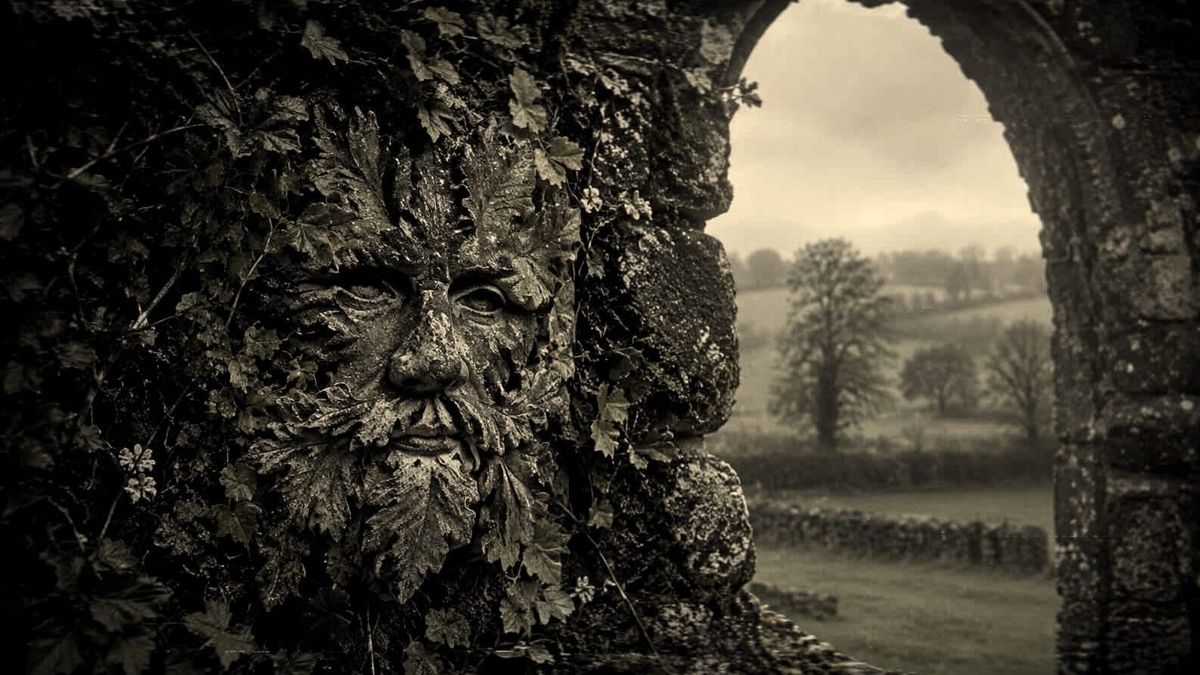
Ask anyone standing beneath one of these carvings what they're looking at, and the answer arrives ready-made: a scrap of pre-Christian Britain the church couldn't quite digest. Almost none of it is true.
At Southwell Minster, in the Chapter House carved around 1290, a man's face pushes through a tangle of hawthorn and oak, foliage spilling from the corners of his mouth as though the stone itself were slowly being reclaimed by the plant. It is now one of the best-known examples of what is called the Green Man. Visitors are routinely told it preserves an older Britain inside a Christian church, proof the old gods survived in the rafters long after the villagers below had been baptised.
The name is younger than the carving, and stranger than either. "Green Man" had already meant something else in England for four centuries before anyone applied it to a piece of stone: a man dressed head to foot in leaves and moss, hired to lead a May procession or startle a crowd at a pageant — theatre, not masonry. It was Julia Somerset, Lady Raglan, who in 1939 borrowed that old theatrical name for an article in the folklore journal and pinned it, for the first time, onto carvings the church itself had never called anything but foliate heads. Two traditions met in print that may never have met anywhere else.
I. What Basford Found Instead
Kathleen Basford spent much of a career trying to separate what Lady Raglan had joined. Her 1978 study — still the only serious scholarship the subject has received — traced the foliate head back past medieval England into late antiquity, where it survives as a kind of male Medusa: a decorative mask, sometimes sprouting snakes as readily as leaves, carried into cathedral stone the way ornament usually travels, mason learning from mason, workshop copying workshop, long before anyone thought to blame the druids for it. The popular line running from these carvings to Jack-in-the-Green, the leaf-costumed figure of the May Day parade, she rejected outright. Two green faces, in her account, that had simply never been introduced.
Basford's version is the harder sell. Transmission through pattern-books lacks the drama of a buried religion resurfacing in a parish church, and folklore, given the choice, usually prefers the resurfacing. But the paper trail she assembled — Roman leaf-masks, Romanesque capitals, the slow drift of a single motif through centuries of stonework — holds up in a way the druid theory never quite has.
II. A Face With Relatives
Loosen the name from the church wall and the face turns out to have relatives nobody in England ever introduced it to. Kirtimukha, the "Face of Glory," glares down from temple lintels across South and Southeast Asia — wide-mouthed and devouring rather than sprouting, placed there, according to Hindu myth, on Shiva's own order to guard every threshold it crosses. Some historians have proposed a route by which the image could have travelled, through the manuscript culture of the medieval Islamic world and into European monastery margins before it reached English stone, though the connection has never been proven, only guessed at with more or less confidence depending on who's arguing it.
Islam keeps a different green figure entirely. Al-Khidr — "the Green One" — is the immortal traveller said to have sat on barren ground until it flowered beneath him, the guide who drank from the Water of Life and still turns up, in local devotion, beside springs and rivers from Konya to the Balkans. Nothing connects him to the English carvings except the same instinct, arrived at on its own: that living land occasionally needs a face.
The pattern holds outside religion too. The Slavic Jarilo was buried, in effigy, at the end of each summer so that spring would have something to return to; the Curupira of Tupi-Guarani belief has feet turned backward, precisely so the hunters he misleads will follow tracks going the wrong way through the forest. Neither had any contact with medieval England. Both solved the same problem England solved with stone: how to give a season, or a warning, a face people would remember.
III. England, Twice Over
England, meanwhile, had folded the same instinct into more than one tradition long before it settled on a single explanation for its own church carvings. The Green Knight who rides into Camelot in the fourteenth-century poem carries an axe in one hand and a sprig of holly in the other — evergreen through the worst of winter — so that death and endurance arrive in the same green fist. And the costumed Green Man that Lady Raglan borrowed her name from never went anywhere. Every 29th of May a man still rides through Castleton, Derbyshire, inside a garland of flowers built up over his head and shoulders until he disappears into it, a walking hedge processing past a church that has, a few hundred yards up the road, a much older and considerably less costumed cousin.
None of these figures asked to be related to each other, and most of them, on the evidence, aren't. Each came out of a different landscape, a different fear of winter, a different way of telling people that the dead season doesn't get the last word. What they share isn't ancestry. It's recurrence — the same solution, reached again and again by people who never compared notes. Which is, if anything, a stranger claim than Lady Raglan's: not that one buried religion survived in the rafters of an English church, but that dozens of unconnected cultures kept inventing the same face out of leaves, on their own, for the same reason. Go back to Southwell, to that mouth full of hawthorn on the Chapter House wall, and the face isn't hiding a secret. It's just doing, in one more country, what faces like it have always done.
Further Reading & Sources
Sources: Lady Raglan, “The ‘Green Man’ in Church Architecture,” Folklore, vol. 50, no. 1 (1939); Kathleen Basford, The Green Man (1978); Richard Hayman, The Green Man (2010); Carolyne Larrington, The Land of the Green Man: A Journey through the Supernatural Landscapes of the British Isles (2015); Jacqueline Simpson and Steve Roud, A Dictionary of English Folklore (2000); Ronald Hutton, The Stations of the Sun: A History of the Ritual Year in Britain(1996); J.R.R. Tolkien and E.V. Gordon, eds., Sir Gawain and the Green Knight; The “Leaves of Southwell” and related historical material published by Southwell Minster; Encyclopaedia Iranica, “Ḵeżr,” with Patrick Franke’s studies of al-Khiḍr in Islamic literature and devotional culture; selected studies on Kīrtimukha in South Asian and Tibetan sacred art, medieval foliate masks, Roman and Romanesque ornamental transmission, Jack-in-the-Green, the Castleton Garland Ceremony, Slavic seasonal ritual and the Tupi-Guarani Curupira tradition.
Editorial Note
This article draws on medieval architectural history, folklore studies, comparative mythology and the later cultural history of the term “Green Man.” It distinguishes documented transmission from visual or functional analogy: resemblance between the foliate heads of medieval Europe, Kīrtimukha, al-Khiḍr, seasonal figures and forest guardians does not by itself establish common ancestry. The comparison is used instead to ask why unrelated cultures repeatedly gave vegetation, renewal, danger and the threshold a human face. Particular caution has been taken with modern survival theories, whose apparent antiquity often derives from twentieth-century naming, folklore collecting and ecological reinterpretation rather than from an unbroken medieval tradition.
Last revised: July 2026