The Bare Cross
Byzantine caves, forged histories, restored frescoes and layered memory

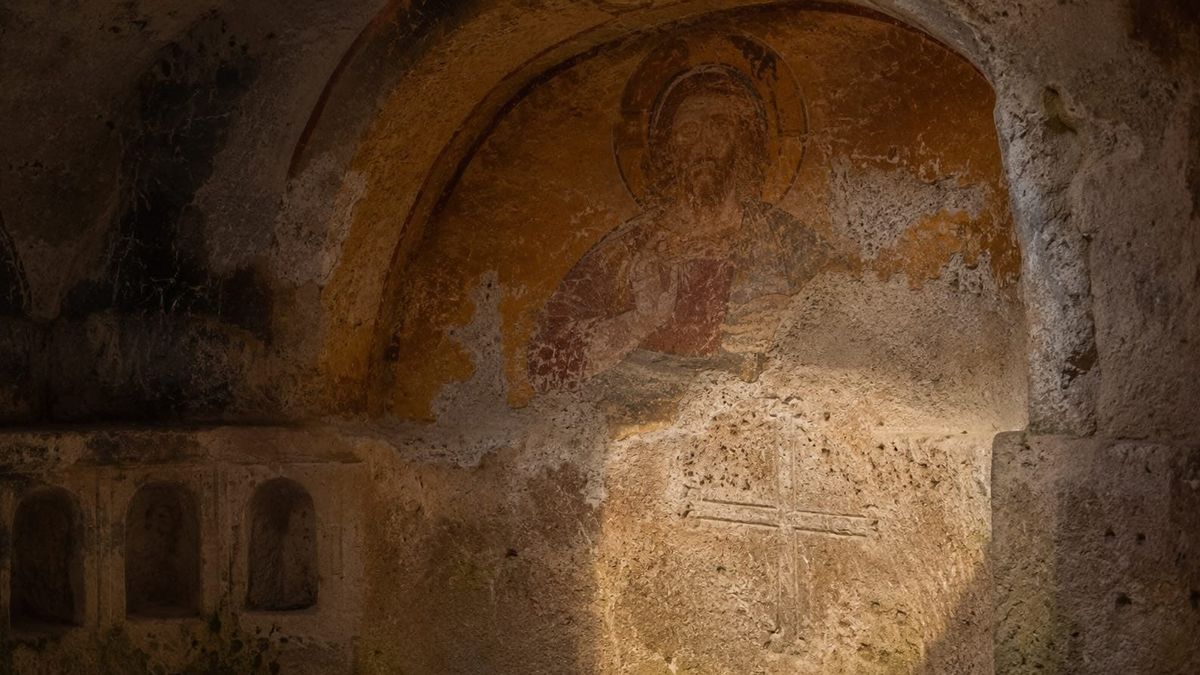
In the crypt of Cristo alle Grotte, in the gravina di San Biagio within the territory of Mottola, the rock is cut with ten bare crosses — of the kind that Byzantine ecclesial culture, two centuries now removed from the official end of the iconoclastic controversy, could still, in certain remote corners of the catapanate, prefer the bare sign to the figure.
No saint, no scene, no face: only the sign, incised in the first half of the eleventh century into a rock already hollowed out by human hands to serve as bema and nave. Only later — the sources do not fix when, and it would be dishonest to pretend otherwise — was a Christ Pantocrator painted onto that same apsidal vault, covering the void with a face the previous century had judged dangerous. Two images superimposed, an absence and a presence, on the same stone — palimpsest here is a term of masonry, not a literary metaphor.
At this point one could write the piece anyone would write: Puglia as a Western Thebaid, the Greek rite surviving beneath the Latin one, the suspended atmosphere of frescoed caves. All of it is true, and precisely for that reason it is the least interesting road available. The story worth telling is not the story of the caves. It is the story of the people who, for a hundred and twenty years, kept having to reinvent their own permission to speak about them.
I. The Heresy of Explanation
In the nineteenth century, two canons — Francesco Paolo Volpe in Matera, Francesco Caramia in Mottola — were among the first to propose a civil origin for these settlements hollowed from the rock: not monasteries, but peasant towns, pre-Christian in their settlement logic even where Christian in worship. They were silenced, or nearly so, by François Lenormant, the great popularizer who imposed, for a century, the dominant interpretation — Basilian monks, fleeing the iconoclastic persecutions of Byzantium, who had supposedly populated the gravine as the Desert Fathers had once populated the Egyptian Thebaid. Charles Diehl and Émile Bertaux reinforced it further, drawing parallels with Cappadocia. The trouble — and here the matter stops being anecdotal and becomes theological in the strictest sense of the word, a question of what one is permitted to believe on the evidence of what has been shown — is that Lenormant built his conclusions on documents later exposed as forgeries. For a century, Europe explained these caves through an ex post facto hagiography, long before anyone thought to ask whether one was needed at all.
Only in the 1950s and 60s, thanks to volunteer research groups rather than university chairs, did the civil hypothesis begin to find its footing again. In 1954 — and this is the document from which the whole argument here proceeds — the Istituto Luce sent a cameraman, Daniele G. Luisi, to shoot ten minutes of colour film titled Cristo fra le campagne: a shepherd crosses himself before a Basilian crypt, the camera moves inside, catalogues the frescoes as a "rare example of Byzantine painting in Italy," calls them a "destination of popular devotion." Three keywords accompany the archive record — Catholic religion, figurative arts, tourism — and those three words already contain the next explanation the century would impose on the rock: heritage, the same object seen through the vocabulary of devotion, aesthetics, and remembrance.
In 1970 Cosimo Damiano Fonseca published Civiltà rupestre in Terra Jonica — the neologism is said to have been coined by Espedito Jacovelli — and the following year, at Casalrotto, within the very territory of Mottola, the first international conference on medieval rupestrian civilisation in the Mezzogiorno was held. It is the act that re-founds the discipline, replacing the fleeing monks with an organised peasant world of its own churches, hamlets, and economy. Sixteen years later, in 1987, the glossy magazine Bell'Italia christened Mottola's four principal churches with the name that has stuck ever since — "the Caves of God." A civil origin first proposed by two provincial canons, buried for a century under a forger's fake documents, and only now sold back to readers as a magazine feature: the cave itself never moved.
II. The Removed Crypt
In Poggiardo, in the Salento — outside the Terra delle Gravine in the strict sense, but within the same Byzantine climate, in that coastal strip once close to the Grecìa Salentina — the crypt of Santa Maria degli Angeli served as a place of worship for over four centuries, until it was entirely abandoned in the sixteenth century, with the definitive disappearance of the Greek rite in that area. Rediscovered in 1929 at the centre of the town, it was found in such poor condition that in 1955 Cesare Brandi, then director of Rome's Istituto Centrale del Restauro, ordered the frescoes detached from the wall — the technical operation is called a strappo — for restoration; two decades of travelling exhibitions followed before they were finally remounted, in 1975, on panels inside a hypogeal museum excavated specifically beneath Piazza Episcopo, a faithful replica of the crypt's original plan.
It is the most exact image this whole territory has to offer, which is why it is worth more than any atmospheric description of the gravine at sunset: an authentic surface, restored to a faithful but false architecture, inside a town that no longer holds the rite that produced it. The sacred image did not come home — it was relocated into a stage set built specifically to resemble one. Anyone looking to English hauntology for the idea of a simulacrum that replaces the original and ends up seeming truer than it has no need of the metaphor here: one can visit it, beneath a square in the Salento, with the opening hours printed on a panel at the entrance.
III. The Polish Graffito and the Blood
Let us return to Mottola, to the gravina di Petruscio, the most extensive rupestrian settlement in its territory, perhaps identifiable with the castellum erected in 1023 by the catapan Basil Boioannes against Saracen raids, perhaps abandoned around 1156 during the campaigns of the emperor Manuel I Komnenos. Among its unpainted churches — the largest simply called "the Cathedral" — is one that still bears the name "the Poles' church": soldiers of the Polish II Corps, whose headquarters stood on a hilltop above the town during the 1943–45 Italian campaign, left inscriptions there. A cavity hollowed out of the eleventh-century Byzantine catapanate, reinhabited by an army in exile nine hundred years later — homesick men scratching their own language into a wall built for a liturgy in a different one, a few metres from a Byzantine apse that had already outlived the empire that carved it.
There is, finally, one last hypothesis, offered with the caution it deserves: scholarly conjecture, not established fact. The high incidence of thalassemia and Mediterranean anaemia among Puglia's population today has been linked, by some researchers, to Byzantine colonisation from the Black Sea, where these genetic mutations — protective against the malaria of once-marshy plains — were already widespread among the settlers. If this hypothesis holds, then the only place where that colonisation has literally never stopped being present is not the stone, not the fresco, not the archive folder: it is the blood of those who still inhabit that land. A haunting that needs no telling, because it transmits itself.
None of this — the bare cross reworked into a Pantocrator, a forger's documents shaping a century of scholarship, a graffito scratched by a homesick army — was invented to resemble an aesthetic. It is what a historiography does when it has to re-incise, every few decades, its own permission to look.
Further Reading & Sources
Primary Sources: Daniele G. Luisi, Cristo fra le campagne (Istituto Nazionale Luce, 1954); Cesare Brandi and the archival documentation of the Istituto Centrale del Restauro relating to the Crypt of Santa Maria degli Angeli, Poggiardo.
Selected Studies: Cosimo Damiano Fonseca, Civiltà Rupestre in Terra Jonica (1970); François Lenormant, La Grande-Grèce (1881–1884); Charles Diehl, L'Art byzantin dans l'Italie méridionale (1894); Émile Bertaux, L'Art dans l'Italie méridionale (1904); Domenico Caragnano, studies on the rupestrian settlements of Mottola and Petruscio; proceedings of the International Conferences on Medieval Rupestrian Civilisation; selected archaeological, historical and art-historical studies on Byzantine Puglia, the Terra delle Gravine, medieval rock-cut architecture, restoration history and southern Italian rupestrian civilisation.
Editorial Note
This article draws on the historiography of southern Italian rupestrian settlements, Byzantine art history, restoration records, archival film and local studies of the gravine around Mottola. It distinguishes documented chronology from later interpretation, particularly where monastic origins, iconoclastic survivals and genetic continuity remain disputed or conjectural. Hwael Mag approaches the cave churches as material sites repeatedly reclassified by scholarship, devotion, conservation and public memory: the stone endures, while the terms by which it is made intelligible continue to change.
Last revised: July 2026