The Balloonist :: Spirit Duplicator
Revisits the schoolrooms and half-heard pop of an 80s childhood.
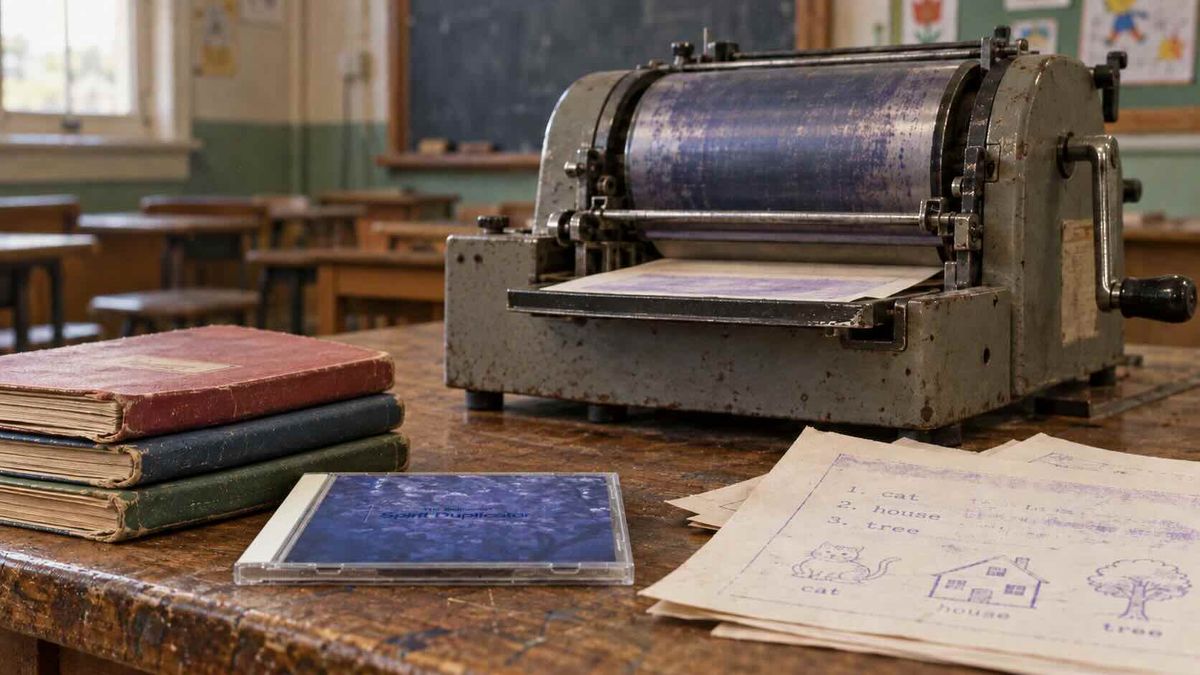
Spirit Duplicator takes its name from the machine that made those copies: an apt object for memories whose outlines survive after their information has gone.
The title comes from a machine. The spirit duplicator, the alcohol-fed ditto machine that for decades ran off worksheets and homework in British schools, made violet copies that smelled of solvent. Each copy came out a little paler than the one before, until the master gave out. Ben Holton has given that name to a record made of the same wear. The twelve pieces of Spirit Duplicator, released on 2 October by Wayside & Woodland, gather fragments of an English childhood of the mid-Eighties: the echo of the school hall, Pet Shop Boys cassettes on a recorder not long bought, television theme tunes on rainy afternoons.
Holton plays everything himself, and recorded, produced and mastered the record. There are synthesisers and programmed drums, and with them guitar, bass, drums, penny whistle, recorder and voice. The recorder is the right instrument in the right place. In England as in Italy you learn it in class, all together, short of breath, fingers arriving late on the holes. It carries into the record a childhood made of spit and imperfect coordination.
“Curtain Light”: the guitars lean towards the pastoral garb of July Skies, then pass through the corrections of the Cocteau Twins. “The Schoolmaster’s House” puts us in the room during the rehearsal of a recital. The pupils blow into flea-market recorders, the teacher holds them up with a Farfisa that is missing a key. The tape slows, and the accompaniment opens into small temporal intrusions, as if another classroom, from another year, were laid over this one for a moment.
“School Face” is a downtempo piece that moves its centre of gravity outside the buildings, with the Beach Fossils passed through reverb. In “The Stars in Winter” the lo-fi advances in the same climate, and the guitars, where saturated reverb feeds on glitches and scraps of time, weave the time of memory.
Then comes “Domesday ’86”, and if the title looks to the BBC videodisc of 1986, “Memory Error” sounds like the message that system would have returned.
The first Balloonist album described its countryside as an Arcadia that exists only in the mind. Spirit Duplicator furnishes it with classrooms, bought objects, television schedules.
A nostalgia this detailed risks exhausting itself in recognition, when the childhood of the listener does not coincide with Holton’s. In a village in the South of Italy the theme tunes were other ones, the rain came in other months; and yet the way of building one’s memories ends up fused with the past, and the television set, carrying the same images from land to land, has made them, almost inevitably, communal memory. The pieces, built with the patience of a slightly absent-minded archivist, bring us in by a side door and leave us the time to sit down in a classroom that is now also ours.