Terrence Malick :: Days of Heaven
Magic-hour cinema, migrant labour, impermanence and light as presence

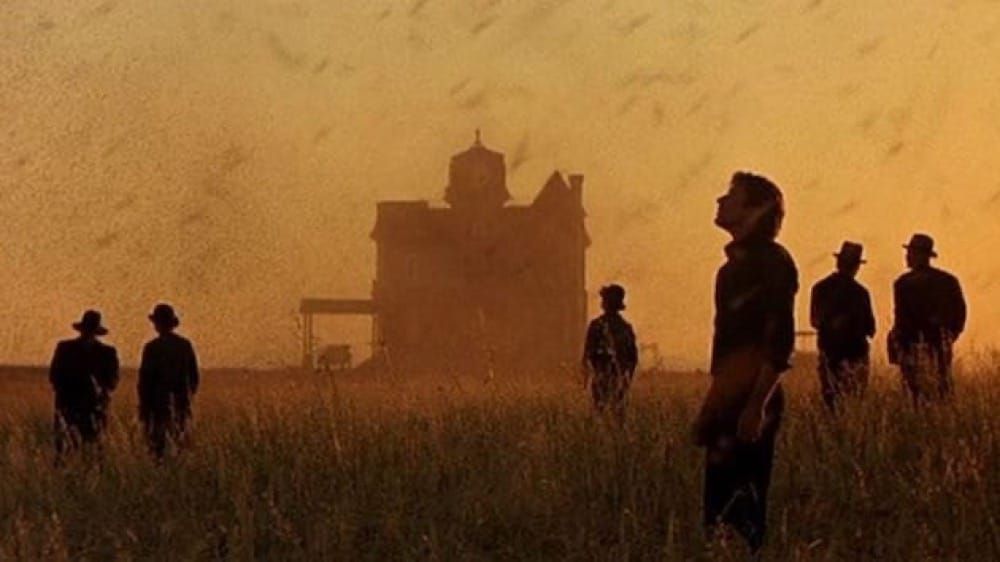
The light about to end. Terrence Malick's Days of Heaven, seen from afar.
A film set in 1916, in the wheat fields of Texas — Alberta, in fact — built around a triangle of migrant farmhands that ends in blood and a plague of locusts: but the plot is almost a pretext, a frame kept deliberately thin.
A film made by waiting for the light to happen.
Almendros described the so-called magic hour as lasting around twenty minutes at most: after the sun had gone but before night, when the sky remained luminous without an obvious source of light. He shot the exteriors largely with natural light; when he had to leave the production, Haskell Wexler completed the photography. The limitation was practical before it became metaphysical. Every evening the crew simply ran out of light.
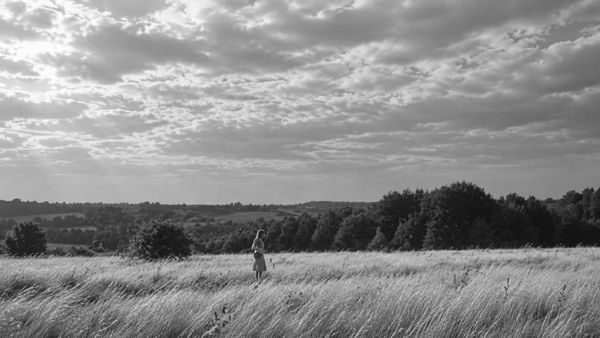
There's a Japanese phrase, mono no aware — the pathos of things, an attentiveness to impermanence — historically associated with classical Japanese aesthetics and often illustrated through the brief flowering of cherry blossom. You watch Days of Heaven and the comparison becomes useful. The wheat fields swaying and whispering in the foreground while the human figures stay small and distant at the back; the golden light always in the act of leaving; the film itself beautiful in the exact measure that its conditions cannot hold. An eye schooled in mono no aware skips the drama of the love triangle for a moment and feels instead the transience steeping every frame. Ozu, in Tokyo Story, found that everyday sadness beneath ordinary things. Malick finds it beneath a wheat field that is about to burn.
Tarkovsky is close by, though influence needs handling more carefully than resemblance. Malick's cinema has long been read alongside Ivan's Childhood and Andrei Rublev, and Days of Heaven, with its conflagrations and landscape given a duration of its own, arrived after Mirror and its burning barn. The BFI has made precisely that connection while stopping short of claiming a direct borrowing. What matters here is less the iconography than the proportion between people and the world around them. Water, fire, wind through grass: elements proceeding according to a time that does not coincide with ours. The farmhands pass, the season passes, love and jealousy pass, and the earth appears to continue with the same indifference afterwards.
From this angle, Days of Heaven begins to look less like an American rural melodrama than a film about disproportion: between the length of a human attachment and the time of a field, between one harvest and the land that will carry another.
And then there is another possible lens: darshan, the reciprocal act of seeing and being seen in Indian religious practice. It would be wrong to turn this into a source for Malick or Almendros; there is no evidence for that. As a way of looking at the film, however, it catches something difficult to name in the photography. Light does not merely reveal the wheat. At moments it seems to become the event itself.
When the sun filters low across the field, when a glass object at the bottom of the water catches the remaining light, the image does not behave like landscape decorated by illumination. The illumination has become the subject. The comparison with darshan belongs here, as interpretation rather than genealogy: seeing becomes a kind of exposure to what is seen. When the locusts arrive and the fields burn, that gift reverses. The same landscape that had seemed to offer itself becomes unreadable in flame.
Three traditions need not be made to agree. Mono no aware, Tarkovsky's landscapes and the idea of darshan come from histories too different to be collapsed into one cosmology. They do, however, place pressure on the same feature of Malick's film: beauty occurs under conditions of disappearance. Sunset, harvest, youth — each matters because it cannot be held.
One presence binds this more securely than any of those comparisons, and that is sound. Days of Heaven spent roughly two years in the edit, and Linda Manz's narration entered late in that process. Malick recorded her improvising while watching the material; some sixty hours of voice-over were eventually reduced to around fifteen minutes in the finished film. Her voice gave the fragmented footage a rhythm and a point of consciousness it had not originally possessed.
The consciousness that speaks is a child's, and it says things as someone might remember them years later without quite knowing what they meant at the time. Manz does not explain the adults. She catches pieces of them.
Morricone's score moves around that voice rather than resolving it. The opening uses “Aquarium” from Saint-Saëns's Carnival of the Animals; Morricone's own music then carries strings and woodwinds through the film, with Malick placing much of it differently from where it had originally been written. The exception, according to editor Billy Weber's recollection, was the music for the wheat-field fire, which Morricone asked him not to move.
The music feels more remembered than lived. That may be the most precise description of the whole film.
Each evening offers only a few minutes in which the sky still holds light after the sun has gone; the film is built inside that practical disappearance.
The field that had carried light so gently becomes unreadable in flame, turning the film's gift back against itself.
Recorded late in the edit, Manz’s improvised narration remembers the adults without fully understanding them and gives the images their fractured rhythm.
Days of Heaven doesn't so much tell a summer as remember one while it's still happening, looking at it already from afar in the very instant it is lived. The way you watch the light of the magic hour knowing that in ten minutes it won't be there — and for that very reason you can't look away.