Tapes T370 to T372
Lomax and Carpitella's 1954 Puglia tapes, the blanks beside them, and the evening in 2018 that began to fill them.

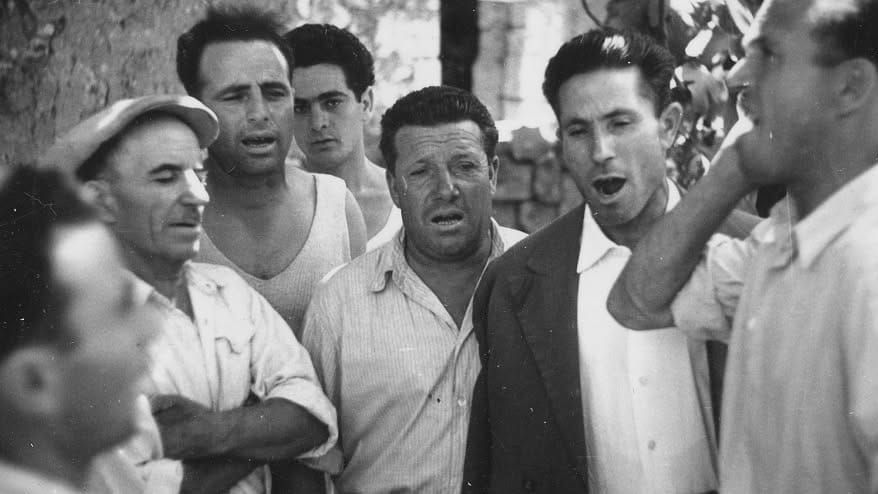
On 18 August 1954 the mayor of Locorotondo walked two strangers and a Magnecord PT6 tape recorder into the San Marco neighbourhood, where, he said, there were many singers. By evening the songs were on three reels; the neighbourhood would wait sixty-four years to hear those reels played back.
Alan Lomax made his first Italian recordings on 2 July 1954, in a tuna fishery at Sciacca in Sicily, and his last in Campania the following January. The BBC put its name and some money behind the journey, though Lomax paid for most of it himself. Its immediate purpose was practical: to gather material for the Columbia World Library of Folk and Primitive Music, the anthology series he was then assembling. Diego Carpitella, nine years his junior, had been appointed that year to work alongside Giorgio Nataletti at the Centro Nazionale Studi di Musica Popolare at the Accademia di Santa Cecilia. He was no beginner: he had spent most of October 1952 in Basilicata with Ernesto de Martino on a single subject, the funeral lament. He stayed with Lomax until the first week of October. They travelled in a Volkswagen van, which appears parked behind Carpitella in at least one of Lomax's photographs from early August.
Puglia took up about two weeks of August. From the 12th to the 17th they worked through the Salento, including Martano, Calimera and Corigliano d'Otranto, villages where Griko, a dialect of Greek, is still spoken. On the 18th they were in Locorotondo, and by the 23rd they had crossed to the Gargano, moving through Cagnano, Carpino, Monte Sant'Angelo and the shore of Lago di Varano at the pace of a survey. Carpitella later called the whole Italian trip "exploratory and panoramic", and the second word concedes a good deal.
What follows reads the Puglian reels for what is missing from them. The tapes preserved the voices with remarkable fidelity, but beside them lie three kinds of gap. Some things the collectors never wrote down: names, trades, ages. Some no tape could catch, such as the gesture that went with a lament. Others were recorded and then put aside as waste. The rest of the story is the slow work of closing those gaps, done largely by people the expedition never met and, in one case, by the people it recorded.
I. Sixteen songs, eighteen tracks
Locorotondo is the best documented of the Puglian stops, largely thanks to recent research. According to the account pieced together by Massimiliano Morabito, a musician and ethnomusicologist from the town, the mayor took Lomax and Carpitella to San Marco, and they spent the day there and in the neighbourhoods nearby, recording sixteen songs on eighteen tracks, spread over reels labelled T370, T371 and T372: lullabies, songs for work in the fields, devotional and processional pieces, teasing songs traded back and forth, quadrilles, and a fast tarantella the singers called pizzica pizzica.
"Tomma tommë", one of the work songs, sets out the order of tasks at harvest. Following the linguist Gerhard Rohlfs, Morabito traces its title to the tomolo, the unit by which land in the South was measured until well into the last century. A song named after a land measure is a small record of how field labour was reckoned, by area and by head, and that record reached the tape intact. Who led and who answered, how old they were, whose land they were harvesting: the tape does not say. The photographs from this part of the journey still carry captions such as "Unidentified women singing" and "Grape pickers singing", and Morabito's first task, sixty years on, was to find out who the singers were.
A few days later, at Carpino on the Gargano, the same two men recorded singers accompanied by the chitarra battente, and this time the names were taken down. That tradition, carried on by the Cantori di Carpino, became the best-known folk music of the Gargano. Locorotondo was recorded in the same fortnight by the same collectors; its singers seem to have gone unnamed through the accident of a single day's work.
Carpitella knew the limits of the method as well as anyone. Writing in 1973 about the 1954 journey, he counted some three thousand recordings, nearly all previously unknown, and admitted that many lacked a transcription of the words or any note of the performers' trade, age or literacy, and that the social context had been caught only in fragments. Maurizio Agamennone, who has given much of his career to these archives, states the other limits plainly: the days in the field were few, many performances were given on request, and the collecting, done with an anthology in mind, took what it was offered. The Magnecord was the best portable machine to be had, and none of these gaps was its fault.
II. A handkerchief in Martano
In the Griko villages, what the tape missed was sometimes a movement. Women lamenting the dead held a handkerchief taut between their hands and swung it from side to side in a steady two-beat motion that set the pace of the lament. Carpitella saw it at Martano in August 1954. We know of it through Agamennone, who reports the observation. The gesture stayed with Carpitella and fed his later thinking on what he liked to call somatizzazione del suono, the way sound settles in the body. The idea ran through his work until his death in 1990.
The Salento material occupies an unusual place in the archive. Carpitella returned in the summer of 1959 with de Martino for the fieldwork on tarantism that became La terra del rimorso, and again on his own in 1960, but on neither trip did he record in the Grecìa Salentina, the Greek-speaking enclave. The 1954 reels from Martano, Calimera and Corigliano d'Otranto, collection 24 B in the Santa Cecilia archives, are therefore his only recordings of that area, and the earliest known, made in a six-day pass by a man who, two years earlier, had spent a month in Basilicata on a single subject. Rounder, the Massachusetts label, later issued a selection as Puglia: The Salento in its Italian Treasury series, with notes by Luisa Del Giudice and Sandra Tarantino. The disc gathers songs of love and of scorn, satirical and erotic songs, work songs and laments, in Salentine dialect and in Griko.
Agamennone's later work points to the third kind of gap. Going through the 1950s reels, he found many stretches of tape that had been ignored, the parts around and between the takes, and argued that they hold information the selected recordings do not.
III. The parish hall
The tapes began to travel almost at once, and they travelled a long way from the people who sang on them. Between March and June 1955 Lomax put together an eight-part series, The Folk Music of Italy, for the BBC Third Programme. Recordings from the trip went into Columbia's anthology and later into Rounder's regional volumes, which print whatever names the logs supply. Goffredo Plastino has shown that the soundtrack of Pasolini's Decameron (1971) draws almost entirely on Lomax's recordings from Campania and Calabria; Lomax is not named in the credits and was never told. No Puglian recording went into that film, but the case shows which way the tapes were moving: outward, to studios, broadcasters and listeners for whom the people on the reels were seldom more than a place name.
On 28 April 2018, for one evening, the tapes came home. In the parish hall of San Marco, Morabito mounted an exhibition of Lomax's Locorotondo photographs, having first gathered what could still be learned about the people in them and on the tapes. The Sunday before, the parish priest had told his congregation to skip Mass that week and go to the hall instead, adding that "culture is spiritual food". About four hundred people came, Lomax's family among them. Those who had been there in 1954, or whose parents had been, shared what they remembered; the neighbourhood's children were taught the songs; and the recordings from that August were played, and sung again in the room.
The evening left reels T370, T371 and T372 exactly as they were. The first of the gaps beside them was closed, as far as it ever could be, by the people best placed to close it, in the neighbourhood to which the mayor had brought the machine.
Last revised: October 2026