soccer Committee :: AM Reworks
Ambient folk reworks tracing twenty years of Mariska Baars’s songcraft.

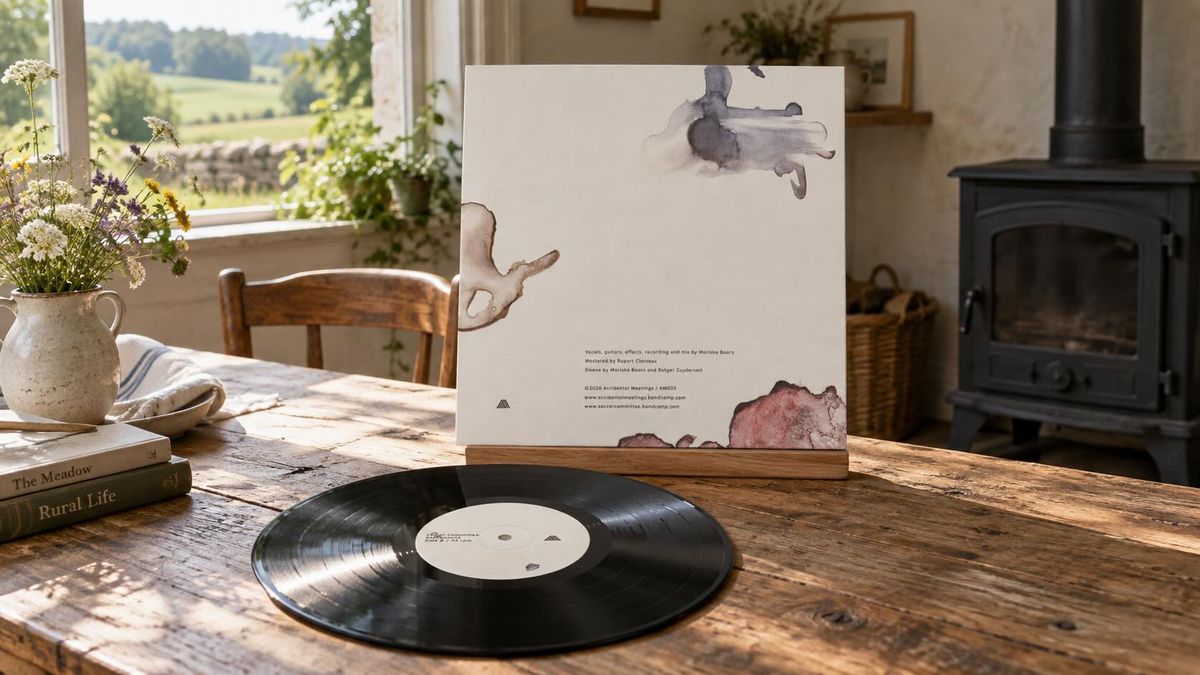
Twenty-one years ago Mariska Baars worried that releasing her songs might damage the private place where she made them. On AM Reworks, she goes back and opens several of them again.
That fear stayed in the notes accompanying the 2022 reissue of soccer Committee's first CDr. Before the guitar, Baars had spent years composing almost only with voice, then found a way of working where voice, strings, silence and harmonics seemed like something to watch as much as to listen to. The songs recorded between 2004 and 2005 were, in her words, small prayers sung to herself.
Three of those songs come back here: "Life So Right", "Kaleidoscope" and "Moi et Mon Coeur". Which makes AM Reworks a rather strange retrospective. Baars doesn't look back at her debut from the safety of twenty years' distance: she puts her hands back into music written while that way of playing was still forming.
A few notes of electric guitar, played almost like an acoustic, are enough for the voice to start behaving like another instrument: exposed next to the strings instead of dissolved inside the arrangement, it stays a recognisable body, almost a stranger, inside the economy of the piece.
At first, time can be measured just as plainly, with a stopwatch. "Life So Right" ran 2:08 in the original recording, here it reaches 3:02; "Kaleidoscope" goes from 1:57 to 2:39, "Moi et Mon Coeur" from 2:19 to 3:19. In songs this small these are huge differences: much of Baars's music lives exactly inside those seconds where a guitar tone stops sounding like a note just played and just stays there, weaker and weaker, almost separated from the hand that produced it. Forty seconds, in a two-minute piece, is an enormous margin.
Then "No Turn to Harm" arrives and immediately wrecks any comfortable theory about lengthening. It opened ♥/Lamb in 2023 at over six minutes; here it lasts 3:26, almost half.
For Baars the past is not a uniform material to be stretched always the same way: sometimes she lengthens it, sometimes she cuts it to the bone.
This is also why "minimal" has always been a somewhat poor word for soccer Committee. It makes you think of someone who takes away until only the essential is left, while Baars has described an almost opposite procedure: start from an improvisation, add a tone, see what happens, add another. In an interview she talked about sounds as shapes and lines suspended in space, something whose behaviour you follow more than its meaning. It is, in the end, a question of how much time you grant each element, how long a sound can stay before its profile starts to deform, more than of how many elements you use.
"Moi et mon coeur" has a small story all of its own. Rutger Zuydervelt had already gone back to the track for the 2022 reissue of the debut, taking the original 2:19 and turning them into a good fifteen minutes under the Machinefabriek name. He said he wanted to grab the atmosphere of the piece and stretch it out. Baars now offers a version of 3:19. In twenty-one years that tiny song has had at least three lives: the original, a long dig by another musician, then the author's own return. None of the three versions feels like the definitive one.
The more recent tracks make the path less orderly. "So gefällt" comes from tell from the grass, 2021, "No Turn to Harm" from ♥/Lamb, 2023, while "Unrequited Love" had appeared only last year on eye.
She recorded and mixed these new versions herself, handling voice, guitars and effects; Rupert Clervaux did the mastering. Accidental Meetings has collected them on a seven-track 10", a format smaller than an LP and solid enough to avoid the impression of just an archival extra. Even the design keeps the story inside itself: Baars signs it together with Rutger Zuydervelt.
Going back to songs born when she didn't yet fully own her instrument could have been risky: those first recordings kept the uncertainty of someone who was working out, note by note, what to ask of the guitar. AM Reworks lets the old versions stay next to the new ones, and only asks how much time to grant each one.