Philip Ridley :: The Reflecting Skin
Folk horror, nuclear memory, translation and childhood mythmaking

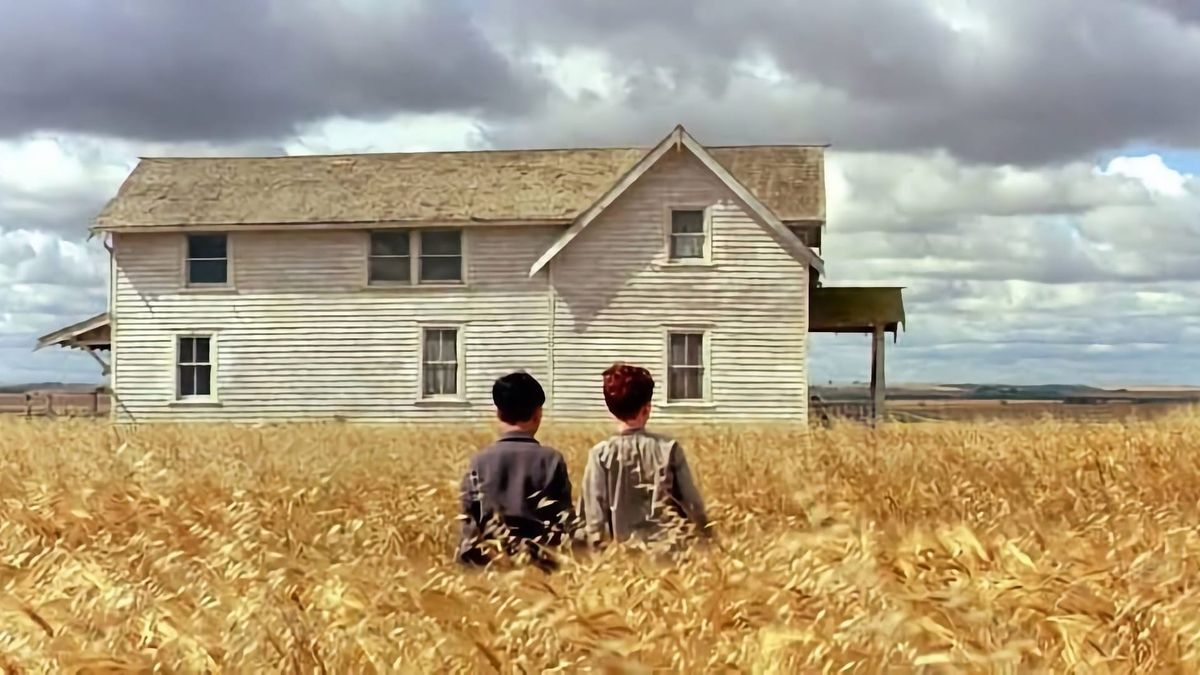
Philip Ridley did not invent the title of The Reflecting Skin (1990) as a figure of speech. Midway through the film, Cameron, home from the Pacific and already losing his hair to a radiation he cannot yet name, hands his eight-year-old brother Seth a photograph of a Japanese infant whose skin has turned silver from the bomb, smooth enough, he says, that you can see your own face in it.
Nearly everything the film is usually admired for depends on that photograph without ever showing it again: the toad inflated with a straw and burst against a widow's face in the film's first minutes, the wheat fields lit like a Wyeth canvas over a body left in a well, a boy who converts his brother's radiation sickness into vampirism because a vampire is at least a story with rules, unlike a dying man. The English title was never a flourish. It is a caption that got separated from its picture and kept travelling on its own.
English-language criticism has treated the film generously and has done so, on the whole, without agreeing with itself. Roger Ebert thought it better than Blue Velvet and said he was not easily going to forget it; Gene Siskel, sitting beside him on the same programme, gave it a thumbs down. Since then it has settled comfortably into the prairie gothic shelf, beside Flannery O'Connor's fiction and the wide Alberta light of Malick's Days of Heaven, and its recurring images have been catalogued with real patience: skin, birds, water, fire, the black Cadillac of small-town killers who turn out to be the only conventional monsters in the whole picture. None of this criticism, reasonably enough, ever had cause to ask what becomes of Cameron's photograph once the film leaves English behind.
In Spanish it travels as La piel que brilla, the skin that shines rather than reflects, as though the silver belonged to the skin outright and not to whatever had been done to it. Russian has never quite settled the question either: Отражающая кожа, reflecting skin, circulates alongside the more common Зеркальная кожа, mirror skin.
A skin that shines and a skin that mirrors are not the same diagnosis.
Neither version quite preserves the mechanism by which the title was born: an irradiated child's skin becoming reflective in a photograph carried home from the Pacific.
Japan is where the transaction turns strangest. The Reflecting Skin opened there on 13 March 1992 and returned in a digitally remastered version on 4 October 2024, and in both releases its title was Yawarakai Kara — The Soft Shell. The mirror has disappeared altogether. In its place is another image: a body not yet hardened enough to survive contact with the world, which is arguably an accurate description of the film Ridley made, a study of children whose armour is still forming while the adults around them explain, badly, what the world intends to do to them.
But the substitution has a cost worth sitting with. A film whose English name was built from a photograph of a Japanese child, his skin altered by the aftermath of an American bomb, arrives in the country that photograph points towards without carrying the reflection in its name at all. One Japanese viewer reviewing the 2024 reissue remarks, almost in passing, that there is “for some reason” a reference to Japan, followed by “why?” — bemused rather than shaken, as though the reference had drifted in from somewhere unrelated.
A Japanese infant whose skin has become silver and mirror-like: the image from which the English title takes its meaning.
The killers move through Ridley's heightened prairie world in an ordinary machine, becoming the film's only conventional monsters.
Alberta light makes the landscape almost painterly while bodies, radiation and childhood terror remain lodged inside it.
What this leaves is not a horror film about a boy who mistakes his neighbour for a vampire, though it will always also be that. It is a study in what a wound looks like after it has passed from hand to hand through cultures that each keep only the part they know how to use: brightness in one, a mirror in another, softness where the mirror would have cut too close. Ridley's subject becomes appropriation as a way of grieving, a child laundering his brother's radiation sickness into folklore because folklore, unlike history, is survivable. Criticism has spent three and a half decades describing that laundering in the boy with real tenderness. It took placing the film's different release titles side by side to notice that the title had already done something similar to itself, quietly, long before Seth ever got the chance.