Music for a Country Being Managed
Public films, library music, tape clubs and Britain’s managed landscape

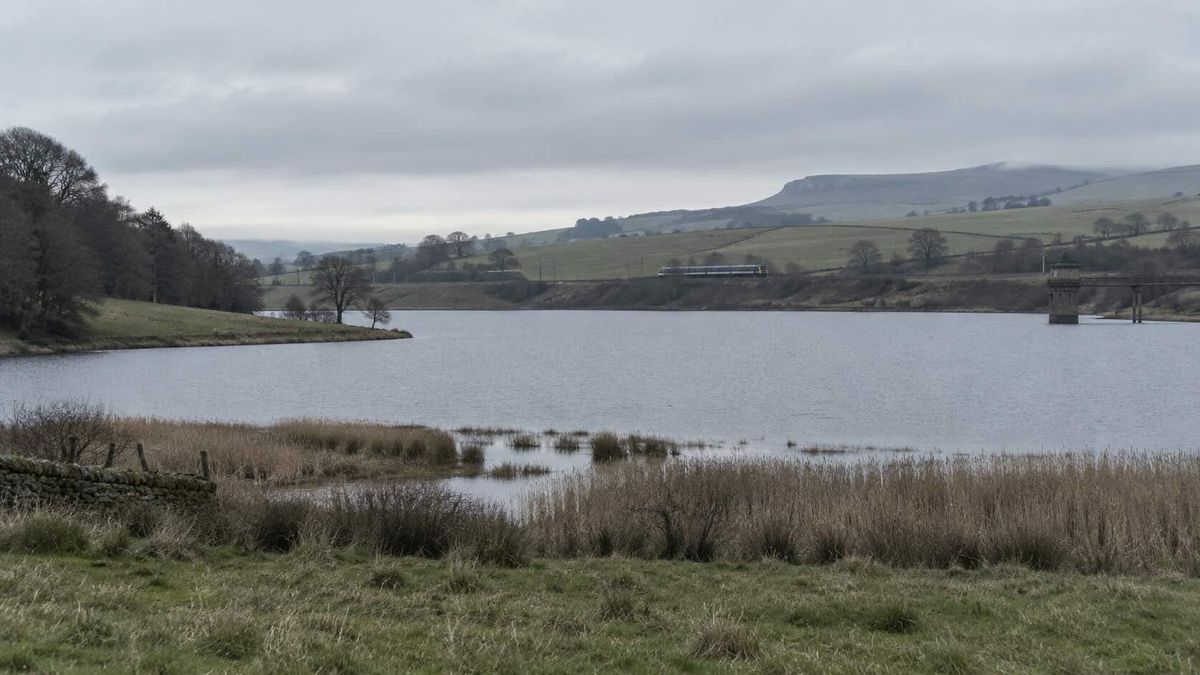
Somewhere in Britain in 1976, water glitters across a reservoir while inexpensive library music tells us what sort of water it is.
A few seconds later the same film needs drought, livestock, industry and supply. The image remains water; the soundtrack changes its instructions.
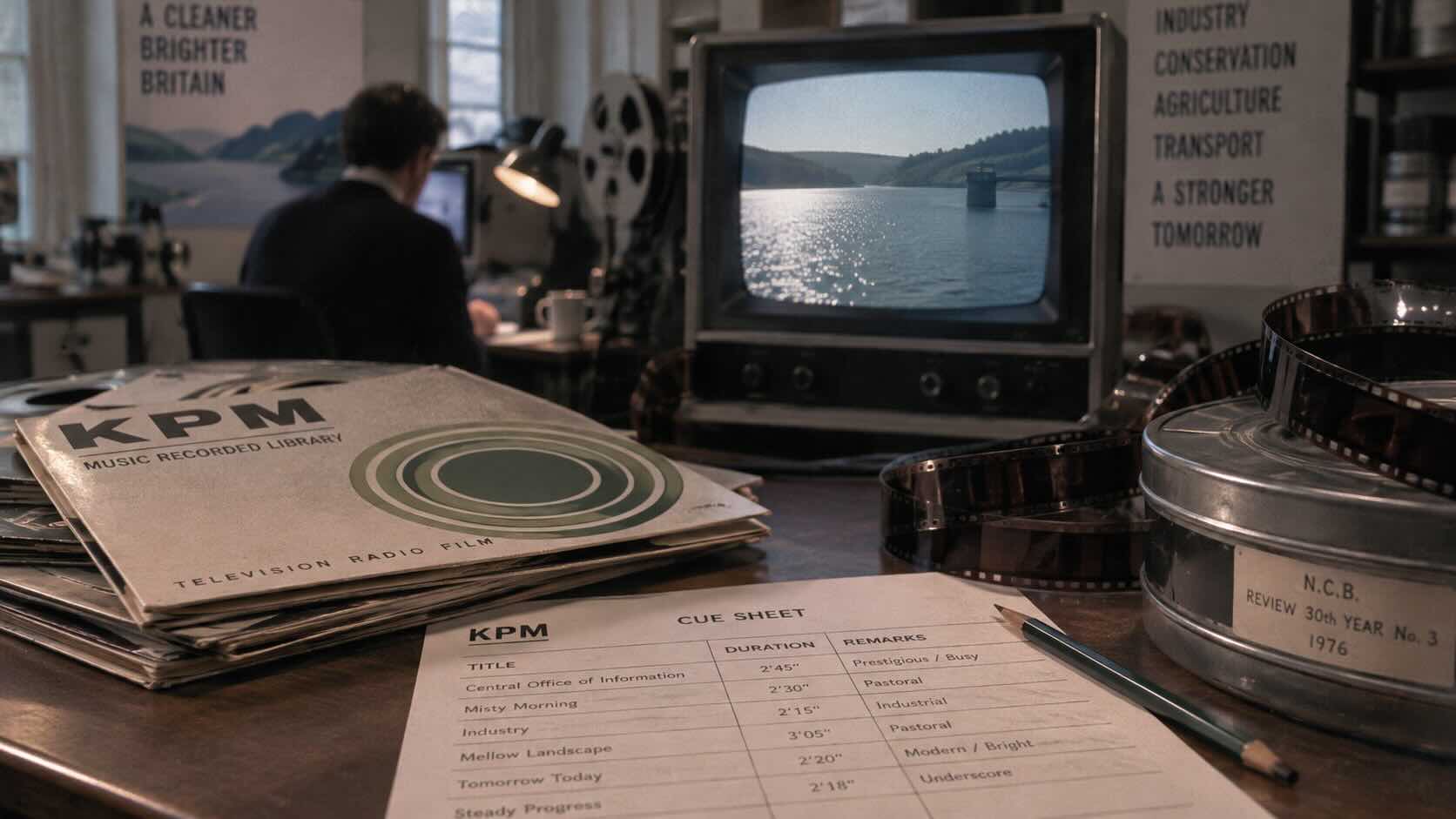
Review 30th Year No. 3 was produced by the National Coal Board during the dry summer of 1976. The BFI's catalogue notes something peculiar about it: environmental subjects had encouraged a more contemplative tendency in industrial filmmaking, and here the natural imagery is accompanied by cheap library music that works beautifully in some passages and conspicuously less well in others. The mismatch is useful. A piece laid over water can make the shot contemplative; another can make it faintly ridiculous. Somebody, somewhere in the production process, had to decide which one belonged there.
For several decades decisions of this sort were made throughout British sponsored and public filmmaking. Government departments, nationalised industries, transport bodies and independent contractors required soundtracks for films about roads, agriculture, electricity, workplace safety, reservoirs, new technology, schools and countryside. Sometimes a score was commissioned. Often the cheaper answer was library music: recordings made before the composer knew which factory floor, railway cutting, laboratory or wet field would eventually require them. Research by Elodie A. Roy into Central Office of Information production records has recovered the COI's own description of itself as Britain's “largest single user of mood music in a film context”. Much of its lower-budget audiovisual production during the 1960s and 1970s relied on library cues.
“Mood music” makes the activity sound decorative. It was also practical classification. Instrumental colours, tempos and electronic textures were repeatedly attached to particular kinds of public image: efficiency, technological novelty, cultivated land, leisure, danger, conservation, controlled water. No central programme was necessary. The associations could emerge from thousands of small editorial decisions.
There is already a familiar history in which public information films, educational television, analogue electronics and production music return decades later through The Prodigy, Boards of Canada, Ghost Box and the culture eventually described as hauntological. The BFI has traced that afterlife particularly well: instructional voices and sounds of authority detach from their original purpose and reappear inside electronic music. That history is persuasive. It begins, however, after the more ordinary process that interests me here.
Before those sounds could return, somebody had put them somewhere.
I. A Catalogue of Possible Places
One library record makes the mechanism unusually visible. Mike Vickers's A Moog for More Reasons, issued by KPM in 1975 as KPM 1155, contains seventeen pieces made for later use. On its second half, “Central Office of Information” sits among “Steady Progress”, “Tomorrow Today”, “Misty Morning”, “I Remember” and finally “Mellow Landscape”. Surviving production-music catalogue data describes “Central Office of Information” as a busy, prestigious theme and “Mellow Landscape” as suitable for gentle pastoral scenes.
There is no evidence that the Central Office of Information commissioned Vickers's track, and the title should not be made to prove that. Its value is smaller and stranger. On one production-music LP, public administration and pastoral scenery appear as neighbouring audiovisual requirements. The record does not tell a story. It offers possibilities.
The wider KPM catalogue worked through the same vocabulary: Industry, Outdoor Life, traffic, rural settings, technological progress, leisure, weather, movement. Titles behave almost like labels on drawers. Open one and there is music for machinery; open another and there is music for countryside. A composition does not need an intrinsic relationship with a reservoir or meadow. The relationship can be made later, at the editing table.
This is the first distinction worth keeping. British institutions did not invent a single national pastoral sound, nor is there evidence of a coordinated programme intended to teach listeners how countryside ought to sound. What existed was a dispersed professional culture in which sounds were continually assigned to places, activities and systems already being managed. Annette Davison's work on British industrial films has shown how little attention this vast area of governmental and corporate music once received, despite units such as British Transport Films and the Shell Film Unit occupying a complicated position between documentary, public relations and cinema. Her discussion of sound as a form of soft persuasion is useful here. Music could help an organisation, technological process or physical landscape appear intelligible before the commentary had finished explaining it. The landscape in such films was rarely passive scenery. It was already being crossed, supplied, electrified, preserved, promoted or reorganised.
II. The Railway Inside the Field
British Transport Films may be the clearest place to see that condition. Its institutional subject was transport, yet the surviving catalogue repeatedly exceeds it. Railways lead into travelogue, coastlines, regional identity and natural history. Films such as The Heart of England and West Country Journey sell movement through the country partly by turning the surrounding country into something worth seeing.
The contradiction is easy to miss because pastoral imagery encourages us to imagine withdrawal from modernity. Here modernity remains inside the frame. A field has a railway crossing it. The countryside becomes accessible because a transport organisation has organised access to it. A coastline can belong simultaneously to natural history and to a national network. This is where public pastoral remains useful, but only as a secondary description. It names pastoral imagery produced from inside institutions engaged in administering modern Britain. It should not become another genre.
Geoffrey Jones pushed the relationship between machine, landscape and music further. In Snow (1963), railway workers fighting the severe winter move through an electronically treated soundtrack. Jones had wanted Sandy Nelson's “Teen Beat”; when licensing failed, Johnny Hawksworth supplied replacement material and Daphne Oram processed it electronically. The contingency matters. Today the film can look almost preassembled for hauntological rediscovery — railway, snow, public corporation, tape treatment, Oram — but part of its strangeness came from a routine problem with music rights. The soundtrack had employment before it acquired atmosphere.
With Locomotion in 1975, Jones treated railway history as musical acceleration. Produced for the 150th anniversary of the Stockton and Darlington Railway, the film assembles hundreds of images into a continuous increase of speed. Donald Fraser's music, performed with members of Steeleye Span, brings traditional instrumentation into contact with contemporary electronics. Folk does not stand outside technological change here. It travels through it.
What happened forty years later gives the film an unusually clean afterlife. Mordant Music reissued the soundtrack in 2015 as “Radiophonic folk in continual accelerando”, alongside a remix and Fraser's “Ghost Train version”. The original train was not a ghost. Time supplied that category.
III. The Lark and the Jet
At roughly the same moment, another culture was learning a different relationship with place. Instead of putting music onto images, amateur recordists were carrying recorders outside and taking sound away.
Jean-Baptiste Masson's research on British and French sound hunters between 1948 and 1978 reconstructs clubs, specialist magazines, radio programmes and national and international competitions largely absent from conventional music history. Wildlife, railway recordings, interviews, family sound, technical exercises and documentary work existed within the same hobby. Cheap tape equipment did more than make recording available: it encouraged learned habits of attention.
An entry in the first British Amateur Tape Recording Contest in 1957 catches that process unusually early. A judge remarked on an anonymous competitor's interest in “sound for its own sake”, particularly a sequence that placed the song of a lark against the scream of a jet aircraft. The combination hardly needs interpretation. A British amateur in 1957 records bird and jet as sounds worth hearing in relation to one another.
Calling it proto-hauntology or ambient folk would make the example weaker. The important thing is that no later category was required. The British countryside already contained technological interruption, and portable tape allowed someone to treat that coexistence as material for listening.
Mark Vernon's recovery of the British tape-club world began decades later by accident. At a car boot sale in Derby he bought a reel-to-reel machine accompanied by a carrier bag of tapes. They had belonged to Bill Howard, a member of Derby Tape Recording Club, and covered more than twenty years of amateur activity. Vernon later contacted former club members and acquired further recordings. The ordinariness of the surviving material matters. These were not lost master tapes from an experimental canon. Club members recorded markets, trains, wildlife, machinery, fairs, workplaces and regional voices because owning a recorder made those things preservable.
A 1966 account of Leicester Tape Recording Club makes the listening practice unusually concrete. Members visited Leicester City Ambulance Station and staged a mock emergency turnout specifically to record it. One travelled inside the ambulance with a portable machine, another recorded it from the road, while others waited in the station yard. At their next meeting, each member brought a tape and explained how it had been made and what had worked or failed. Microphone placement, movement, mechanical sound, distance and error were being discussed socially. This was not merely collecting noises. It was an education in how to listen.
IV. Choosing What Belongs
The institutional editor and the amateur tape recordist were not participating in one coherent movement, and forcing them together would weaken the history. The editor began with an image and selected a sound for it; the sound hunter began with the world and selected something from it to preserve. One practice attached. The other extracted. What they share is more elementary: choice.
A field did not arrive already carrying oboe and strings. Somebody found a cue that seemed to fit. A railway station contained hundreds of possible sounds; somebody pointed a microphone toward one of them. What mattered was not whether either practice belonged to a genre, but that both required somebody to decide what counted as the relevant sound.
Twentieth-century music history naturally privileges records because records are legible objects. They have composers, titles, labels, dates and audiences. Yet a great deal of listening happened around music subordinate to something else: industrial films, classrooms, public-information shorts, exhibitions, television continuity, company demonstrations. At the same time, huge quantities of deliberately recorded environmental sound circulated without becoming commercial music.
The history of ambient listening may therefore be larger than the history of ambient music.
RECORDS ON THE TRACE / 01
Bill Howard — A Moog For More Reasons
Library music begins treating synthesizer texture as usable environment: functional sound already edging toward background as an active listening space rather than a neutral support.
Geoffrey Jones — Snow
The railway becomes rhythm, weather and visual pattern at once: industrial movement is perceived as a total field, with sound functioning less as accompaniment than as a way of organising attention.
Donald Fraser — Locomotion
Traditional instrumentation and electronics accompany technological acceleration before later listeners learn to hear the railway as a ghost: a radiophonic folk already leaning toward ambient perception.
This does not make a 1960s industrial soundtrack secretly ambient, nor does it turn Bill Howard into a neglected field-recording artist. It means that people were already encountering music while attending primarily to something else, while others were learning to treat environmental sound as something worth isolating and replaying. Those are histories of attention before they are histories of genre.
V. Music After Its Employment
Functional music ages differently from a song because part of its meaning once belonged elsewhere. Someone hears a library cue while watching workplace equipment. Someone encounters electronics beside a new transport system. A child hears particular tonalities while a public film explains danger. The music may also exist independently on a KPM LP, but that is not necessarily the form in which most people first meet it.
Later the attachment can disappear. Some old library music still seems to wait for an image: an aerial survey, a rotating diagram, wet tarmac, children entering a school, machinery starting up. Nothing mystical is required. Music made for attachment and repeatedly experienced that way can carry the expectation of another medium.
Here hauntology becomes more precise. The surviving object may retain an earlier relationship between sound, image and authority. A voice, caption, logo or public body once provided the soundtrack's practical surroundings. When those structures become historically remote, the music can keep some trace of their assurance while losing the function that once justified it.
The familiar history of public information films resurfacing in electronic music documents the later stage. What interests me is the earlier one, when none of this material was uncanny because it was still doing its job. Locomotion again provides the cleanest example. In 1975 it belongs to an institutional celebration of railway history and technological modernity. By 2015 it can be marketed as radiophonic folk and produce a “Ghost Train”. The sound survived long enough for its former use to become atmosphere.
VI. The Managed Place
A recurring idea in contemporary landscape music is that place speaks and the musician listens. Sponsored film offers a less innocent version. Place has usually been interpreted before the listener arrives.
Post-war British institutions repeatedly made films about water, freight, railways, electricity, conservation and the organisation of ordinary life. Music entered that machinery alongside narration and montage. It could dignify equipment, soften technological intrusion or make managed land appear coherent. The important point is not that a central authority imposed one national soundtrack, because there is no evidence for that. It is that thousands of smaller decisions accumulated: somebody decided how a reservoir, railway, field or public system ought to sound.
The amateur tape recordist performed the inverse operation. Instead of assigning music to an image, he selected one sound from a place already full of them. A market, an ambulance station, a railway cutting or a flight path became recordable because someone decided that one part of its acoustic life was worth isolating.
These practices belonged to different institutions and different social worlds, but they meet at the same small act: selection. One decides what sound belongs to a place; the other decides what sound can stand for it.
VII. Before the Ghost
Hauntology becomes less interesting when every faded 16mm print, Moog cue and old railway logo is allowed to prove hauntology in advance. These objects had other lives first. A reservoir is not hauntological. Neither is a KPM record, a British Transport Film, a reel-to-reel recorder or the sound of an ambulance returning to a station in Leicester.
What changes is the relation between those objects and later listeners. A public corporation disappears or is reorganised; a film leaves normal circulation; electronics once designed to sound contemporary acquire audible age. A railway presented as modernity can later be heard as a ghost train.
The residue is therefore not simply nostalgia for an old sound. We begin hearing the apparatus that once made the sound ordinary. Somewhere in an editing office there was footage of a reservoir. Several pieces of music were available. One seemed wrong; another seemed right. For perhaps forty seconds that music belonged to that water. Elsewhere, a man carried a recorder into a market, beside a railway, onto an ambulance or beneath a flight path because a sound seemed worth keeping.
Most histories of music have little reason to notice decisions so small. There were thousands of them.
For the later afterlife of those sounds, see Hauntology in Music: The Ghosts of Lost Futures.
Last revised: September 2026