Hauntology in Music: The Ghosts of Lost Futures
Italian library music, RAI archives, lost television and spectral memory


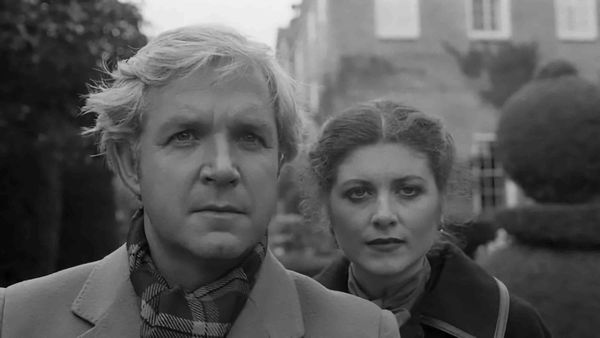
There's a Roman stornello that, somewhere inside Il Segno del Comando, begins singing over images of a Rome that isn't Rome anymore. Trastevere has emptied itself into a topography of narrow streets where an English scholar searches for traces of Byron and discovers instead a woman who exists only as long as someone remembers loving her.
"Cento campane."
The melody is warm, almost convivial. It belongs to taverns, courtyards and ordinary evenings. That is precisely what makes it so profoundly unsettling. A folk song accompanies reincarnations, secret societies and impossible returns. The easy familiarity of communal singing stands guard over a threshold no one should cross.
I was too young to understand the story. The plot escaped me completely. What remained was the feeling that something had slipped out of place. The theme music seemed to know something the narrative had not yet revealed. Looking back, that may have been the first hauntological experience of my life, decades before I encountered Derrida. Not in philosophy, but in afternoon television, when music written to reassure somehow left a disturbance that never entirely faded.
There was another television as well: the anonymous afternoon schedule. Not prestigious dramas, but children's programmes and educational broadcasts whose titles I can no longer recover. What survives is only a synthesizer line trying very hard to sound cheerful and never quite succeeding. I did not choose that music. It arrived before language itself, settling somewhere beneath conscious memory, where it slowly deteriorated like magnetic tape left too close to a radiator. Today I cannot tell whether those melodies truly sounded that way or whether I have patiently reconstructed them across decades of remembering. Most likely both are true at once.
That uncertainty is where hauntology begins.
Derrida introduces the word in Specters of Marx (1993), where it belongs to politics rather than music: communism lingering after its proclaimed death, justice arriving simultaneously from the future and from the dead. More than a decade later, Mark Fisher and Simon Reynolds transferred the concept into cultural criticism. Their hauntology drew upon post-war archives that lay outside conventional pop history: library music, educational broadcasts, public information films, BBC Radiophonic Workshop experiments, forgotten television themes, and records that seemed already old on the day they were made. Ghost Box, Belbury Poly, The Advisory Circle and The Caretaker transformed these remnants into a new aesthetic language. Fisher famously described it as nostalgia for lost futures: mourning directed not towards the past itself, but towards futures that history once promised and then quietly withdrew.
All of that remains persuasive.
Yet it also reflects a particular geography.
Hauntology entered criticism speaking English. That was a biographical accident rather than an ontological necessity. Fisher, Reynolds and Ghost Box described the spectral residues left by Britain's own broadcasting institutions because those were the sounds that had shaped their childhoods. BBC Radiophonic Workshop belongs inseparably to post-war Britain. Public information films belong to Britain. Their ghosts emerged from a specific cultural infrastructure.
Ghosts, however, are never abstract. They belong to broadcasting systems, landscapes, institutions and habits of listening. When geography changes, hauntology changes with it.
That is where the Italian story begins.
I. The Haunted House We Never Left
Italy produced its own archive of spectral sound during exactly the same decades.
The state broadcaster developed an enormous body of library music — sonorizzazioni, as they were called, a wonderfully revealing term. They were not albums intended for listeners. They existed to accompany documentaries, educational films, television dramas and cultural programming before disappearing back into the shelves from which producers had borrowed them. Unlike commercial records, they entered public life anonymously. Millions heard them without ever knowing that they had composers, catalogue numbers or independent identities.
Egisto Macchi. Daniela Casa. Amedeo Tommasi, who under pseudonyms was producing electronic experiments in the mid-1970s that still sound startlingly contemporary. Gerardo Iacoucci's Simbolismo Psichedelico. Composers working within the institutional framework of Rai often found remarkable freedom precisely because they were writing functional music. Detached from commercial expectations, these recordings frequently ventured further than contemporary progressive rock or psychedelic music dared.
These were records that scarcely functioned as records at all.
They survived not because audiences celebrated them, but because institutions quietly stored them.
That distinction matters.
A commercial album enters history through reviews, sales and listeners. A sonorizzazione entered history sideways. It fulfilled its function, disappeared into an archive and waited, sometimes for decades, before anyone listened to it again on its own terms.
British hauntology largely reconstructs an imagined landscape. Ghost Box invented Belbury, an England assembled from fragments of memory and speculation. Italian hauntology requires no comparable act of invention. The haunted landscape already exists. The archives remained physically intact. The ghosts never left.
We simply stopped visiting them.
II. A Ghost Twice Over
Few works demonstrate this more clearly than Le Venti Giornate di Torino.
Giorgio De Maria published the novel in 1977. It received little attention before slipping into decades of obscurity, only to be rediscovered in the twenty-first century as an uncanny precursor of anxieties that later generations suddenly recognised. Like so many hauntological objects, it acquired much of its significance retrospectively.
Then something stranger happened.
An Italian group composed the soundtrack for a Rai adaptation that never existed.
Not a reconstruction of lost television.
Not recovered archive music.
Music for a programme that was never filmed.
The result is perhaps the purest hauntological object imaginable. A soundtrack remembering images that history never produced. A cultural memory generated around an absence rather than a disappearance. One future was abandoned in the 1970s; another returned decades later to compose its soundtrack anyway.
The novel and its imaginary score now participate in the same temporal condition. Neither returns to the cultural landscape that originally produced it. Both enter a different landscape altogether, where delay has itself become part of their meaning.
III. The Schedule That Disappeared
State television once imagined itself as a vast educational project. Entertainment and pedagogy belonged to the same public mission. The music written for documentaries, science programmes and historical dramas assumed those broadcasts would continue to exist within that shared cultural horizon.
That future ended.
The broadcasts vanished. The institutional ambitions that commissioned them dissolved into another media landscape. Yet the music remained.
Detached from its original function, the sonorizzazioni now circulate independently through specialist reissues, collectors and devoted listeners. What once served the image has become an image of history itself.
Their emotional effect has also reversed.
Originally they accompanied contemporary broadcasts, quietly supporting narratives directed towards the future. Today those same recordings carry the emotional weight of a vanished institutional world. We no longer hear only the compositions. We hear the disappearance of the conditions that once made them ordinary.
Which brings me back to that Roman stornello.
It still sings over empty streets.
Only now I cannot tell whether I am remembering the programme itself or remembering all the years spent remembering it.
Perhaps that uncertainty is hauntology's true home.
Not the archive alone, but the moment when memory ceases trying to reproduce the past faithfully and begins, quietly and inevitably, to compose it again.
Last revised: July 2026