Naomi Kawase :: The Mourning Forest
Drama on grief, care and the difficulty of following another person.

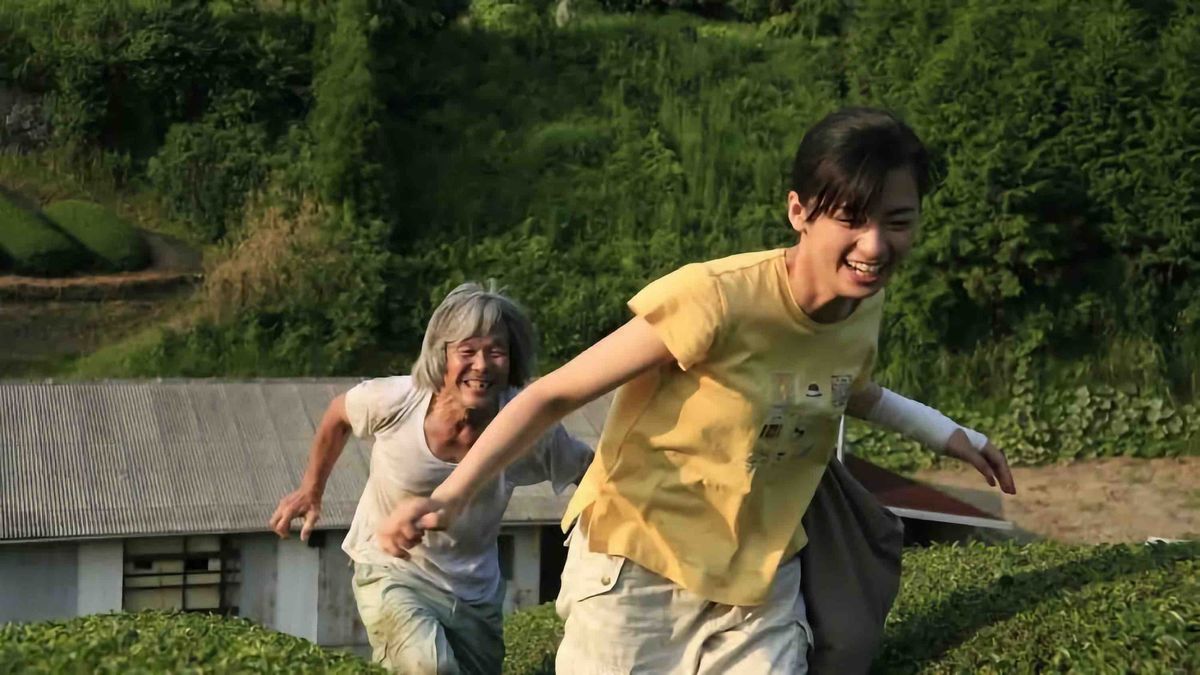
Before the trees close around them, Shigeki and Machiko run through a landscape somebody else has already shaped: the clipped tea hedges of Nara’s Tahara district, narrow green corridors, an agricultural order their bodies keep vanishing into and coming out of, out of breath and laughing.
Machiko, played by Machiko Ono, has just started work at a small residential home in the hills. Her young son has died. Shigeki, a resident with dementia, has been mourning his wife Mako for thirty-three years, and the number carries more weight than an English subtitle can give it.
In Japanese Buddhist observance the thirty-third memorial is, for many families, the last one; after it the dead are expected to stop being an individual presence among the living and to pass on. A monk visiting the home tells Shigeki more or less this: his wife has become a Buddha, and she will not come back. Kawase places her film at the precise moment when ritual declares a grief complete, and gives that moment to a man who has not consented to it.
Machiko arrives at this threshold with a job to do. Shigeki arrives with somewhere he wants to go. For a while the film lets these two facts coexist in the soft light of the home, and the 2007 Cannes jury seems to have loved it partly for that softness. The difficulty, which the film handles better than its reputation for serenity suggests, is that the institution and the rite are both asking for a kind of closure, one in the name of safety, the other in the name of release, and Shigeki refuses both.
An early calligraphy exercise puts the problem on paper. Her name is written 真千子; Shigeki inks out the middle character, 千, “thousand”, and what remains reads Mako, his wife’s name. To recognise the living woman he removes a thousand of something from her.
The gesture is tender and it is also an intrusion, and Kawase leaves both inside the bond without sorting them. Machiko’s usefulness to him, her resemblance to someone absent, and her own separate grief are never folded into a single benevolent relationship.
Then the backpack. Machiko lifts it during an ordinary round of cleaning and Shigeki lashes out. Writing in the Japanese welfare journal Normalization in November 2007, Miyuki Kaminuma reads the scene through the gap between what the worker sees, a bag in the way, and what the resident believes is being taken from him.
The bag belongs to his journey, and to the notebooks he has been filling for Mako. A routine task has touched a private economy of value that no care plan records. Later, with the car stranded in a ditch and Shigeki walking into the woods, Machiko’s responsibility will run far ahead of anything she knows.
What the second half asks of her has no clean name in a training manual.
Ono plays this with very little sentiment. Her pursuit through the undergrowth is frightened and clumsy, and it keeps the film honest at exactly the point where it would most like to drift upward.
The cost of closeness
Shigeki Uda, a bookseller Kawase knew in Nara, had never acted. At Cannes he described spending three months in a home for older people before the shoot, sharing meals, baths and the rhythm of the day.
The fictional home was then built inside a village house, with advice from care professionals and the participation of local residents. Its apparent ease is the product of preparation; people had to learn how to occupy those rooms together before the camera could pretend merely to find them there.
Kawase’s own account of directing Uda complicates the ease further. Speaking to Claudia Siefen for Filmkrant, she recalled repeating the running takes until he was exhausted and then keeping the last one. His breathlessness gives the image a bodily truth that acting might have withheld.
It also puts a weight on the film’s tenderness that I find hard to set down: a director making a film about care obtained a performance by spending an old man’s strength. That knowledge sits beside the tea-field game now, every time I watch it, and the scene is still beautiful.
The same interview unsettles the forest. Insect noise, she said, made the location dialogue unusable, so the soundtrack was rebuilt and dubbed in Paris, in winter. The summer woods we hear have travelled a long way from the place they help us inhabit.
Knowing this changes how the film sounds to me. Its closeness is assembled through listening, repetition and adjustment, the same way the home’s daily life was assembled before the first take, and it needed people working in a cold studio on another continent to become audible.
What the ground keeps
Nara corrects any temptation to read the trees as pure symbol. The production notes explain that Kawase chose the area because families and neighbours there still prepare their own dead and bury them in the earth, without undertakers and without cremation, in a country where cremation is close to universal.
In a later Japanese conversation published by MUJI she remembered that digging a new grave could turn up earlier neighbours, a pair of spectacles or a walking stick surviving among the bones, and that those remains would be gathered and buried again. She was describing one community’s practice, and she said so. In that account the soil holds obligations between households as well as private memories; whoever digs has to handle what another generation left behind, with their hands.
Mogari (殯) is an old word for the interval in which the dead were kept, temporarily, before final burial, a period recorded above all for early sovereigns. Kawase glosses it more loosely as the time, or the place, of mourning. Either way the title names an interval, and the film is set at the end of one.
That is where its weakness lies too. As the woods deepen, Kawase grows eager to give the interval a spiritual destination, and Shigeki’s illness starts to look like privileged access to truths Machiko needs. The film half-believes this. Ono’s body keeps contradicting it. At the swollen stream somebody has to stop a living man from being swept away, and no revelation is going to do that for her.
When the film stays near the ground its claims get harder and more useful. Wet clothes cling and have to be taken off by a fire. The bag has to be carried, by her, once his strength goes.
At the end Shigeki lies down in a hollow he has scraped out under a tree, the notebooks beside him, and Machiko kneels at the edge of it, attending to a place whose meaning she has reached on foot and will never own.