Polonius :: Anaxia (Original Soundtrack)
Film score and cassette fantasy: Polonius builds Razooli’s Oskexis out of tape.

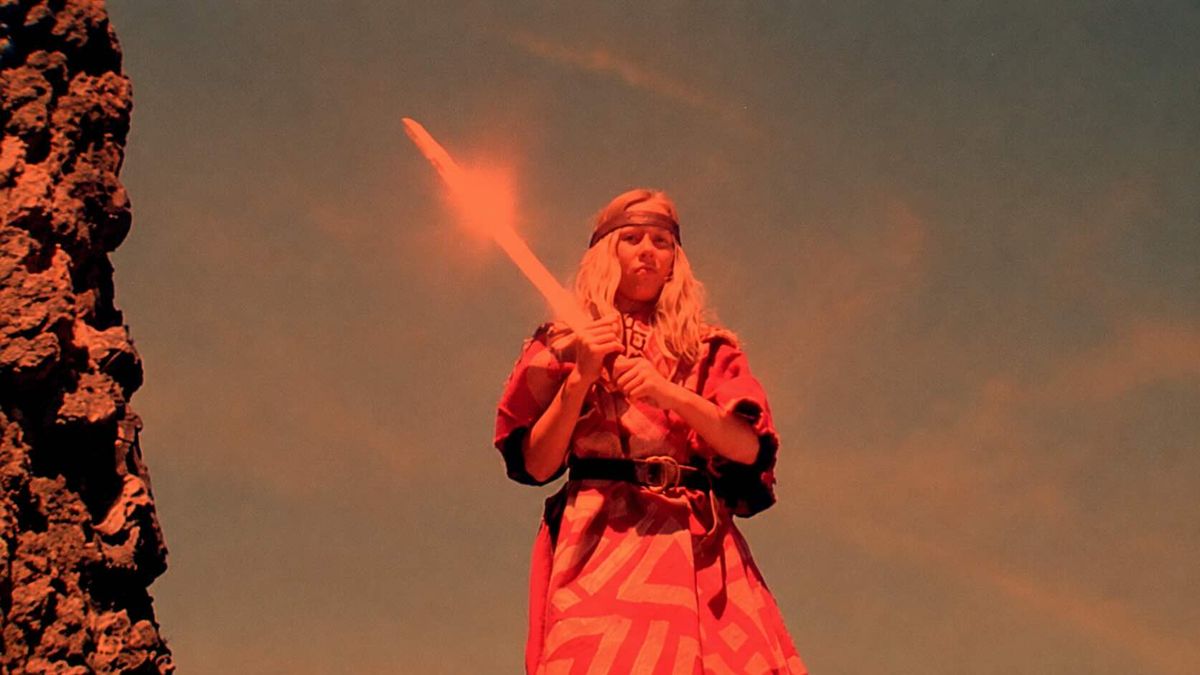
Weston Razooli’s film is a short; the cassette Seif Gaber drew from it runs twenty-five minutes, and the land of Oskexis, with its contested oases and its mining warlords, stays longer on the tape than it ever did on the screen.
Anaxia is, before anything else, a name that keeps changing hands. In 2015 Razooli, who grew up in Park City, Utah, and trained somewhere between illustration and fashion in San Francisco, gives it to the small production company he sets up in Los Angeles. In 2018 it becomes the title of a fantasy short, and in 2023 it turns up again among the producers of Riddle of Fire, the feature that took Razooli to the Quinzaine at Cannes. Inside the fiction, Anaxia is an archaic magic worked out by the ancient engineer-mystics of Trocia, able to navigate other people’s minds and move them about like puppets. The soundtrack belongs to the same chain of handovers. Artetetra released it on 16 January 2019 as a C25 cassette (catalogue ATA23). Gaber, born and raised in Cairo and active under half a dozen aliases, had already scored Shades of Paradise (2017) for the same director, and the Milan label would put that score out as well, two months later.
The text that comes with the release opens with a welcome and signs off by promising a glossary, the only tool, it says, for finding your way around the new magical world. Oskexis is an underground frontier beneath the continent of Trocia, its soil rich in metals no one has identified, minerals, gems and fuel. The few oases left belong to feudal lords caught up in military and mining campaigns that never end. A fantasy landscape built on extraction, then, and the track titles fill it in entry by entry: a place, a hunting ground, an enchantress, the theme of a hunter’s luck, a tabletop die. The cassette becomes a glossary of the film’s world, giving its places and characters more time than they have on screen.
On tape, duration turns into architecture. Side A adds up to twelve minutes and thirty-three seconds, side B to twelve and thirty. Three seconds apart, and each side closes on its longest piece: “Hunter-Prowler (Tracking in Oskexis)” at 6:39 and “Golden Mystic’s Harp Canticle : Pixie Exodus” at 6:50. The tape opens with fifty-two seconds called “Anaxia!”, exclamation mark and all, like the opening credits at a second-run picture house. So the record makes two slow descents, one per side, and between them come pieces of two and a half minutes that work as rooms you pass through on the way.
It’s worth listening with the tracklist in front of you, since every title announces what the piece is meant to be before the music bears it out: a trail followed, a harp canticle, pixies in flight. “Hunter’s Luck Theme” keeps its promise by a more crooked route. A forest recording, full of noises nobody wrote and a depth nobody mixed, shares the space with 16-bit sounds sketching short mellotron-like phrases. It is an imitation at one remove, given that the mellotron itself played back strings and flutes from strips of tape recorded by other people, and it’s precisely that poverty that makes the piece work: next to a forest this physical, the little theme sounds like a painted backdrop, and the forest in turn loses a little of its reality. Closing side B, “Golden Mystic’s Harp Canticle : Pixie Exodus” lines up exercises for digital harp over percussion sampled at low resolution, with no body and no attack, which can’t even be bothered to keep time. Each sound arrives on its own and stays as long as it needs. What comes out is a low-definition psychedelia, measured by the length of single events, and it suits the pace of the short rather well. The means are few, and the listener fills in the rest of the fantasy.
Artetetra built its catalogue on an exoticism that is openly artificial, born online and well aware of it, and Anaxia may be the title where that idea fits the music most closely. Mid-century exotica built nonexistent elsewheres inside Californian studios. Here a composer born in Cairo gives sound to a desert invented by a Los Angeles director, oases, hunters, enchantresses included, and takes on the same candour about fakery that exotica had made familiar. As far as we know, Gaber has said nothing to support this reading, which is Hwael’s own. It does help explain why the record sounds ironic without sliding into parody: the artifice is declared from the first line of the glossary.
The weakness has the same origin. Many of these pieces were written as cues for a short, and the extended edition doesn’t always manage to give them a shape of their own. The short tracks sometimes stop where the shot would stop, leaving you holding a glossary entry without the sentence that was supposed to use it. The two long closing tracks hold up better, because they have time to become places too.
Start with the short, which can be watched on YouTube, then the tape, then Shades of Paradise, also on Artetetra. Seven years on, the record documents a moment when a small fantasy world lived mostly in its paperwork: a glossary, a tape, a Creative Commons BY-NC-SA licence that lets anyone share and rework the music with credit, for no profit and on the same terms. The pro-dubbed cassettes, with variant labels, are sold out. Oskexis lives on in twenty-five minutes of tape and a name Razooli still carries with him.