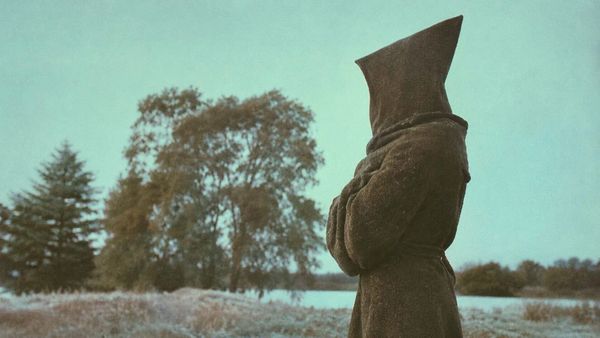
Michael Scott Dawson & Aiko Takahashi :: Two Places At Once
Ambient piano loops, texture and field recordings made at a distance

Three titles on Two Places At Once share their names with tunes from Appalachian old-time music; two of them are written in katakana, and every track on the record rests on piano loops sent back and forth between Vancouver and the banks of the Isonzo.
Two Places At Once came out on 6 November 2026 on We All Speak In Poems, the Toronto label run by Alaskan Tapes, and it is the first record Michael Scott Dawson and Aiko Takahashi have made together. Ten tracks, a little over thirty-five minutes, recorded at a distance: Dawson in Vancouver, Takahashi between Gorizia and Nova Gorica, the Italian town and the one Yugoslavia built beside it after the 1947 border cut Gorizia in two; in 2025 the two together became the first cross-border European Capital of Culture. It was mastered at 12k's studio and pressed on 180-gram blue-and-white split vinyl.
Aiko Takahashi is an anonymous project: the Japanese name belongs to someone raised in the countryside around Gorizia, whose earlier records are built from muffled piano, a few bells and whatever comes in through the window. Dawson, from south-east Saskatchewan, has spent his recent records pushing ambient towards an imagined West of guitar, tape and crickets, with a detour through a tape made for his Japanese tour. Here Takahashi's piano loops hold up every track, and Dawson surrounds them with birds, texture, insects and small household sounds.
“Brushy Fork”, "ダーク・ホロウ・ブルース" (Dark Hollow Blues) and "コール・クリーク・マーチ" (Coal Creek March) share their names with old-time tunes; the last is a banjo piece named after the Tennessee miners’ revolt of the early 1890s, the heaviest memory any of these titles carries. Two of them are written in katakana, the script Japanese mostly keeps for foreign words.
The loops are simple and grow slowly, like a crystal forming grain by grain, so that each piece ends up a short way from where it set out; the tone is one of domestic calm, with the windows open to the birds. I hear a great deal of affection on this album, the habit of someone who loves a distant music and holds on to its names. Affection of that kind usually also leaves a mark somewhere, in a credit, a dedication or a nod to the old melody, and here the record leaves none. The piano has the calm of spring coming back into flower and, with it, the wary melancholy of autumn that the East feels more keenly. It is music always in motion, which frees the listener from expecting anything and meanwhile settles its substance into the listener’s own stillness.
The last title is in French. In "Toi qui sait" the verb takes the third person where standard French would write "sais", and the phrase slides towards "qui sait", who knows; it runs two and a half minutes and closes the album.