Folk Horror and Public Information Films in 1970s Britain
Essay on folk horror, state films and fear as public pedagogy

On the evening of 10 December 1970 the BBC broadcast its first great television folk horror, and in many English homes the screen went dark just as the village closed its circle around the woman from the city.
The play was Robin Redbreast, a Play for Today written by John Bowen and directed by James MacTaggart. Norah, a television script editor whose long relationship has just ended, retreats to the country cottage the couple had kept. The village watches her with a farmer's patience, cuts her off from the world a little at a time, lets her believe she is choosing, and all the while walks her towards the role it set aside for her on the first day. The Blood on Satan's Claw had been shot but not yet released; The Wicker Man would not go into production for another two years.
That winter the electricity supply workers had begun a work-to-rule, and the dispute came into living rooms as power cuts. In many areas the dark arrived before the ending did, and viewers sat in front of a blank screen with the tea still warm on the arm of the chair, left to wonder what the village had done with Norah until the BBC repeated the play in February 1971. Later the colour tape was wiped and reused, as was routine, and what survives is a black-and-white telerecording on 16mm film, scratched and grainy, where the grey eats into the woods.
British television folk horror starts there, cut short by an industrial dispute and kept in a second-generation copy. Much of the decade reaches us the same way, through telerecordings, off-air recordings of later repeats and childhood memories of programmes nobody could rewatch for decades, let alone check.
I. A voice with an address
Mark Fisher, Simon Reynolds and the other critics associated with hauntology have argued that the decade haunts us because it holds futures that were promised and never arrived: modernist council housing, the Radiophonic Workshop, a public broadcaster that assumed its audience could learn. From 2004 Jim Jupp and Julian House's label Ghost Box gave that regret a look and a sound, built from school textbooks, idents and library music. Richard Littler later invented Scarfolk, a town in the north-west of England assembled from public information posters and films, and in 2017 Bob Fischer, writing in the Fortean Times, named the generation raised on those warnings the Haunted Generation.
Writers on hauntology have catalogued the state's warnings in loving detail; fewer have asked what followed from their having an accountable sender. In 1970s Britain much of the fright aimed at children had a public author, a commissioning body with an office in London and a declared purpose, which was to keep them alive. The pond, the tractor and the stranger with sweets each had a short film and a voice-over.
Cinema folk horror came from somewhere else. Witchfinder General and The Blood on Satan's Claw were Tigon productions and The Wicker Man came from British Lion, genre pictures made for the market, and Witchfinder predates the best known of the safety films by five years. Michael Reeves and Robin Hardy owed nothing to the Central Office of Information. The two families meet only in their reception, among viewers who found both on the same screen, sometimes in the same week, and who grew up to treat them as relatives.
II. The spirit of dark and lonely water
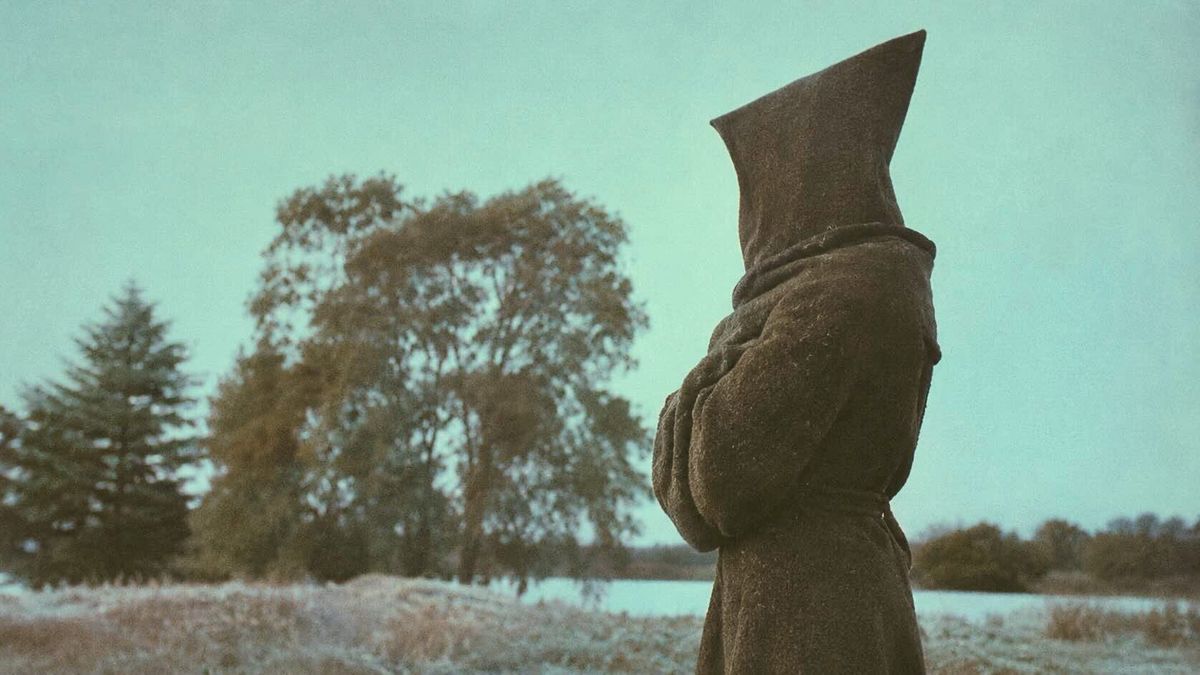
In 1973 the Central Office of Information commissioned Jeff Grant to make a ninety-second film about water safety. The result was Lonely Water. A faceless, monk-like figure in black stands at the edge of ponds, flooded quarries and suburban canals, waiting for the children who lean out too far. The voice is Donald Pleasence's, and it introduces itself as the Spirit of Dark and Lonely Water. Outwitted by a boy who knows better, the figure promises to come back. It went out in the gaps between children's programmes, and Fischer's account of the Haunted Generation is built around that hooded figure.
In 1973 Richard Taylor's studio also animated Charley Says, in which a cat called Charley miaows advice to a boy called Tony about matches, pans on the cooker and strangers. Taylor draws in soft picture-book lines, and most episodes stage a household accident narrowly avoided.
In February 1977, on a farm in the Home Counties, John Mackenzie shot Apaches on 16mm from a script by Neville Smith, produced by Graphic Films for the COI on behalf of the Health and Safety Executive. Six children play at being Apaches among silos, tractors and slurry pits, and the BFI's synopsis states that five of them will never come home. The film runs twenty-six minutes and was shown in schools across the country. Two years later Mackenzie shot The Long Good Friday.
Seen now, Apaches could be a lost reel of The Blood on Satan's Claw. The countryside kills the children one by one, as if the victims had been chosen in advance, and the only higher power on screen is the agency whose name appears in the credits.
III. The film to be seen only once
In the autumn of 1975 the Home Office began preparing a civil defence campaign, aiming to have a booklet, radio tapes and a series of short animated films ready by the following March. Taylor's studio, which had drawn Charley, animated the films, which were called Protect and Survive. They explain how to whitewash your windows, how to build an inner refuge from doors lifted off their hinges, where to put the bodies of relatives who have died if the wait in the refuge runs past a few days.
They were aimed at adults and stayed classified, to be shown on every channel only once the government judged a nuclear attack likely within seventy-two hours. A Home Office memorandum dated 3 September 1975 observes that the average person, offered a choice between being incinerated at once and taking a chance on a slow death from fallout, would always pick the second.
The same state that wanted children kept alive at the edge of the pond also decided how much an adult could be allowed to know. An internal memo explained that the booklet would not circulate before it had to, so as not to alarm the public; in 1976 only local authorities received it, for training, and the Home Office's own emergency planning division, F6, found it misleading, hard to follow and dated in its presentation. The Home Office held the booklet back, but because it was a named office, it could be asked why. When Panorama showed extracts in March 1980 and MPs asked why a copy lodged in the Commons library could not be photographed or removed, the government published the booklet in May, and the historian E. P. Thompson replied with a pamphlet whose title changed a single letter: Protest and Survive.
The pastel colours, the calm voice and the idea that people can be taught to die in an orderly way are 1970s in tone, even though the public first saw the films in the decade of Threads.
IV. The countryside at teatime
The decade's television put the English countryside into more corners of the schedule than we tend to remember. Robin Redbreast and Penda's Fen, written by David Rudkin and directed by Alan Clarke in 1974, were evening Plays for Today made for adults; from 1971 Lawrence Gordon Clark's A Ghost Story for Christmas made M. R. James a fixture of Christmas viewing.
In the children's teatime slot, between January and March 1975, BBC1 showed The Changes, ten twenty-five-minute episodes produced by Anna Home from Peter Dickinson's trilogy. A noise rises from under the ground and from then on the English cannot bear machines: they smash them, bury them and go back to the plough and the village market. Superstition returns as the technology goes, and the young heroine, Nicky, crosses a country where outsiders are treated as witches. One of Dickinson's novels, The Devil's Children, follows a Sikh family in a countryside slipped back into the past; the villagers fear them at first, then come to depend on them.
Paddy Kingsland, who had joined the BBC Radiophonic Workshop in 1970, wrote the music by pairing an EMS Synthi 100 with a small live group of horn, sitar and percussion. The sitar comes in mostly with the Sikh family, whom the village calls devils; the machine-hating story itself is scored on the BBC's largest synthesiser. EMS had been set up to pay for a private utopia. Peter Zinovieff, who had built a computer-controlled electronic studio in his garden in Putney, advertised for backers in The Times in 1969 and received a single reply: fifty pounds, from a reader who thought he was ordering a synthesiser. Zinovieff later said the company existed to fund the studio and, when it went under, pulled the studio down with it.
Children of the Stones dates from 1977 and was filmed inside the stone circle at Avebury, with a dissonant choir that viewers who saw it as children still describe as frightening. It was made by HTV, a commercial ITV company that drew nothing from the licence fee and held its franchise from a regulator that expected quality programmes for children. HTV frightened children with no protective purpose at all, and answered to the IBA; the BBC answered to its governors and to complainants. In 1976 Mary Whitehouse complained about a cliffhanger in Doctor Who in which the Doctor is held under water, and the BBC trimmed the shot when the story was repeated.
V. A name that came late
The decade barely used the name. In 1970 the trade paper Kine Weekly sent Rod Cooper to the set of a film then called The Devil's Touch, and Cooper described it as a study in folk horror. The film came out as The Blood on Satan's Claw and the phrase lay largely dormant for more than thirty years. The film's director, Piers Haggard, revived it in a 2003 interview with M. J. Simpson for Fangoria, and in 2010 Mark Gatiss gave it a wider audience in A History of Horror on BBC Four, after which came the essays of Adam Scovell, the BFI seasons and the festivals.
Its loudest champions belonged to the safety-film generation. Gatiss was born in 1966; Fischer, who gathered the memories, in 1973, the year of Lonely Water. The genre's name returned after the public voice that frightened in order to protect had gone quiet, and it came to cover that voice too. In December 2022 BFI Southbank gave an evening to the lingering legacy of the public information film, with Fischer introducing it.
VI. Who answers now
Through the 1980s the children's safety film gradually lost its airtime. Fear campaigns aimed at adults carried on, from drink-driving films to the AIDS warnings of 1987, while the spots for children grew rarer and glossier; the Central Office of Information itself closed in 2012.
Contemporary folk horror, from Kill List to Midsommar, has learned the grammar of the 1970s very well: sunlit fields, choral singing, the smiling community that waits. As cinema it never had a public author, any more than Tigon did. No government office now puts its name to a fright made for children at teatime and expects to be questioned about it afterwards, as MPs and journalists questioned the Home Office in 1980 about the booklet it had held back.
Apaches is free to watch on BFI Player.
Last revised: November 2026