Maya Ongaku :: Nothing Space Music
Japanese ambient folk, Rhodes, field recordings and coastal stillness

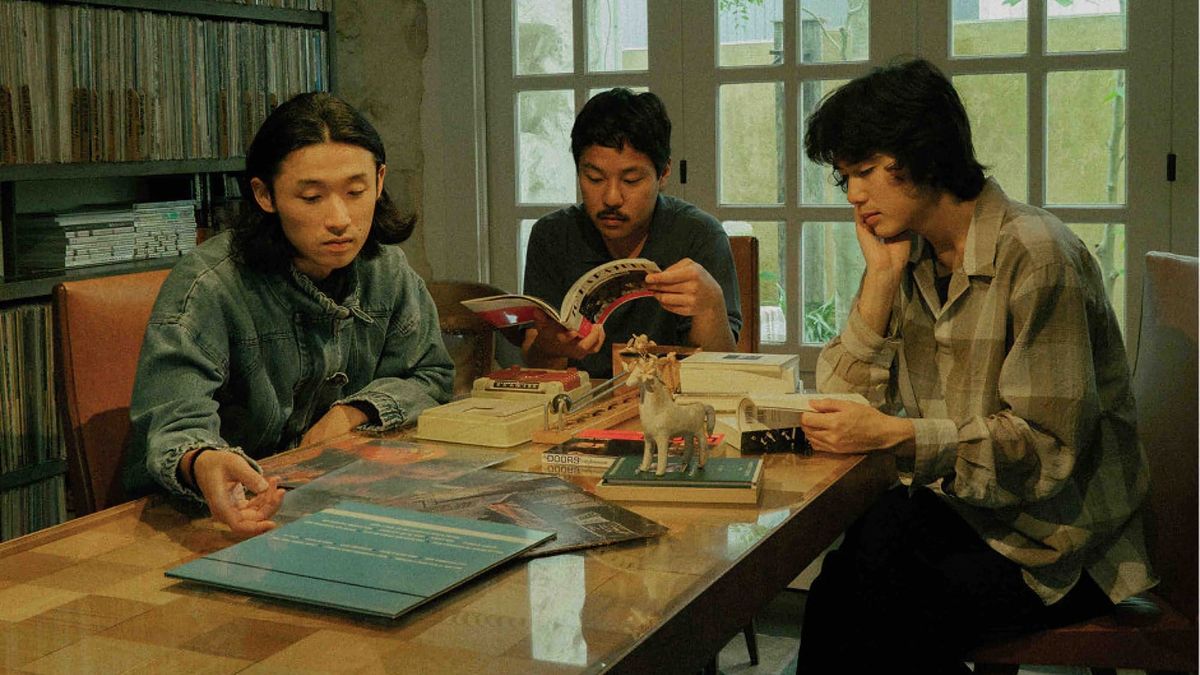
Maya Ongaku formed in the coastal towns around Enoshima, some fifty kilometres south of Tokyo.
Nothing Space Music, their second full-length after 2023's Approach to Anima, was released digitally by Bayon Production / Guruguru Brain on 7 August 2026. It came after years of international touring, when increasingly large stages produced the opposite impulse in the group: a return to silence.
In Shōnan, near a seaside shrine in their home region, they converted a large soundproofed building into Nothing Space Studio, where the album was recorded and mixed in relative isolation.
Their guiding principle remains shizen hassei, spontaneous occurrence. Sonoda has acknowledged that professional activity, schedules, efficiency and other people's expectations inevitably make the creative process more structured, and that preserving spontaneity now requires a conscious decision. Nothing Space Studio was built around that contradiction: arranging the conditions in which something might still seem to happen of its own accord.
I first heard the record properly on a late train home, the kind where the carriage empties out somewhere past the last useful stop and the window stops showing anything but your own face. The album kept making more sense as there was less and less to look at.
"Vanishing Waves" opens in unusually clear light. Tsutomu Sonoda's voice is almost crystalline, while piano, acoustic guitar and muted electronics stay wrapped in something absorbent around it, as if recorded through a thin curtain. Somewhere behind the song is the afterimage of an earlier Japanese folk-pop, already fading on the glass.
"Astral Echoes" carries those colours onto the water. Rhodes, clarinet, percussion and the faint mechanics of rhythm behave like a small ensemble assembled temporarily on the deck of a boat, and it's the landscape that does the moving, not the musicians. The group has described the piece as an attempt to catch the moment an idea enters consciousness before it has decided what it is — which makes sense here, since the melody itself never quite resolves into a single shape.
"Thinkingscape" carries the sensibility of the label Clay Pipe Music eastward. Library music is one possible ancestry, though its function here is a stranger one: music for thinking while a thought is still forming, moving through half-remembered places before deciding what they amount to. The folk instruments briefly recall the damp margins of a Scottish field; sleigh bells, caxixi and güiro won't let the association settle for long. Several things can be sounding at once and the space still stays intimate.
"Flowing" makes the idea particularly clear: music open to everyone, though rooted somewhere specific. Flute and field recordings pull the piece back toward folk practice, while the Rhodes traces a descending, faintly hesitant melody before dropping behind the voice. Even the triangle earns its place. The song keeps a recognisable verse structure because the landscape it describes runs on relationships — water, breath, human measure, repetition.
"Hisoku Blue" changes the hour, and it was somewhere around here, on that train, that I stopped taking notes. The bass holds the piece upright while everything above it settles into the pace of nocturnal slow jazz — something of the unhurried tread of Josh Haden's band Spain relocated to a less metropolitan latitude. Shoei Ikeda's saxophone gives up the usual authority of a jazz solo; he plays it like an instrument that's been let out of the club for the night, and for six minutes I forgot I was supposed to be reviewing anything.
"In Nothing Space" is a transition lasting barely one minute and twenty-four seconds. The sea stays audible while a short synth loop imitates its motion.
The synthesiser repeats; the sea does not, quite — close enough that you almost don't notice which one you're listening to.
"Vanishing Waves"
Sonoda's voice is almost crystalline, while piano, acoustic guitar and muted electronics stay wrapped in something absorbent around it.
"Hisoku Blue"
The bass holds the piece upright while everything above it settles into the pace of nocturnal slow jazz.
"In Nothing Space"
The sea stays audible while a short synth loop imitates its motion.
"You are Silence" works with an almost disarming simplicity. The guitar sets the song's perimeter immediately, and when the synth enters, it borrows that perimeter rather than pushing past it. The voice holds close to the same register for most of the record, and by this point that sameness has become part of the band's vocabulary rather than a limitation of it.
"Permanent Waves" moves closer to the album's centre of gravity. The acoustic guitar arpeggiates and the voice takes on nearly the same tilt, melody and accompaniment walking side by side without either pulling ahead. On another record a song this still might read as restraint; here it reads as arrival, music that has found a distance it no longer needs to prove it can leave. The track doesn't look for an exit from the record's language — it stays at the centre of it and tests how long that centre can hold weight.
By the time it ended, my stop had already disappeared from the display. What the album lives on, in the end, is proximity without intrusion: instruments sharing a room like neighbours who already know each other's hours, never needing to knock.