Clay Pipe Music at Low Tide
Pastoral, electronica, library music, handmade records and lost places
At low tide the Thames gives things back. Walk the foreshore below the city and the mud lets go of what it has been keeping: oyster shells, bottle stems, ha'pennies rubbed faceless, and, in the places where they collect, clay pipes, the throwaway cigarettes of the seventeenth and eighteenth centuries, snapped off, dropped, taken by the river.
You pick one up and it is nothing, a scrap of fired clay, and it is also the hand of a dockworker or a bargeman or somebody who was only walking home two hundred years ago, closed now inside yours. Frances Castle came down here to mudlark, and, among other things, to find a name. She found it in the silt. Everything worth knowing about the label she started in 2010 is already lying on that foreshore: the small thing, made by hand, carrying a place and a life that has gone, no use to anyone who won't stoop for it.
I. The Object
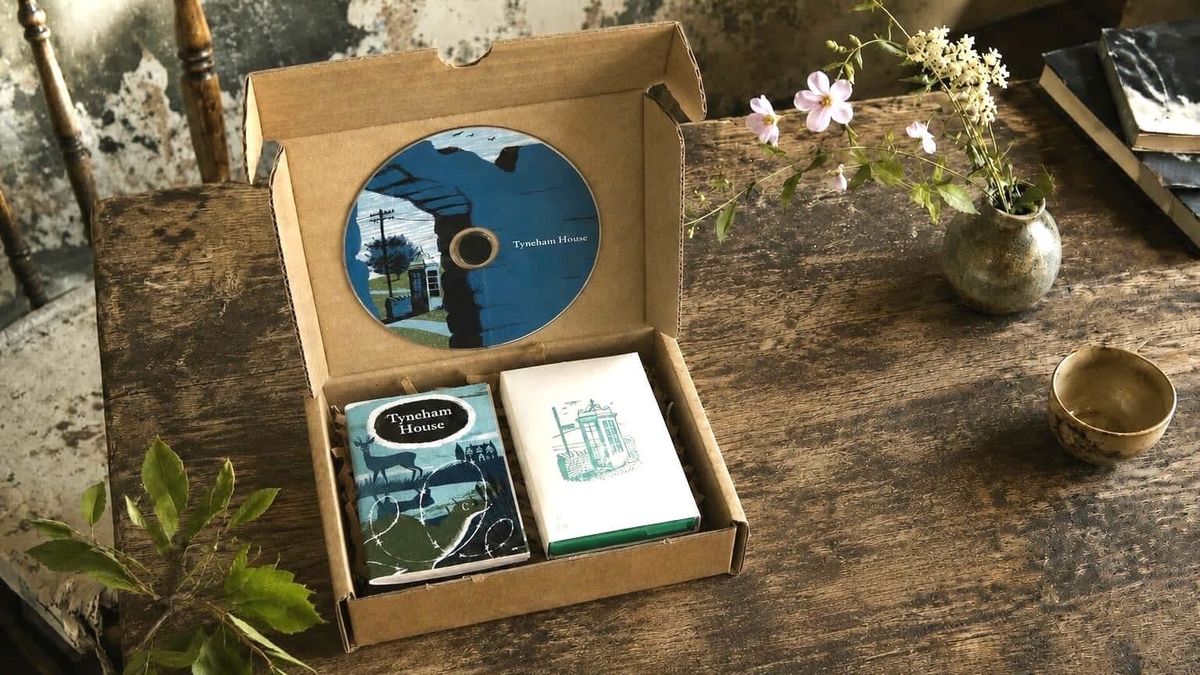
The easy move, and by now the automatic one, is to shelve Clay Pipe under hauntology and be done: the spectral, the half-remembered England, tape hiss standing in for lost futures. The label certainly carries those traces, but hauntology gets you only so far. Whatever haunts this label does not come out of a sampler; it is in the object. Castle draws every sleeve herself, and she draws it with the record playing, over weeks, by the same slow accretive method she uses for the music. She has said, almost apologetically, that she isn't really a musician, that she puts a piece together the way she puts together a picture, a bit at a time. Take that seriously and the label stops being a discography with good covers. The sleeve belongs to the same construction.
Where she goes looking for her ancestors tells you more than the family tree usually pinned on her. Set the standard hauntological reference points aside. The name Castle keeps returning to is Rena Gardiner, the Dorset artist who wrote, illustrated and printed her own guidebooks to churches and coast paths from a cottage, by hand, laboriously, and was overlooked for the better part of a working life. There is the real lineage: the hand-made guide to one particular place, begun and finished by a single person. Nearer home there was Second Language, Glen Johnson's label, whose homemade sleeves she loved early on, and with which Clay Pipe would later share a release or two. You can hear both of them in the way a Clay Pipe record is made rather than simply issued: numbered, editioned, cut on coloured vinyl, reissued with new art instead of merely reprinted, loaded with inserts that get faintly devotional. That fold-out cardboard Green Line bus tucked into Gilroy Mere's record about a defunct country bus route is the whole argument, in your two hands. You unfold it. That is what it is for.
None of which is neutral. Castle has said she built the label partly to make the kind of design her paying work would never allow: a small room of her own, run after hours, kept to a size she could manage by herself.
II. The Place
Ask what a Clay Pipe record is about and you nearly always get a place, though almost never a famous one. The label's own note says as much: music with a strong sense of place. The catalogue tells you which places it has in mind. Not summits and cathedrals. The small, the bureaucratic, the emptied-out. Tyneham House drifts on flute through the ruins of the Dorset village the army requisitioned in 1943 and never gave back to the families it turned out. The Green Line is Oliver Cherer, recording as Gilroy Mere, grieving a mid-century bus service that once ran from the centre of London out to the fields of Kent and Sussex. Jon Brooks's Shapwick moves queasily forward and back in time over one dim Somerset hamlet. A Dream Life Of Hackney Marshes goes to the edgelands, Estuary English to the tideline, Adlestrop to the little Gloucestershire platform out of Edward Thomas where an express drew up for no reason for a minute and the birds of a whole vanished country answered back. A gazetteer of the unregarded.
I should declare an interest. The first Clay Pipe record I ever heard was Tyneham House, and it turned me right around. I had grown up on new wave, and this was the hinge, the thing that pushed me toward pastoral folk and library music and never let me back. I played the little video on the label's site and felt something I still can't name properly: that this remote, drowned-green England had somehow once been mine, in a place and a time I couldn't point to, even though I have spent my whole life in a small town in Puglia, at the other end of Europe and the other end of the weather. The colours of that footage carried me from one place to another without the feeling underneath ever shifting. One-minute sketches, two at the most. I ended up recording my own tribute to one of its pieces and sending it to Frances Castle, which is not the sort of thing a critic is meant to confess, and I am confessing it.
Go far enough in and you notice the "place" was never really geography at all. It is a way of paying attention, and every so often it is invention outright. Cate Brooks's Lofoten conjures the Arctic Norwegian islands out of synth and a Synclavier without her ever once having gone there. She assembled it from a narrated sleep story and a fixation she couldn't argue herself out of, and the record is not a degree less exact for being imagined. If anything more so. David Boulter's Whitby does the opposite: a real North Yorkshire coast he actually walked in the summer of 2024, turned into instruments instead of field recordings, the weather kept and the postcard binned. Somewhere between those two is what the label is really after. Not the map. The pull you feel stooping over one. A place remembered; a place grieved; a place you have never seen and miss anyway.
Where this comes from is not hard to find. Castle grew up half in Kew and half in a borrowed countryside, in Cookham, where the family had known Stanley Spencer well enough to gossip about him, and where her grandfather Frank Sherwin painted the British Railways posters that sold post-war England back to itself as one long pastoral. The town child driven out at weekends to an idealised version of the country is exactly the split her label keeps working: the city person's countryside, half real and half wished-for, seen from a train window or the top deck of a bus. Which is also, I think, why the records stay just the right side of heritage kitsch. The homesickness in them is for places that were slightly out of reach even at the time.
III. The Scale
That word, reach, is the third principle, and the one most out of step with its moment. Clay Pipe stays small on purpose. The editions are numbered and they finish; a pressing sells through and is gone in that form; it may return months or years later in another colour, another sleeve, another numbered life, but it is never treated as an infinitely replenishable unit. Since 2022 there has been a parallel line of Mini CDs, hand-cut CD-R miniatures, small even by the label's own standards, almost defiantly modest. And there is a studio shop, open on weekdays: an actual room in an actual city that you can walk into and buy a record off the woman who drew it.
Set that against the machinery all around it: the bottomless catalogue, the feed that chooses for you, the "track" that cannot sell out because it was never a thing to begin with. Next to that, the smallness begins to look like a stance, not a shortfall. A pressing that can run out is a thing that can be lost, which is the one condition the streaming file can never meet, and roughly the reason anyone bothers. Scarcity here is not a stunt lifted from the vinyl revival. It follows from all the rest. The places are disappearing, the formats are the ones that rot, the runs come to an end, and the label leaves that fact alone.
And I should admit I am exactly the reader this label lays the trap for. I own Andrew Wasylyk's Irreparable Parables, and I own its instrumental shadow, Inundated Indentations, and I keep the two together the way I keep both of Edith Holden's Edwardian nature diaries, for the completeness of it, for the set, for the object. Ask me whether I play the second record as often as I reach for it and I would have to look away. That is no fault of Wasylyk's. It is the trap folded into all this care: when the sleeve and the edition and the story are this good, you can catch yourself prizing the thing and under-listening to the record inside it.
It is also why Castle refuses to let the thing settle. She has said she doesn't want to keep bringing out the same record, so the roster turns over, new names arriving next to the regulars, the sense of place migrating from Dorset to the Lofotens to a chalk shaft under Dover. Small, but restless. Almost literally a cottage industry, held to the size of one person's evenings and weekends.
For a magazine like this one the appeal is not hard to place. A label with no interest in unlimited scale or the usual machinery of promotion, no advertising, none of the infinite scroll: only the made object, the run that ends, the plain insistence that one small thing held in the hand beats an endless one you never hold at all.
And then back down to the river. Every one of these records is a small thing let deliberately into the current, made by hand, marked with a place, left for whoever comes along the bank later and still thinks to look down. Some are already gone for good, runs that reached their number and stopped. Castle doesn't fight it; it was the plan. What she prints are things that can be lost, and in her hands that has never once looked like a flaw.
Further Reading & Sources
Sources: Clay Pipe Music catalogue, release notes and interviews with Frances Castle; Julian Francis, Rena Gardiner: Artist and Printmaker, with archival material from the Dorset History Centre and National Trust; Lara Maiklem, Mudlarking; release documentation for Tyneham House, Gilroy Mere, Jon Brooks, Cate Brooks, David Boulter and Andrew Wasylyk.
Editorial Note
This essay treats Clay Pipe as a material and curatorial practice in which sound, illustration, format and place belong to the same work. References to artistic lineage and imagined place are interpretive; autobiographical passages describe the author's own response.
Last revised: July 2026