Lawrence Gordon Clark :: The Signalman
BBC ghost story: railway haunting, signals, telegraphy and dread

The little bell is more disturbing than the apparition. It belongs to a system in which a sound should have an origin, a meaning and somebody at the other end of the line. In The Signalman, all three become uncertain.
Lawrence Gordon Clark came to The Signalman almost by accident. For the 1976 A Ghost Story for Christmas he had intended to continue with M. R. James and film “Number 13”, but decided that the story needed a Scandinavian environment he could not convincingly supply. Dickens replaced James; Andrew Davies, then nowhere near the television institution he would become, wrote the adaptation. Clark later remembered the script as exceptional. The film was shot that October and broadcast on BBC1 on 22 December 1976, the first instalment of Clark’s run to leave James behind.
The substitution changes more than the author. James usually allows the past to enter through an object, a manuscript, an excavation, something touched by a scholar who should perhaps have left it alone. Dickens puts his ghost beside equipment that is already modern: telegraph needles, an electric bell, signal lamps, rails, timetables, an iron handle. Nobody has excavated anything. Nobody needs to summon the past. The difficulty is occurring inside a working communications system.
That matters because the signalman’s job consists almost entirely of interpretation.
Dickens makes this unusually explicit in the original story. The man has little manual labour to perform; what his employers require are “exactness and watchfulness”. He reads messages, sends replies, changes signals, records entries and watches the line. He has educated himself during the long hours below: a language, fractions and decimals, some algebra. Earlier in life he had even attended lectures in natural philosophy. The traveller eventually judges him one of the safest men imaginable for the post.
Clark does not explain all of this at the length Dickens does, yet Denholm Elliott seems to carry it around with him. His signalman is not a credulous man frightened because he lacks the intellectual equipment to understand what he sees. Quite the reverse. His suffering comes from having spent his life learning that signs have meanings.
And now one does not.
The apparition has already proved reliable. It appears; afterwards, catastrophe follows. The bell associated with it is heard. The red danger light gives it a location. Its gesture resembles a warning. Yet none of this produces information the signalman can use. Dickens gives him the exact question at the centre of the story: “What does the spectre mean?”
This is more frightening than a broken signalling system. Nothing has obviously broken.
The warning arrives. The receiver receives it. He understands that it matters. What is absent is the instruction that would convert foreknowledge into action.
Clark builds almost the entire film around that small cruelty. Elliott’s attention keeps dividing itself between Bernard Lloyd’s traveller and the apparatus around him. A conversation can stop because the bell has rung. His head turns towards the line. His eyes check the tunnel. The ordinary railway signals remain perfectly comprehensible, which makes the other signal worse. If every bell were unreliable, there would be no problem to solve; there would simply be chaos.
The ghost instead seems to have borrowed the railway’s vocabulary.
The original story appeared in December 1866 inside Mugby Junction, the Christmas number of Dickens’s All the Year Round, under the telling heading “No. 1 Branch Line: The Signal-Man”. “Mugby” itself points towards Rugby, the great railway junction. The story was therefore not a traditional ghost tale onto which Dickens happened to bolt some trains. It was embedded from the beginning inside an imaginative structure of junctions, branch lines and movement.
Its historical background makes the apparatus still less decorative. Dickens had survived the Staplehurst railway disaster in June 1865. Railway accidents and failures of signalling belonged to the contemporary world of the story. The supernatural warning enters a culture already learning that technological systems could be extraordinarily precise and still produce mass death.
Clark found a physical equivalent for this at the Severn Valley Railway. The signal-box interiors were filmed at Highley Station; Bircham Coppice Cutting, near the Bewdley Tunnel, supplied the deep approach in which the film seems to bury Elliott. The place looks abandoned by almost everybody except trains.
It was nothing of the kind.
Clark later recalled that the location was immediately beside a school and a housing estate. Children disrupted filming by throwing things towards the production. Heavy fog caused another problem and made The Signalman the one film in the series Clark could not finish within the scheduled time.
That mundane information changes the images when you know it. The isolation in The Signalman is partly manufactured. Clark and cinematographer David Whitson remove an inhabited 1976 England from around the cutting until a piece of functioning railway infrastructure looks cut off from ordinary social time. Housing, schoolchildren, contemporary life: just outside the frame.
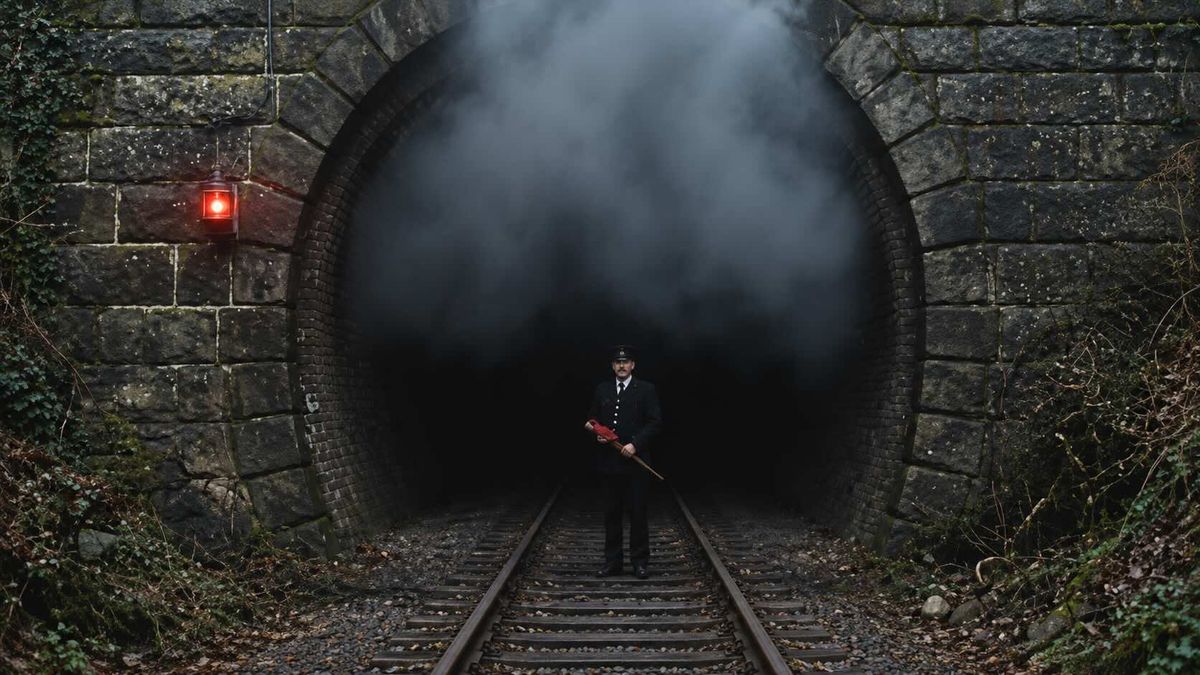
The film does something similar to the railway itself. By 1976 a steam railway could already be photographed as heritage, with all the easy consolations that implies. Clark refuses most of them. The rails are wet metal. The semaphore and lamps have duties. Steam obscures vision. The tunnel is less picturesque Victorian masonry than a black interruption in a system whose purpose is to keep things moving safely through it.
Whitson deserves some of the credit for this. Clark had storyboarded the entire film, yet later said those drawings could not account for what Whitson brought through lighting and composition. The distinction is useful. On paper the cutting has a simple geometry — rails, box, signal, tunnel — while the photographed place keeps losing information into darkness, fog and steep walls.
The engineering remains legible; the space around it keeps slipping away.
Even the vertical arrangement is peculiar. The traveller first calls down to the signalman. To reach him he has to descend into the cutting, leaving open ground and daylight for what Dickens described as a damp channel between high stone walls. The signalman’s world lies physically below ordinary circulation. Trains pass through it; he stays there.
This is why Elliott’s performance feels less like conventional haunted-man acting the longer the film goes on. Clark called him a “tightly coiled spring”, which catches the visible strain, though there is something more occupational in it too. He cannot afford not to look. A frightened person might turn away from the tunnel. A signalman is paid to keep watching it.
The vigilance that keeps the railway safe becomes, for him, the thing he cannot escape.
Its most disturbing trick comes at the end, when the distinction between supernatural and operational warning collapses altogether. The words, gestures and position associated with the apparition return through an actual railway worker trying to avert a real death. What the signalman had been seeing was therefore, in one sense, accurate. The problem was chronology. He received a usable railway warning before there was any possible use for it.
The film never gives a mechanism for this, and supplying one would weaken it. There is no need to decide whether the spectre is prophecy, temporal repetition, psychic impression or the after-image of an event that has somehow arrived before itself. Each explanation would add machinery where Clark has deliberately left an absence.
What matters is the order:
a warning is sent;
a man receives it;
the event that would explain it has not happened yet.
The signalman is trapped between transmission and meaning.
There is another uncomfortable detail in Dickens that Clark preserves in spirit. The man does not ask primarily whether the apparition exists. He has progressed past that question. He wants to know what responsibility the knowledge places upon him. Contemporary and later readings of the story have often returned to that burden: a conscientious worker made responsible for lives he may be unable to protect because the warning reaching him cannot be interpreted.
That makes The Signalman unexpectedly close to a film about labour. The horror belongs to somebody whose work is repetitive, exact and largely invisible until something goes wrong. He occupies one small point in a network much larger than himself and is expected to respond correctly to information passing through it. The supernatural does not take him away from his occupation. It gives him an impossible version of the same job.
This may also explain why the red light remains more troubling than the ghost itself. Clark hardly has to transform it. A danger lamp already asks the viewer to anticipate something outside the frame. Red means stop; the tunnel means something may emerge; the rails mean whatever comes will follow a predetermined path. The film begins with a ready-made visual language of expectation and then introduces one sign for which no railway manual can provide the next action.
A sound inside a working system, heard clearly and still unable to tell the signalman what to do.
An ordinary railway instruction becomes disturbing once the apparition borrows its position and authority.
Wet rails, fog, stone walls and a black tunnel; an inhabited 1976 England removed from the frame until infrastructure looks abandoned.
For thirty-eight minutes, very little is needed beyond two men, tea, a bell, a signal box and the black mouth of a tunnel. Clark had come to television drama from documentaries, and his best work in the series often retained something of that patience with actual places. He later argued that television was particularly suited to ghost stories because of its intimacy: the apparition arrived directly into the home rather than onto a distant cinema screen.
Here that intimacy is oddly doubled. The signal box is itself a small receiving station. Messages enter. Bells ring. A man waits for information from elsewhere.
So did the living room in which BBC viewers watched it on 22 December 1976.
The comparison does not need pushing much further. The Signalman already understands the unease of receiving something through a system whose workings you trust. Its ghost does not smash the machinery, possess a locomotive or drag the railway backwards into some older England. It uses warning, repetition, distance and delay — the railway’s own terms — and leaves one conscientious man with the single piece of information his profession cannot process.